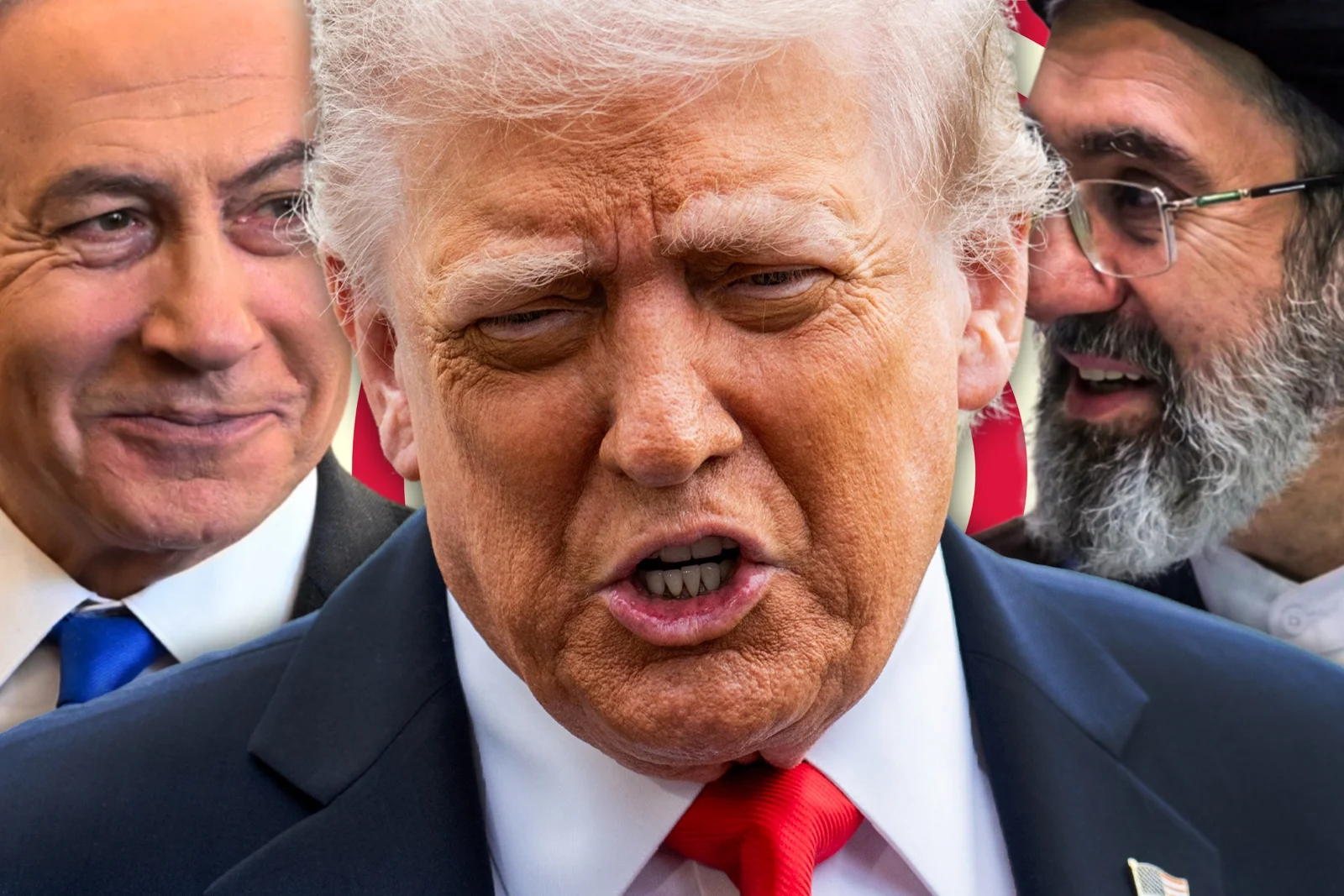

The Hammer Meets the Millstone in Iran
As the U.S.–Israel war on Iran enters its third week, one early assumption has already collapsed: that overwhelming military pressure, coupled with leadership decapitation, would trigger a swift political unraveling in Tehran. Such expectations are almost ritual at the outset of asymmetric wars. History, however, offers a more sobering lesson. Regimes rarely fall on the timetable imagined by those bombing them. If past conflicts are any guide, the likelier outcome is not rapid collapse but a grinding, economically punishing confrontation in which endurance matters as much as firepower.
Just one week into the war, President Trump declared victory, dismissing any settlement short of Iran’s unconditional surrender. Days later, speaking to supporters in Kentucky, he insisted the war had been won “from the first hour.” Yet the reality unfolding across the region tells a different story. The Iranian government remains firmly in control. Its missiles and drones continue to strike targets in Israel and U.S. bases across the Gulf, with no visible indication of retreat or de-escalation.
What is taking shape increasingly resembles a familiar pattern. Overwhelming military force can destroy infrastructure and eliminate targets, but it rarely collapses political systems. What Washington appears to have intended as a decisive hammer blow is instead colliding with something far more immovable—a granite millstone, governed by a different strategic logic, one rooted not in speed but in endurance.
Trump’s declaration of victory amid an intensifying war recalls an earlier moment of premature triumphalism. In May 2003, George W. Bush landed theatrically on the USS Abraham Lincoln and declared the end of major combat operations in Iraq beneath a banner reading “Mission Accomplished.” The war that followed lasted nearly a decade longer and cost the lives of 3,424 American troops. The parallels extend beyond symbolism. Trump’s claims that Iran was preparing imminent attacks on U.S. targets—and that Iranian operatives had attempted to assassinate him—echo now-discredited assertions about Iraqi weapons of mass destruction and Saddam Hussein’s alleged plot against Bush’s father. Both wars have also drawn sustained criticism as violations of the UN Charter and international law.
The call for “unconditional surrender” draws from a strategic vocabulary shaped by the Second World War, when total war made absolute defeat conceivable. A similar analogy surfaced in Prime Minister Benjamin Netanyahu’s July 2024 address to Congress, where he invoked the postwar transformation of Germany and Japan as a model for “demilitarization and deradicalization” in Gaza. Yet such comparisons obscure more than they illuminate. The conditions that made unconditional surrender possible in 1945—total military collapse, occupation, and a fundamentally different international order—do not exist today. Applied to a regional power like Iran, this framework risks overstating what military force can achieve. Modern conflicts rarely end in capitulation; more often, they entrench resistance and extend the war.
The deeper issue may not be premature declarations of victory but a recurring pattern in American strategic thinking. In policy circles, the “hammer” metaphor is often invoked to describe cognitive bias and strategic narrowness. The psychologist Abraham Maslow captured it succinctly: if the only tool you have is a hammer, everything begins to look like a nail. The phrase endures because it describes a persistent tendency to rely on familiar instruments even when they are poorly suited to the problem at hand.
The United States possesses unmatched military power, and that strength inevitably shapes how challenges are perceived and addressed. Military force becomes the default instrument, even in situations where diplomatic or political tools might prove less costly and more effective. The temptation intensifies after apparent successes. The U.S. extraction of Nicolás Maduro from Venezuela in January 2026 seemed to demonstrate how decisive force could quickly produce political outcomes.
Iran, however, has proven to be a different kind of adversary. In Persian ethical poetry, resilience is often likened to the lower millstone—the stone that bears immense pressure yet neither moves nor breaks. The image captures a philosophy of endurance under sustained force. Faced with overwhelming U.S.–Israeli airpower, Iran has followed precisely that logic, bending under pressure without collapsing.
Decades of sanctions have forced Iran to cultivate significant domestic scientific and technological capacity, including advances in nanotechnology, artificial intelligence, space research, and biotechnology. This emphasis on self-reliance has provided both the tools and the mindset necessary to sustain resistance. At the same time, shifts in military technology have altered the battlefield. Relatively inexpensive drones can now achieve effects once reserved for far more costly and sophisticated systems, allowing a weaker actor to impose persistent costs on a stronger one.
The central miscalculation by the United States and Israel appears increasingly clear. The assumption that overwhelming force would produce rapid political collapse has instead yielded a protracted contest of endurance, one whose economic consequences are already rippling through global energy markets.
Washington seeks to coerce without becoming trapped in a larger ground war. Tehran, by contrast, seeks survival while steadily imposing costs. The United States and Israel continue to intensify their air campaign, but Iran retains a broad array of asymmetric tools: ballistic and cruise missiles, drones, regional proxy forces, and the capacity to disrupt maritime traffic in the Gulf. These capabilities ensure that the conflict’s consequences extend far beyond the battlefield, affecting energy flows and the wider global economy.
As domestic and international pressure mounts on Washington to bring the war to an end, a more fundamental question begins to surface: why did the United States enter the conflict in the first place, and what objective was it meant to achieve? Strategic theory offers a useful lens. Terry Deibel has argued that strategy must serve a clear purpose rooted in national interest. If a condition in the international environment does not threaten a vital interest, it cannot be considered a strategic threat, no matter how objectionable it may be. By that standard, the rationale for war becomes difficult to define. Did Iran pose a direct threat to the United States, and if so, was a costly war the only viable instrument of statecraft to address it?
The conduct of the war from its opening days suggests an absence of clearly defined political objectives. Instead, strategy appears to have rested on the expectation that the regime in Tehran would quickly collapse and be replaced by more accommodating leadership. Yet in statecraft, hope is not a strategy, and desired outcomes cannot substitute for a concrete plan. As the historian Lawrence Freedman has noted, strategy is ultimately about linking military means to political ends. When those ends are unclear, even overwhelming force struggles to produce meaningful results.
As the costs of the war begin to register at home—most visibly at the fuel pump—the need for an off-ramp grows more urgent. Washington will have to pursue de-escalation with the same intensity it brought to escalation. Any viable exit strategy must offer political cover while limiting the risk of broader economic and regional fallout.
The war is already reshaping Washington’s international relationships. Gulf Arab states, which opposed the conflict from the outset, now find themselves exposed to retaliation as Iranian strikes target U.S. bases across the region. At the same time, tensions have widened between Washington and several European allies, as well as Canada, which declined to participate but now faces the economic and security consequences of instability in the Strait of Hormuz. The conflict has once again exposed the limits of the assumption that American military power can impose rapid political outcomes in complex regional environments.
The most plausible outcome is not the collapse of the Iranian state but its adaptation. Tehran’s government may emerge battered yet intact, potentially reshaped by a younger and more hardened leadership forged through confrontation rather than accommodation. In that sense, the strategic result would look less like a decisive victory than a costly stalemate with enduring geopolitical consequences.
What began as an attempt to deliver a decisive hammer blow may ultimately be remembered as something else entirely: a confrontation with a millstone, an adversary that absorbs pressure, endures sustained force, and refuses to break.