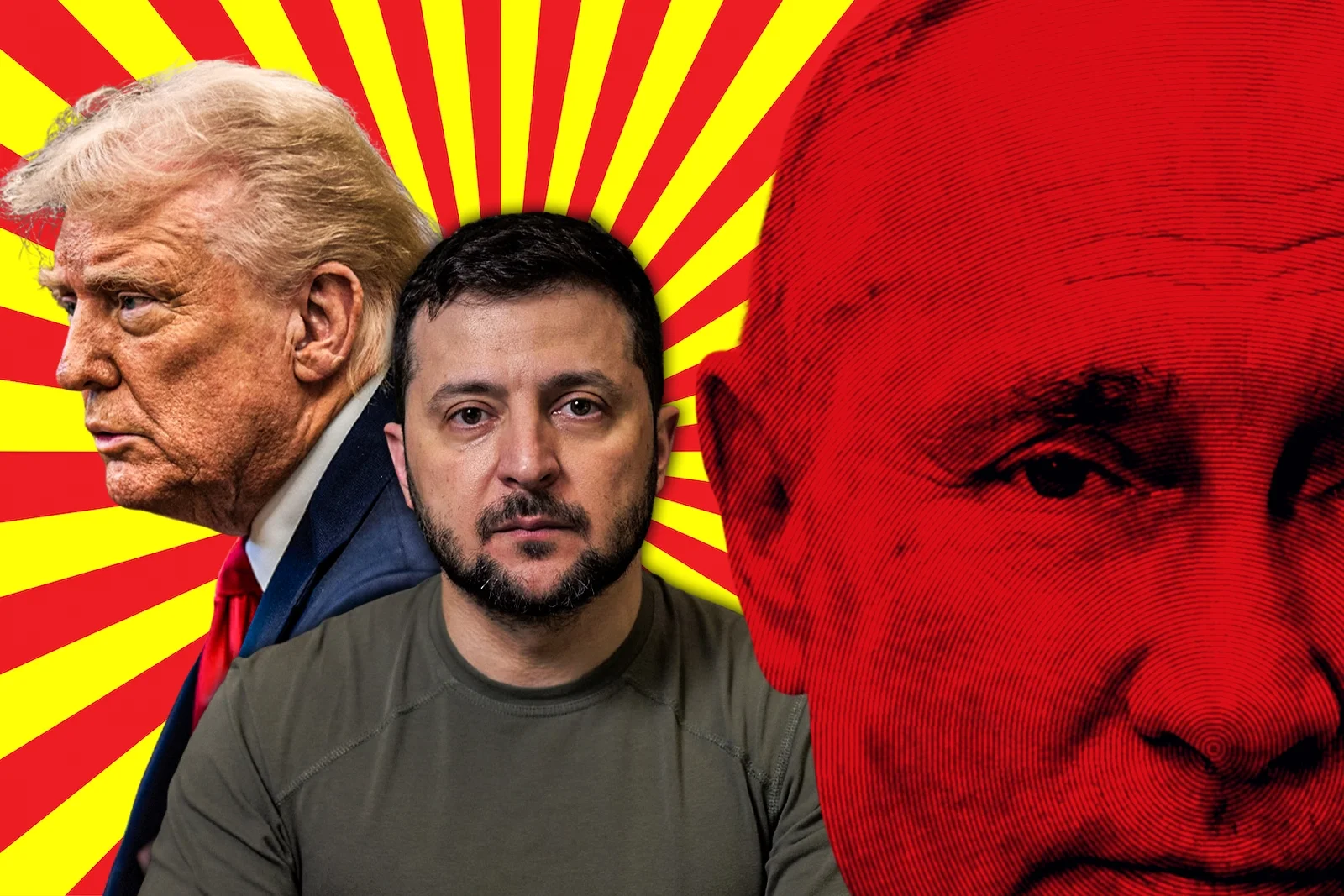

Ukraine Can Survive Putin. Trump May Be Another Matter.
On July 6, Ukrainian drones struck the Omsk refinery, 2,500 kilometers inside Russia. Two days later, NATO leaders meeting in Ankara pledged €70 billion for Ukraine’s defense, while President Donald Trump declared that a settlement was “getting closer than people realize.”
Two forces are now bearing down on Kyiv from opposite directions. The first is Vladimir Putin’s war. Having failed to take Ukraine by force, Russia is grinding away at the country through attrition: refineries, drones, casualties, and infrastructure rather than sweeping territorial gains. The second is Trump’s diplomacy, which promises to end the war on terms Kyiv did not write and has already resisted.
Ukraine’s survival, in the narrowest sense, is not really in question. The country is not on the verge of conquest. What remains genuinely uncertain is whether Ukraine can survive on its own terms: economically viable, territorially defensible, and politically sovereign. It is being squeezed between an adversary that cannot win outright and an ally that increasingly wants the war over, almost regardless of the terms.
Three Failed Bets
Four years into the war, its trajectory can be understood through three failed bets, all of them wagers on speed. Russia bet in 2022 that maneuver warfare would force Ukraine’s capitulation within weeks. The West bet that sanctions would compress Russia’s economy into submission on a similarly short timetable. Washington’s latest diplomatic offensive amounts to a third bet: that personal engagement among Trump, Putin, and Ukrainian President Volodymyr Zelensky can close within months a gulf that four years of bloodshed have only widened.
Each bet assumed that some decisive mechanism would work quickly. None of the mechanisms involved actually does. Attrition, institutional adaptation, and credible security guarantees operate on a timeline measured in years, not months.
What remains, as each bet fails in turn, is a contest of reciprocal cost imposition. Russia and Ukraine are each trying to outlast the other’s ability to fund, fuel, and arm itself, while Washington attempts to steer that contest toward a settlement rather than wait for either side to prevail. The central question is therefore not whether Ukraine will be defeated; the evidence suggests that is unlikely. It is the terms on which the country endures, and the strain it must absorb along the way.
Putin’s War: Attrition Without Victory
Russia’s front had hardened into a positional stalemate by 2024. Since then, its campaign has deteriorated into something closer to a rout in slow motion. Russia’s net territorial gain during the first half of 2026 was just 97 square kilometers.
Against that meager advance, Ukrainian estimates put Russian casualties at nearly 40,000 in June alone, a loss rate per square kilometer roughly 19 times higher than a year earlier. Cumulative Russian casualties had reached approximately 1.4 million by July.
For the first time in the war, monthly losses of 30,000 to 34,000 have begun to exceed monthly recruitment of roughly 27,000, even after Moscow raised signing bonuses to as much as $80,000. As one Russia analyst bluntly summarized the problem, the Kremlin can print rubles and pump oil, but it cannot manufacture men.
That does not mean Ukraine is safe from the damage Russia can still inflict. Moscow’s assault on the Ukrainian power grid continues, aimed less at seizing territory than at making ordinary life unbearable during the winter ahead. Yet the manpower arithmetic offers the clearest evidence that Russia’s original theory of victory, built on the assumption that Ukraine would break first, has not survived four years of war.
The Energy Front
The logic of attrition is clearest in the energy war, where strikes by both sides serve two purposes. Classical coercion theory distinguishes denial, which degrades an adversary’s ability to fight, from punishment, which imposes costs on civilians in hopes of forcing a change in policy. Ukraine’s refinery campaign does both.
The attacks have knocked out roughly a quarter of Russia’s refining capacity and hit eight of its 10 largest plants since March. They deny fuel to Russian forces while producing shortages for ordinary Russians. Fuel restrictions have been reported across 55 of Russia’s 83 regions. In Sevastopol, gasoline briefly climbed above 199 rubles a liter, compared with roughly 86 rubles across the wider Crimean Peninsula. Moscow has banned petrol exports and turned to imports from India and Belarus.
Russia’s campaign against Ukraine’s electrical grid applies the same logic in reverse. The new element is the combination of financial exclusion and precision strikes against physical chokepoints. Together, they compress a process that sanctions theory typically treats as slow and blunt into one measured in weeks. Refining capacity and grid resilience, not territory alone, have become the better measures of strategic depth.
The Drone Economy
A related industrial struggle is unfolding in the skies. Drones have restructured the economics of this war more profoundly than any other weapons system. Ukraine’s annual production rose from roughly 2.2 million drones in 2024 to about 4 million in 2025. Its capacity now exceeds 8 million units across more than 160 manufacturers.
Ukrainian officials believe Russia is pursuing a comparable scale, reportedly targeting more than 7 million first-person-view drones and 7.8 million warheads in 2026, although Russian production figures are more difficult to verify independently.
Conventional warfare concentrates enormous costs in a limited number of sophisticated platforms. Drone warfare distributes those costs across millions of expendable units priced in the hundreds of dollars, turning the contest from one of platform quality into one of manufacturing tempo. But that transformation cuts both ways. Ukraine must now devote as much industrial effort to interception as it does to attack. The same economics that allow Russia to send thousands of drones and missiles toward Ukrainian cities every month compel Kyiv to manufacture cheap counter-drone systems on a similar scale.
Sanctions and Their Limits
Sanctions have encountered a limit that kinetic strikes do not share: They depend on the cooperation of other states, and that cooperation has proved partial.
China overtook Saudi Arabia as Russia’s leading customer for seaborne crude in January, buying a record 1.86 million barrels a day and, for the first time, taking all available ESPO crude exports. India’s purchases have been more volatile. They fell sharply after Washington sanctioned Rosneft and Lukoil in October 2025, then recovered. By May, India was once again the second-largest buyer of Russian hydrocarbons, importing roughly €5.8 billion worth that month alone despite tariffs explicitly intended to end the trade.
The pattern is one of adaptation, not withdrawal. Buyers turn to intermediaries rather than stop buying because discounted Russian oil remains commercially attractive. That distinction matters because Russia’s two principal vulnerabilities are not equally transferable. Precision strikes damage domestic refineries that Russia cannot relocate. Sanctions target export revenue that Moscow can partially reroute through Beijing and New Delhi. Russia’s endurance is being squeezed at home even as its revenue lifeline abroad adapts rather than closes. Ukraine therefore cannot rely on sanctions alone to accomplish what the battlefield has not.
Two Economies Under Strain
The financial and military fronts increasingly mirror one another, converging from opposite directions. Sanctions have reportedly denied Russia an estimated $500 billion in war-related resources and frozen about 70 percent of its banking system’s assets. Yet the country’s resilience has depended on more than oil revenue. It rests on institutions shaped by 15 years of improvised crisis management.
That resilience is beginning to fray. Russia’s growth slowed to roughly 1 percent in 2025, while GDP contracted by about 0.2 percent year on year in the first quarter of 2026, the economy’s first quarterly decline in three years.
Ukraine’s resilience has operated through an entirely different mechanism: It has been externally financed rather than internally generated. Economic output collapsed by nearly 29 percent in 2022 before rebounding by 5.3 percent the following year. Growth then turned negative in the same quarter as Russia’s, contracting by 0.6 percent as the country’s binding constraint shifted from obtaining financing to having the power, labor, and institutional capacity to absorb it.
The hryvnia slid from roughly 42 to the dollar in January toward 45 by late June as the central bank sold reserves to defend it. A June donor conference in Gdańsk provided another $3.7 billion in budget support, alongside $6.8 billion for the armed forces during the same period. Meanwhile, Ukraine’s reconstruction needs are approaching $588 billion, nearly three times the country’s annual economic output.
Two economies, resilient for entirely different reasons, are running short of runway at the same time. Only one of them can be refinanced by a donor conference.
Trump’s Peace Push
Where President Joe Biden tied U.S. support for Kyiv to Russia’s culpability for the war, Trump has recast Washington as an “impartial broker.” His administration has pressed Ukraine toward territorial compromise while ruling out NATO membership altogether.
The push began with Trump’s August 2025 summit with Putin in Anchorage. The meeting produced no signed agreement, but it established the basis for a peace framework that has since been narrowed from 28 points to 20, still without Moscow’s explicit endorsement.
As reported, the 20-point proposal would freeze the front near its current lines in Kherson and Zaporizhzhia, require additional Ukrainian withdrawals from parts of Donetsk, and channel $100 billion in frozen Russian central-bank assets into a U.S.-led reconstruction vehicle from which Washington would retain half the returns. Kyiv and several European capitals have resisted the terms as too favorable to Moscow, even as a separate $800 billion reconstruction target remains almost entirely unfunded.
This is the second source of pressure on Ukraine, and it is distinct from the war itself. The threat is not battlefield defeat. It is that a peace process driven by Washington’s timetable will produce terms shaped more by what can end the fighting quickly than by what Ukraine can sustainably accept.
At Ankara, Trump tempered that pressure by welcoming NATO’s €70 billion pledge and offering to help Ukraine manufacture Patriot systems domestically. Still, the underlying commitment problem remains unresolved. Neither Moscow nor Kyiv can credibly commit to a settlement while the other side’s ability to endure renewed fighting remains uncertain.
Can Ukraine Survive?
The narrow answer is yes. Nothing in the military or economic evidence suggests that Russia can force Ukraine to capitulate. Kyiv’s drone and air-defense industries have expanded quickly enough to keep imposing costs that Moscow cannot easily absorb.
The harder question is what kind of survival is actually on offer. Economically, Ukraine is being sustained by external financing it does not control while confronting a reconstruction bill several times the size of its annual output.
Diplomatically, it is resisting a peace process whose chief architect appears to want an agreement more than he wants any particular agreement, and whose terms Kyiv has already had to push back against. Militarily, Ukraine faces an adversary that can no longer win outright but can still make the war costly enough to test the patience of Kyiv’s coalition.
None of these pressures alone appears decisive. Together, however, they describe a country that is not losing the war but cannot yet be said to be winning the peace. Ukraine’s room for maneuver over the coming year will probably be determined less by what happens along the front than by what Washington, Kyiv, and Europe remain willing to pay for, and what each is prepared to accept when the bill comes due.