
How Journalism Survives Ukraine’s War
Russia’s full-scale invasion of Ukraine has transformed war reporting as dramatically as it has reshaped the battlefield itself. The front line is no longer a fixed boundary but a shifting web of artillery ranges, drone surveillance, and missile strikes that extend danger far beyond traditional combat zones. Journalists who travel to Ukraine to report on the war must now navigate not only the violence of the conflict but also the technological realities of a battlefield saturated with drones, electronic warfare, and near-constant surveillance.
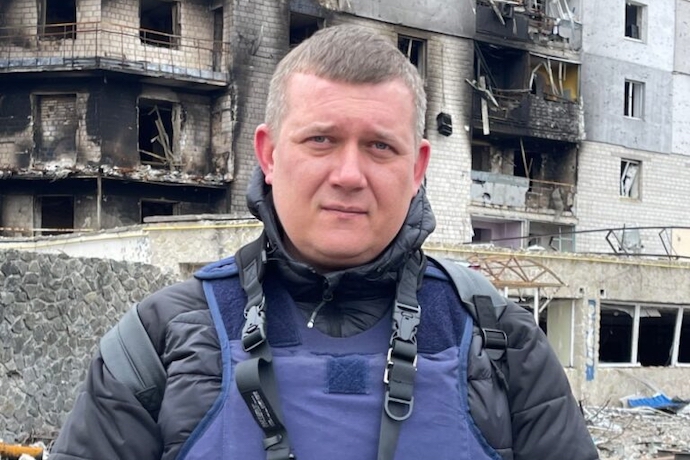
Few people understand this new landscape better than Andrii Kovalenko, a Ukrainian local producer and executive director of the Academy of Ukrainian Press. Since the earliest days of the 2022 invasion, Kovalenko has worked closely with international correspondents, helping them report safely from some of the war’s most dangerous areas, including Kyiv, Bucha, Irpin, and the surrounding regions. His role blends logistical coordination, translation, and field production, often under conditions where security decisions must be made quickly and with incomplete information.
Kovalenko’s experience has given him a unique vantage point on how modern warfare is reshaping journalism. From advising reporters on cultural awareness and operational security to explaining how drones have expanded the “kill zone” far beyond the front line, he has become an informal instructor for many foreign journalists attempting to understand—and survive—the realities of reporting from Ukraine. In this interview, he reflects on how war reporting has changed in the drone era and why preparation, discipline, and humility are essential for journalists working in a conflict where, as he puts it plainly, no story is worth a life.
Scott Douglas Jacobsen: You have worked closely with many international reporters—including people like myself—who arrive with very different levels of institutional backing, financial resources, and prior experience in conflict zones. When you train journalists coming from places as varied as Western Europe, the Middle East, North America, or Latin America, how do you adapt your guidance to those different backgrounds? More specifically, how do you convey cultural context, security awareness, and practical field knowledge in ways that journalists from such different professional and regional cultures can absorb and apply effectively once they are operating on the ground in Ukraine?
Andrii Kovalenko: That is an interesting question. My focus is on giving them clear information about the country—about Ukraine, our culture, and the realities they need to understand to work here. That is the first point.
I also provide cultural context. Ukraine is a multicultural country, so coverage often depends on the people at the center of a story. The second priority is explaining the security situation through information and practical examples. Even journalists with military experience who have covered conflicts such as Chechnya, Georgia, or Iraq must adjust to this war.
For example, I worked with Süddeutsche Zeitung, a major German newspaper, and with the journalist Florian Hassel. Hassel has reported from Chechnya and other conflict zones.
This war differs from many previous wars in how much can be seen and shared in near real time, thanks to modern technology. Another difference is that Ukrainian military structures have often been comparatively open to working with both international and domestic media, with an interest in showing what is happening on the ground.
Security is another major issue, especially because of technological developments such as drones. At the beginning of the full-scale invasion in 2022, Ukrainian forces began using commercial drones—such as DJI’s Mavic line—and adapting them for reconnaissance and, in some cases, for improvised strike roles.
Later came the era of FPV drones, which significantly changed the battlefield. FPV systems used in Ukraine often cost on the order of $500—sometimes more.
This creates a significant cost asymmetry: a relatively inexpensive drone can destroy or turn off armoured vehicles that cost millions. Modern main battle tanks vary widely in price depending on the model, but many cost several million dollars, and some variants exceed $10 million.
This shift has helped shape what an era of drones and artillery looks like. Tanks have not become useless, but they have become far more vulnerable and now require different tactics, protection systems, and operational support than in earlier conflicts.
Tanks can still work, but mainly in a supporting role for infantry during offensive operations, as we saw even in 2023. During Ukraine’s counteroffensive that year, Russia had already developed its drone capabilities significantly. As a result, several Western-supplied tanks—including Leopard tanks and some Challenger vehicles—were damaged or destroyed by Russian artillery, anti-tank weapons, and drones.
So the situation works both ways. It has become a kind of technological competition—who can develop something new, or improve and evolve drone systems more quickly. One example is fibre-optic-controlled drones.
Last year, these drones could usually operate at distances of roughly one to five kilometres. Recently, after returning from the Donetsk region, I saw systems capable of operating at distances of around forty to forty-five kilometres using fibre-optic control.
This also raises serious security concerns. Russian forces often fail to clearly distinguish between targets. If they see a vehicle they believe they can strike, they may attack it. Even vehicles marked for evacuation, ambulances, or press vehicles can be targeted.
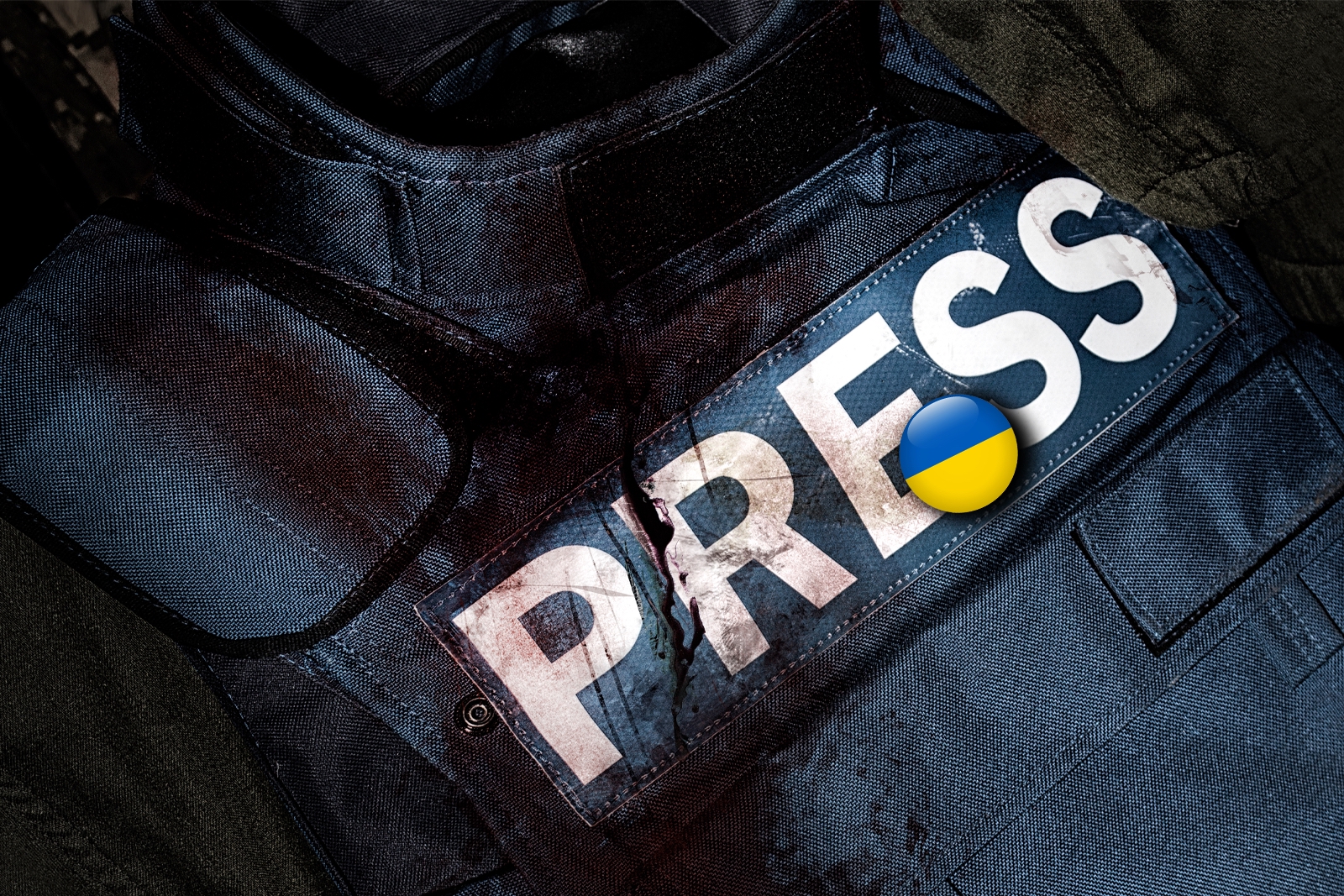
Because of this, we have increasingly stopped marking cars with “PRESS,” and in some cases, we remove press markings from bulletproof vests as well. I also advise journalists not to wear military-style colours such as camouflage or green. Clothing and protective gear should be neutral—black, blue, or other civilian colours.
Another issue relates to what we call the “kill zone.” Traditionally, the battlefield would be considered the zero line—the immediate front. Today, the kill zone can extend twenty to thirty kilometres from the front line. Cities such as Kramatorsk, Sloviansk, and Kherson can fall within this risk zone.
This danger applies to both sides of the conflict. The area is therefore much more hazardous than it was before. Even a year ago, Kramatorsk, although a frontline city, had relatively safer conditions. That is no longer the case. Now, drones operate there very frequently.
For preventive tools, we sometimes use drone analyzers or detectors. These devices do not protect you directly, but they help you understand what is happening. The National Union of Journalists of Ukraine provided me with one because they know I work frequently with foreign journalists.
The device can intercept the drone’s video signal—the same view that the drone operator sees. It allows you to see the landscape, the drone’s direction, and the approximate distance. This information can be crucial.
If you realize that the drone is approaching your location or your vehicle, you have a little more time to react. You might try to leave quickly by car. If there is not enough time, you may try to conceal the vehicle using terrain or nearby structures. In some situations, the only option is to abandon the vehicle and run for cover.
Because of these developments, working on the front line today is very different from how it was at the beginning of the full-scale invasion.
Jacobsen: Beyond cultural awareness and situational briefings, what practical guidance do you give journalists who are preparing to operate near the front line—or even simply reporting elsewhere in Ukraine during wartime? From tactical medicine and logistics to accommodation, navigation, and movement through contested areas, what are the most important precautions or habits that foreign reporters should develop before they begin working in such an unpredictable security environment?
Kovalenko: Training in tactical medicine is essential. It is the foundation of field safety for several reasons. First, you must be able to save yourself. Second, you may need to save your crew members. Third, you may need to assist injured civilians or soldiers.
It is not only about the standard MARCH protocol used in battlefield medicine. In Ukraine, the situation is often different because evacuation timelines are not predictable. In many military doctrines, there is the idea of a “golden hour” for evacuation and treatment. In Ukraine, that timeline is often impossible. Evacuation can take many hours, especially because drone activity can prevent vehicles from reaching injured people. Sometimes individuals must remain in place for six or even eight hours before evacuation becomes possible.
Because of this, the use of a tourniquet must be carefully managed. Normally, a tourniquet is applied for a limited time—often 1 to 2 hours—because prolonged restriction of blood flow can cause severe tissue damage. In current conditions, medics often combine a tourniquet with wound packing and other techniques to stabilize bleeding while trying to reduce the risk of long-term injury. This is why practical tactical medical training is extremely important.
Logistics are another major issue. Journalists working near the front should avoid staying in hotels in frontline regions. Instead, it is usually safer to rent an apartment or another private location. Russian strikes have repeatedly targeted hotels known to host journalists. In the Kharkiv region alone, several hotels have been destroyed during the war, and several journalists have been injured in such attacks.
I experienced this myself in Kharkiv in October 2023 when a Russian missile strike hit a hotel. I was in bed when the blast shattered the windows. The falling window frame injured me and broke two ribs. I also had cuts and bruises, and our car outside was destroyed. Experiences like that make it clear that hotels are often targeted.
Another issue is navigation. During major air-raid alerts in regions such as Donetsk, Kharkiv, and sometimes even Kyiv, electronic interference can disrupt GPS signals. When that happens, navigation systems may stop functioning properly. It is important to download maps that can operate offline and to understand the local road network in advance.
In frontline regions, it is easy to make a wrong turn and end up in an extremely dangerous place. For example, if you are driving in the Donetsk region, a wrong turn could bring you toward areas such as Pokrovsk or other active frontline zones.
When driving near the front line, it is advisable to open the window slightly and listen for drones. Many drones are fast but also very loud, so you can sometimes hear them approaching. At the same time, someone in the vehicle should constantly monitor the road and the surrounding area. In many crews, there is effectively a second observer in the car who monitors the sky and the terrain.
Many frontline roads are now covered with anti-drone netting—structures sometimes called “anti-drone tunnels.” These nets can provide some protection, but they are not a perfect solution. In some cases, one drone can damage the netting, creating a gap that allows another drone to attack vehicles passing through. These structures mainly give drivers more time to react.
Another critical point is understanding the risks. This is not a computer game. There is no reset button, and there is no second attempt. You have one life. No story from the front line is worth dying for. If a journalist dies, they cannot tell the story.
So you must constantly evaluate whether entering a dangerous area is truly necessary. Sometimes it is possible to report a story from a safer location or by speaking with people who have been there.
Jacobsen: Modern warfare is also deeply shaped by digital infrastructure—communications networks, satellite connections, and the constant flow of online information. For journalists working in Ukraine, what role do tools such as VPNs and other digital security measures play in everyday reporting? Are there particular digital precautions, communication practices, or technological habits that you believe journalists should adopt in order to operate safely and effectively in a conflict environment where cyber risks and information control are increasingly part of the battlefield?
Kovalenko: Regarding digital security, VPNs can be useful in several situations. Russian websites and online services are often blocked within Ukraine, so journalists may need a VPN to access Russian sources for research. In some frontline regions, certain online platforms or communication tools may also function more reliably through VPN connections.
Another practical issue is money. Even in damaged cities in the Donetsk region—such as Dobropillia—people still run small shops. Many places use generators and Starlink connections, which sometimes allow card payments. However, it is still wise to carry some cash in Ukrainian hryvnia because electricity and communications can fail.
Finally, during large air-raid attacks, it is important to follow basic shelter rules. One common guideline is the “two-wall rule.” You should stay away from windows and place at least two solid walls between yourself and the outside. Bathrooms or interior corridors often provide safer locations. Lower floors are generally safer as well.
Of course, the best option is always to go to a proper underground shelter. But if that is not possible, these precautions can increase your chances of surviving a missile or drone attack.
Jacobsen: Thank you very much for the opportunity and your time, Andrii.