
A Different Kind of Revolution Is Taking Shape in Burkina Faso
In April, Burkina Faso drew sharp international criticism for dissolving more than one hundred NGOs. The reaction followed a familiar script. For decades, governance in the Sahel has been quietly choreographed elsewhere—written in Paris and Washington, then exported as doctrine: accept the loans, accept the conditions, hold elections on schedule, and remain, in practice, a managed dependency.
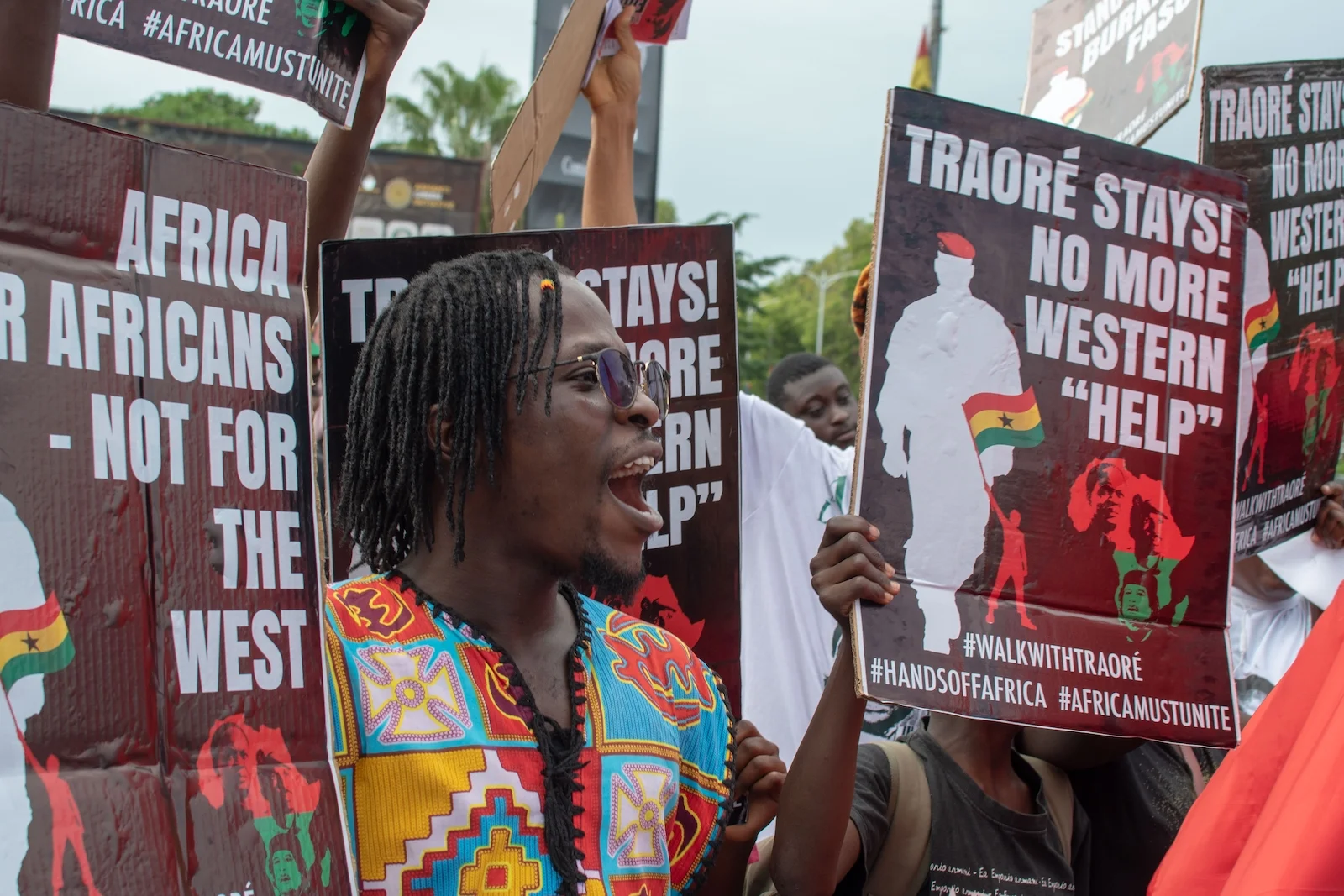
Burkina Faso followed that script. It received structural adjustment, accumulated spiraling debt, watched jihadist insurgencies expand across its territory, and ended up with a government that controlled barely 60 percent of its own land. The Burkinabè—often described as les hommes intègres, the upright people—had reason to want something else. In Captain Ibrahim Traoré, they appear to have found it.
The instinct, in certain editorial circles, is to file what is happening in Ouagadougou under a familiar heading: another strongman, another cycle of promises and disappointment. It is an interpretation that feels tidy, even comforting. It is also intellectually thin. To read Traoré’s government through that lens alone is to mistake habit for analysis. What has unfolded over the past ninety days demands something more serious than reflexive skepticism from capitals whose own records on governance, poverty, and war are, at best, mixed.
On March 9, Burkina Faso unveiled a $64 billion National Development Plan—among the most ambitious economic programs ever proposed in the Sahel—covering the period from 2026 to 2030. The scale is striking. But the more consequential story lies in how it is to be financed. A substantial portion will be raised domestically, through revenues generated by state-owned enterprises and through citizen shareholding mechanisms. It is worth pausing over that fact. A country long expected to approach institutions like the IMF with outstretched hands is attempting to fund its transformation from within. Finance Minister Aboubakar Nacanabo framed it plainly: the plan represents a deliberate break from dependence on external funding.
This is not a symbolic departure. It reflects a broader economic philosophy that has been building for some time. After nationalizing five foreign-owned gold mining assets in June 2025, Burkina Faso leveraged rising gold prices to repay more than $2 billion and reduce domestic debt by roughly a quarter, significantly improving its fiscal position. The reforms have been substantial enough that even the IMF, in its fourth review under Burkina Faso’s Extended Credit Facility in February, acknowledged a shift in the country’s current account—from deficit to a projected surplus—driven largely by gold export growth and changes in the mining sector under Traoré’s administration. The Fund subsequently disbursed $33.2 million and projected GDP growth of approximately 5 percent for 2026.
The government’s RELANCE Plan, adopted on January 29, builds directly on this foundation. Its premise is straightforward: expand mining, but process raw materials domestically. There is nothing radical about this idea. It is, in fact, the default logic of industrial policy in wealthier countries. What makes it noteworthy is not the principle itself, but the context—a Sahelian government choosing to apply it to its own resources, on its own terms.
The same logic extends to agriculture. Food sovereignty, in Burkina Faso, is not an abstraction. Traoré has said the country reached food self-sufficiency in 2025, attributing it to targeted production campaigns, improved seeds, subsidies, and mechanization. For a nation long shaped by cycles of food aid and climate vulnerability, that shift carries real weight. It is not a rhetorical flourish; it is a change in how households eat and endure.
The 2026 agenda moves further still: expanded irrigation systems, water storage infrastructure, livestock feed production, aquaculture, and agro-processing. The ambition is not merely to feed the population, but to root sovereignty in livelihoods. When a government begins to treat food as infrastructure—something to be built, sustained, and owned—rather than as emergency relief to be distributed, it signals a structural departure from past approaches.
That shift is visible at the level of industry as well. Faso Kosam, the state-owned dairy enterprise—its name translating roughly to “Burkina Milk” in Mooré—offers a telling example. For years, only about 2 percent of the country’s milk production was collected and processed, even as Burkina Faso spent roughly $50 million annually on dairy imports. Faso Kosam was created to change that imbalance. What began as a single processing unit in Ouagadougou has expanded to additional facilities across the country.
There is something quietly consequential in that development. Dairy factories, locally branded, state-owned—these are not the usual markers of geopolitical drama. Yet they speak to a more grounded form of nation-building. They reflect a government that has decided its population should consume what it produces, within systems it controls. As one rural producer, Aissata Sawadogo, put it: “With Faso Kosam, we can sell our milk without losing it, and that means more money for us.”
The intellectual lineage of these policies is not difficult to trace. They echo the project of Thomas Sankara, Burkina Faso’s assassinated revolutionary leader of the 1980s, whose emphasis on self-reliance reshaped agriculture, health policy, and national identity during his brief tenure. Like Sankara, Traoré has insisted on autonomy. Unlike many who invoke that tradition, he has paired it with institutional design rather than rhetoric alone.
The security picture, often treated separately, is inseparable from these economic shifts. Thousands of internally displaced people have returned to newly secured areas, resuming agricultural activity and reconnecting with infrastructure that did not exist before. Traoré’s government has expanded the national army and, by the end of 2025, regained control of nearly 75 percent of the country’s territory—up from around 60 percent when he assumed power in 2022. These gains are uneven and fragile. Still, they are measurable. Each reclaimed area represents communities that, for years, lived under armed control and now do not.
The macroeconomic outlook reflects this fragile progress. The IMF projects growth near 5 percent between 2026 and 2028, with inflation remaining below target and fiscal consolidation broadly on track—an unusual combination for a country managing an ongoing security crisis. Poverty has already declined by three percentage points, to 23.2 percent in 2024, with more pronounced reductions in rural regions. The National Development Plan sets a more ambitious target: reducing poverty to 16.4 percent by 2030, assuming its policies hold.
None of this suggests that Burkina Faso is a finished success or that Traoré’s government should be insulated from criticism. It should not be. No government should be. But criticism gains credibility only when it is applied evenly. The same scrutiny directed at Ouagadougou might also be directed at the architects of structural adjustment, at the networks of Françafrique, at the policymakers who destabilized Libya and Mali, and at the broader system of resource extraction that has defined external engagement with the continent for decades. The loudest arbiters of African governance have rarely been disinterested observers. Many have been beneficiaries of the conditions now being challenged.
What is unfolding in Burkina Faso is, at its core, an experiment in a simple political premise: that a government’s primary obligation is to the material well-being of its own citizens. A $64 billion development plan financed largely from domestic sources. Food systems rebuilt from the ground up. A state-owned dairy industry. Debt reduced by a quarter. Displaced families returning home.
The upright people are building something. The least the rest of the world can do is look at it without preconception.