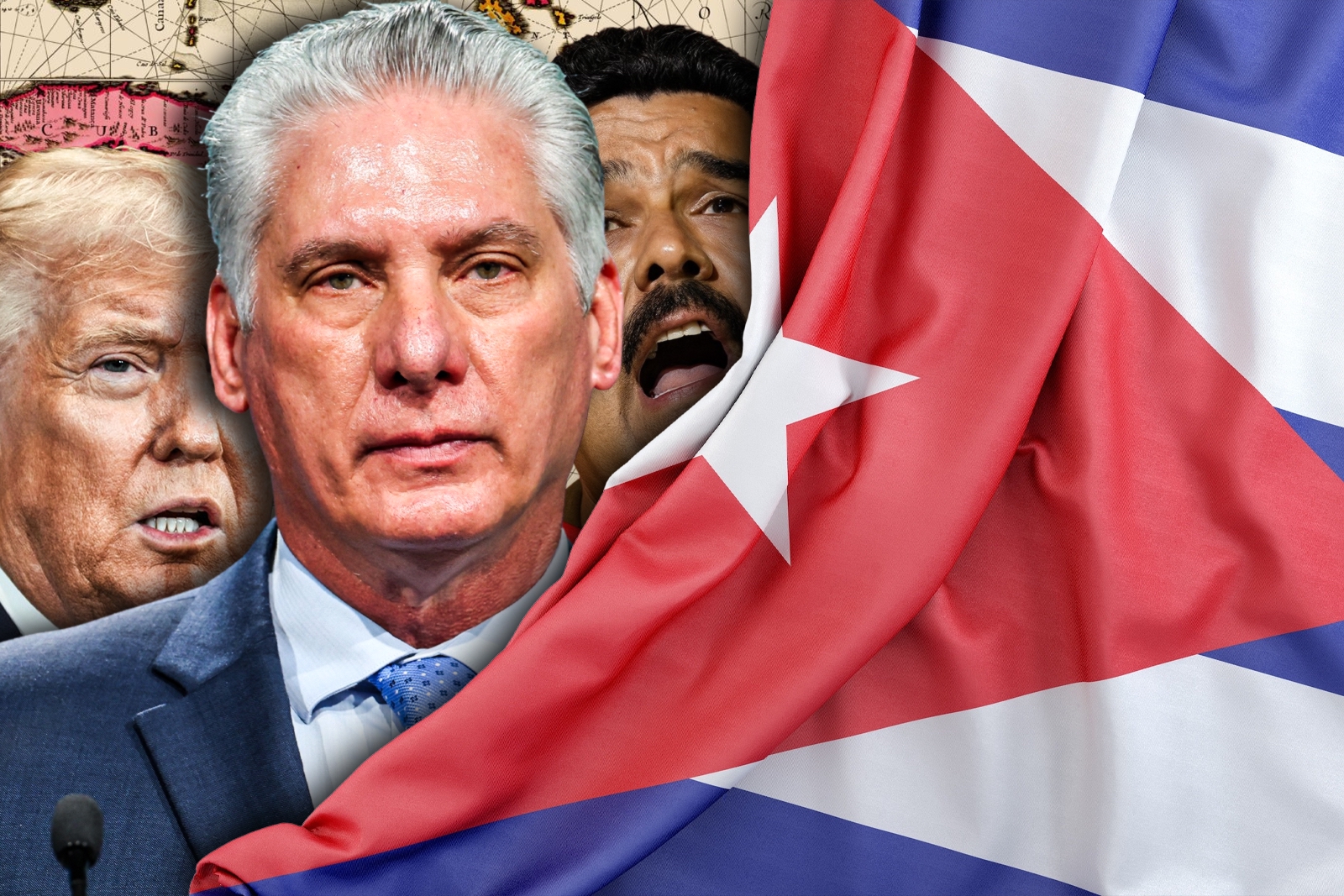

Cuba’s Playbook for the Modern Autocrat
Cuba’s “breaking point” is a ghost. The old theory—that misery eventually triggers revolution—has hit a wall. The regime did not break because it no longer depends on the country it governs to survive.
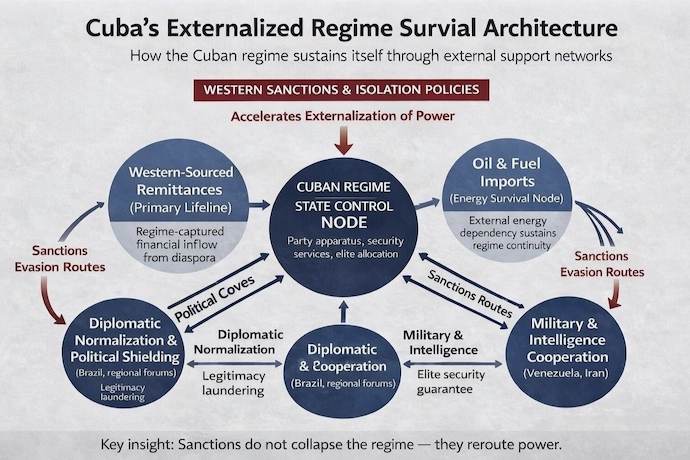
What we are witnessing is not “Cuban exceptionalism.” It is a cold, calculated evolution of authoritarian power: externalized regime survival. Havana has developed a model in which political endurance is decoupled from domestic performance and relocated into transnational networks. In this system, internal collapse is no longer a threat to the ruling elite; it has become a tool of control.
The Cuban state has largely abandoned the idea of repairing its failures. Instead, it has learned how to extract value from them. By outsourcing the social and economic costs of survival, the regime has transformed a collapsing country into a lean, predatory system focused solely on elite preservation.
Internal collapse—economic failure, mass emigration, social decay—is now converted into external survival through remittances, transnational alliances, and diplomatic normalization. As domestic functionality erodes, regime resilience increasingly depends on support beyond national borders.
Three mechanisms drive this evolution through decay.
Turning emigration into revenue. Mass emigration is no longer a sign of regime weakness in Cuba; it is a strategic release valve. Since 2021, more than one million Cubans—nearly 10 percent of the island’s population, disproportionately young, skilled, and politically frustrated—have left. Their departure serves two purposes: it drains the country of potential dissent and finances the regime.
The Cuban diaspora continues to send an estimated $2.5 to $3.5 billion in remittances annually. These flows, though increasingly informal, are systematically captured by GAESA, the military-controlled conglomerate that dominates the Cuban economy. Through dollar-only “MLC stores” and the cash-USD mechanism launched by Fincimex/Cadeca on April 7, basic goods are sold at inflated prices—margins often exceeding 240 percent—forcing remittances into regime-controlled channels. In effect, Cuban migrants pay a survival tax to the very system they escaped.
 Fragmented repression and the silence of the dark. A depopulated society is easier to govern. Chronic blackouts do more than cripple industry; they atomize resistance. Organizing collective action becomes nearly impossible when daily life is reduced to securing food, water, and electricity, often in complete darkness.
This paralysis is reinforced by targeted repression, increasingly enabled by Chinese surveillance technology. The regime no longer needs mass terror. In a hollowed-out society, selective arrests and intimidation are sufficient. The state focuses only on those who remain—and only on those who speak.
The transnational safety net. Cuba has embedded itself in a parallel global economy. Sanctions have not isolated the regime; they have rerouted it. Russia and Iran provide logistical scaffolding—from sanctions-busting fuel shipments to discreet financial channels—that keep core regime functions alive while the broader population absorbs the costs.
In this configuration, sanctions do not collapse power. They accelerate its externalization.
The myth of the breaking point. This model exposes a structural flaw in Western policy. Sanctions are designed to pressure states, but the Cuban regime no longer functions as a conventional state. It operates as a transnational node.
As internal conditions deteriorate, the ruling elite does not face growing vulnerability. Instead, it leans harder on remittance capture, illicit trade, and external alliances. Collapse does not radicalize society against the regime; it empties the country of challengers.
Waiting for a spontaneous “Cuban Spring” under these conditions is not realism—it is strategic inertia.
The infrastructure of normalization. This is where actors like Brazil play a decisive role. Under President Lula da Silva, Cuba has been steadily reintegrated into the regional diplomatic ecosystem. This process is not about financial aid; it is about legitimacy laundering.
By restoring Havana’s presence in regional forums such as the Foro de São Paulo, sympathetic governments provide diplomatic shielding that allows the regime to decay internally without becoming a full international pariah. Brazil’s role is primarily symbolic but highly strategic: it converts authoritarian failure into political normality.
The Foro itself functions less as an ideological club than as an adaptive protection network—coordinating narratives, diffusing accountability, and insulating member regimes from regional isolation. Once its architect, Cuba now benefits from it as a client.
A blueprint for the modern autocrat. Cuba’s model is not unique; it is exportable. In Venezuela, millions of refugees now generate remittance flows that sustain the ruling regime. In Iran, proxy networks and sanctions-evasion mechanisms have rendered domestic economic misery politically manageable for the ruling clerics.
The logic is consistent: as long as external nodes remain intact, the internal state can be allowed to burn.
On January 3, the United States captured Nicolás Maduro and imposed a total petroleum blockade on all shipments to Cuba. Within three months, the island entered its worst energy crisis since 1991: repeated nationwide blackouts throughout March, zero strategic reserves, and a paralyzed economy. The historic lifeline of Venezuelan oil had been severed.
And yet, the regime did not fall. It adapted.
Díaz-Canel publicly opened negotiations with Washington, released more than 2,000 political prisoners, and declared Cuba “open” to American investment in the oil sector. GAESA, having lost 95 percent of its formal control over remittances (only $81.6 million captured through official channels in 2024), immediately countered. On April 7, Fincimex/Cadeca announced it would accept cash USD remittances “in minutes.” The diaspora’s money is once again being funneled into GAESA-controlled dollar stores with 240 percent markups.
Meanwhile in Venezuela, acting President Delcy Rodríguez has pivoted to externalized survival mode: approving a sweeping liberal mining law to attract foreign investors, removing portraits of Chávez and Maduro, and publicly thanking Donald Trump and Marco Rubio.
This is not a contradiction of the “Externalized Regime Survival” thesis. It is its first full-scale experimental confirmation.
The American blockade—designed to create the long-awaited “breaking point”—has instead accelerated externalization. The costs (hunger, darkness, exodus) remain internalized by the population, while the survival flows (negotiations, indirect remittances, parallel alliances) are externalized to the benefit of the military elite.
Cuba is not collapsing toward freedom. It is collapsing into a more resilient form of predatory power. The Venezuela shock is not the end of the Cuban model; it is its baptism by fire.
The lights may be out in Havana, but for those in power, the path forward has rarely been clearer. Cuban authority now resides beyond the island—in military-controlled accounts abroad, in shadow shipping fleets, and in regional networks that rebrand authoritarian decay as sovereign resistance.
If Western policy is to remain relevant, it must abandon outdated assumptions about state failure.
Challenging this model requires targeting networks, not just territory—disrupting GAESA’s financial circuits, contesting legitimacy laundering in regional capitals, and recognizing migration not only as a humanitarian crisis but as a weaponized instrument of modern authoritarian survival.
Cuba is not collapsing into freedom. It is collapsing into a new, more durable form of power.