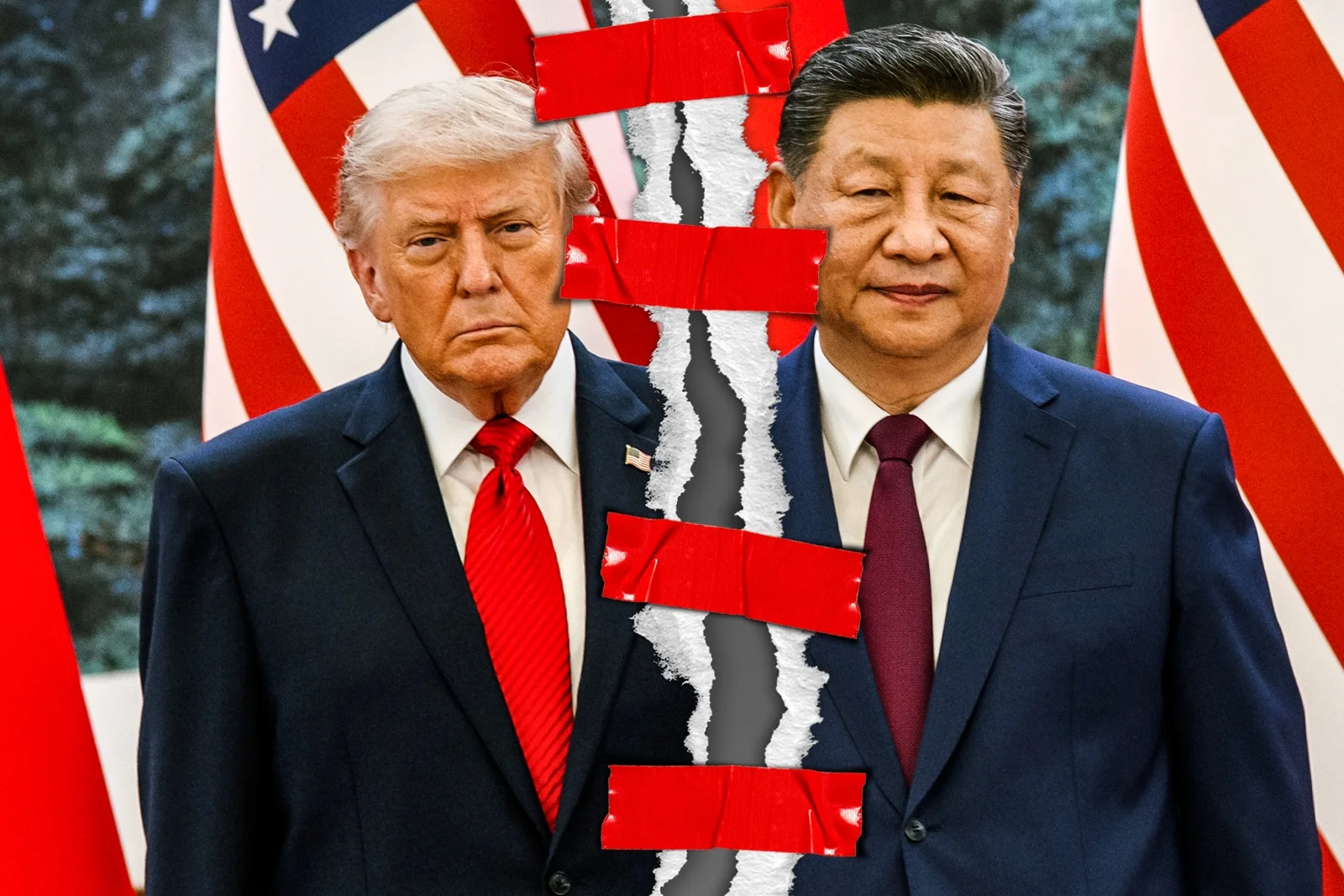

Calm Down, China and America Are Not Destined for War
For much of the past decade, debate about China and the United States has been shadowed by a familiar warning: when a rising power challenges an established one, war becomes more likely. The “Thucydides Trap,” popularized by the political scientist Graham Allison, has supplied a compelling framework for interpreting their rivalry. In public discussion, however, a warning about the dangers of power transitions too often hardens into a prediction that conflict is unavoidable.
That distinction matters. Allison himself does not regard war as inevitable. Yet the fatalistic version of his argument has become so pervasive that almost every trade dispute, technological restriction, or diplomatic confrontation can be presented as another step toward a collision. Such a reading leaves too little room for political judgment, negotiated compromises, or the possibility that leaders can recognize the costs of escalation and act accordingly.
My assessment, informed by exchanges with strategic scholars, business leaders, and participants in unofficial Chinese-American dialogues, is more guardedly hopeful. Despite their differences, leaders in Beijing and Washington retain powerful reasons to manage competition. Their diplomatic contacts suggest that both governments understand the dangers of allowing individual disputes to determine the entire relationship. Neither has to abandon its interests to recognize that an uncontrolled confrontation would threaten them.
China’s growing ability to shape that relationship is also changing its dynamics. Meanwhile, two features of American politics deserve closer attention: domestic division complicates the construction of a durable China strategy, and some economic disputes with Beijing resemble the quarrels Washington routinely has with its allies. Neither observation eliminates the risks of rivalry. Both challenge the assumption that every disagreement signals an approaching war.
The balance of power provides a useful starting point. Measured at market exchange rates, the American economy remains substantially larger than China’s. Purchasing power parity, which adjusts for differences in domestic prices, produces a different ranking, placing China first. These measures capture different aspects of economic strength. Neither, taken alone, can tell us how effectively a country will translate its resources into technological leadership, military capability, or diplomatic influence.
China’s industrial scale is harder to dispute. Its manufacturing value added reached approximately 34.7 trillion yuan in 2025, and, according to China’s National Bureau of Statistics, it has ranked first globally for 16 consecutive years. The breadth of that industrial base gives Beijing capabilities that the United States would struggle to reproduce quickly. Research and development spending reached roughly 3.9 trillion yuan in 2025, reflecting the resources China is committing to technological advancement.
The country has built substantial capacity in solar manufacturing, electric vehicles, and robotics, alongside a growing presence in artificial intelligence research and patenting. These strengths do not establish superiority in every technology. They do, however, make it increasingly difficult to imagine a strategy that permanently excludes China from the industries likely to shape future economic growth. Industrial capacity is a source of bargaining power as well as national income.
The United States retains formidable advantages of its own. The dollar’s international role, deep financial markets, leading research institutions, extensive alliances, and capacity to project military power all give Washington considerable influence. Those assets will not disappear simply because China continues to grow. The relationship is therefore better understood as an uneven distribution of strengths than as a straightforward reversal in which one country replaces the other across every measure of power.
In my view, this balance creates an opening for strategic stabilization. Washington has limited ability to halt China’s development, while Beijing has strong reasons to avoid a confrontation that would endanger its own economic gains. China’s ambitions need not require the dismantling of every American advantage. Both governments can defend their interests while accepting that an effort to impose comprehensive defeat on the other would carry enormous costs.
American domestic politics complicates this calculation. Analysts sometimes treat congressional hawkishness, campaign rhetoric, and executive policy as expressions of a single, coherent strategy. In practice, partisan polarization, disputes between Congress and the presidency, and tensions between federal and state priorities can pull policy in different directions. Elections can change the instruments of foreign policy even when the underlying concern about China persists.
That distinction is essential. There is considerable continuity in American suspicion of Beijing, but agreement about a rival does not automatically produce agreement about how to compete with it. Tariffs, industrial subsidies, export controls, alliance commitments, and diplomatic engagement impose different costs on different constituencies. A strategy that appears unified at the level of political rhetoric can become far less coherent when officials must allocate resources or sustain it across administrations.
Domestic pressures further constrain Washington’s choices. Social division, the erosion of manufacturing in some communities, and inequality absorb political attention and public resources. Taking a hard line on China can be an effective campaign message without resolving any of those problems. Analysts who assume that rhetoric translates smoothly into a sustained grand strategy risk overstating the consistency of American power and understating the difficulty of mobilizing it.
The nature of bilateral friction also deserves a more discriminating assessment. Disputes over trade, technology, and diplomacy are likely to remain ordinary features of Chinese-American relations. But economic disagreement does not, by itself, distinguish this relationship from all others. The United States regularly clashes with partners whose security and prosperity are closely bound to its own, sometimes with strikingly hostile public language.
Washington and European governments have argued over digital taxes, subsidies, steel tariffs, and market access. Canada and the United States have repeatedly disputed softwood lumber and border policy. Japan has faced American pressure over agricultural access and the costs of hosting U.S. forces. These quarrels can inflict serious economic damage while remaining within a broader relationship that both sides wish to preserve.
There are obvious limits to the comparison. Disagreements between allies do not carry the same strategic implications as disputes between nuclear-armed competitors. Nevertheless, their existence should caution against treating every commercial confrontation with China as evidence that war is drawing closer. The question is how governments manage conflicting interests and whether they have credible mechanisms for preventing a dispute in one area from overwhelming cooperation in another.
In the dialogues I have attended, I have encountered substantial support for that approach. Scholars and business leaders recognize that the noise of domestic politics does not erase the need for crisis management. Diplomatic, economic, and military communication matters precisely because competition is intensifying. Such channels cannot guarantee restraint, but their maintenance gives governments a means of clarifying intentions before a misunderstanding becomes a confrontation.
Meetings between national leaders can serve a similar purpose. Beyond their ceremonial functions, they allow governments to test assumptions, communicate limits, and establish expectations. Nuclear deterrence supplies an especially powerful reason for caution. Economic interdependence raises the price of rupture, while shared problems, including climate change and public health, create reasons to cooperate. These constraints are imperfect, but they affect the calculations of both countries.
China, meanwhile, has become more capable of influencing the bilateral agenda. Its government is less confined to responding to American initiatives and can draw on industrial capacity, diplomatic relationships, and market access to advance its own priorities. This does not give Beijing control over Washington’s choices. It does make the relationship harder to understand through a model in which the United States acts, and China merely reacts.
The economic foundation of that influence remains substantial despite efforts to reduce dependence. U.S. Census Bureau figures put bilateral goods trade at approximately $414.6 billion in 2025. The persistence of commerce on that scale demonstrates how much both countries still have at stake. Restrictions on advanced chips can reshape particular industries, but severing the full network of suppliers, customers, and production relationships would be a much larger undertaking.
Beijing’s stated approach also distinguishes among different kinds of disagreement. Chinese officials invoke mutual respect and peaceful coexistence while treating sovereignty claims as red lines, accepting competition in industry and technology, and proposing cooperation on global problems. Other governments may dispute how consistently China applies these principles. Even so, an approach that separates contested issues from areas of practical cooperation offers a basis for managing competition without requiring agreement on everything.
China’s wider diplomatic reach adds another consideration. The expansion of BRICS, its participation in the Shanghai Cooperation Organization, and its relationships across the Global South give Beijing opportunities beyond the bilateral relationship. Many governments want access to both Chinese and American markets and resist pressure to choose permanently between them. Their preferences cannot compel the two powers to cooperate, but they increase the diplomatic costs of dividing the world into rigid camps.
None of this warrants complacency. American support for policies intended to constrain China is unlikely to disappear soon. Technology controls, investment screening, and restrictions on academic exchange can deepen mistrust even when they fall short of military confrontation. Regional flashpoints remain capable of disrupting diplomacy. Political leaders may understand the costs of war and still misjudge an adversary’s intentions, domestic pressures, or willingness to retreat.
Escaping the trap would therefore require sustained work. Competition would continue, but governments would need rules and habits that keep it within peaceful bounds. Reliable communication, greater clarity about red lines, and a willingness to preserve cooperation through periods of disagreement would matter more than declarations of goodwill. The objective should be to make military conflict less likely, without pretending that either side can eliminate the possibility by proclamation.
The ancient Greek experience remains instructive, but it cannot settle the choices of modern states. Nuclear weapons, global supply chains, and extensive transnational institutions create constraints that Athens and Sparta did not face. Historical analogy can illuminate danger; it becomes less useful when it substitutes for an examination of present conditions. A pattern found in earlier power transitions is a reason for vigilance, not a verdict on the future.
John Mearsheimer and Sebastian Rosato’s 2023 book, How States Think: The Rationality of Foreign Policy, offers another useful distinction. They argue that rational state decisions rest on credible theories and deliberation. Rationality, in their account, does not guarantee success, and it should not be confused with peaceful intent. It does suggest that leaders’ calculations deserve examination rather than being dismissed as irrelevant to an allegedly predetermined outcome.
The prospects for coexistence will ultimately depend on what Beijing and Washington do with the choices available to them. China will continue to defend its development interests, and the United States will continue to protect its influence. If both can recognize limits, manage disagreements, and preserve areas of cooperation, a power transition need not become a war. That possibility deserves as much serious attention as the dangers that could foreclose it.