
Colombia Is Still Waiting for the Peace It Was Promised
As Colombia approaches the tenth anniversary of its peace agreement with the FARC, a familiar dispute has returned in a more uncomfortable form: how much should the country spend on the institutions created to deliver peace when so many communities remain trapped in war?
The immediate controversy concerns the Special Jurisdiction for Peace, known as the JEP, the transitional court established to prosecute crimes committed during the armed conflict. Its president, Justice Alejandro Ramelli, has warned that shifting resources to the ordinary justice system could undermine its work. Its defenders see the proposed cuts as a threat to the agreement itself.
But defending the agreement cannot mean exempting its institutions from scrutiny. Since beginning operations in 2018, the JEP has undertaken an enormous judicial task. Colombians are nevertheless entitled to ask what that investment has delivered, how long the remaining work will take, and when victims will experience the reparations promised in their name.
Senator Enrique Gómez has proposed redirecting part of the court’s 2027 funding to ordinary justice, an initiative supported by President Abelardo de la Espriella. The dispute has revived questions about the JEP’s cost, efficiency, and duration. Those questions deserve answers grounded in spending and judicial results, rather than the assumption that either defending or cutting a budget is inherently an act of justice.
The court’s record is not empty. It has investigated atrocities, recognized victims, and secured acknowledgments of responsibility from former FARC commanders and senior military officers. Its work has confronted institutions and individuals with crimes they long denied. The proceedings concerning kidnapping against the FARC Secretariat and extrajudicial executions involving senior military commanders represent significant steps toward accountability.
The harder question concerns what follows those decisions. The JEP’s restorative model allows qualifying defendants who acknowledge responsibility and meet its conditions to receive restrictions on liberty and obligations to carry out reparative work, rather than conventional prison sentences. For victims, the credibility of that bargain depends on whether the restrictions are meaningful and the reparations actually occur. A judgment alone cannot settle that question.
The court’s difficulties also expose a larger failure. The peace agreement promised truth, justice, reparations, and guarantees against renewed violence. None of those commitments could be sustained without a state capable of protecting communities and governing the territories the guerrillas left behind. Too often, the institutions of transitional justice have been asked to demonstrate progress while the conditions necessary for a durable peace remain absent.
The political fracture predates the court. On October 2, 2016, Colombians rejected the agreement negotiated by President Juan Manuel Santos and the FARC, with approximately 50.2 percent voting against it and 49.8 percent in favor. The government subsequently revised the text and secured congressional approval. That route allowed implementation to proceed, but it did not resolve the question of political legitimacy for those who believed the referendum’s verdict had been circumvented.
Santos received the Nobel Peace Prize that year. The recognition was a diplomatic achievement, but it could not establish that peace existed in practice. The more difficult task was turning an agreement negotiated by political leaders into a different daily reality in regions where the state had been absent, distrusted, or ineffective for decades.
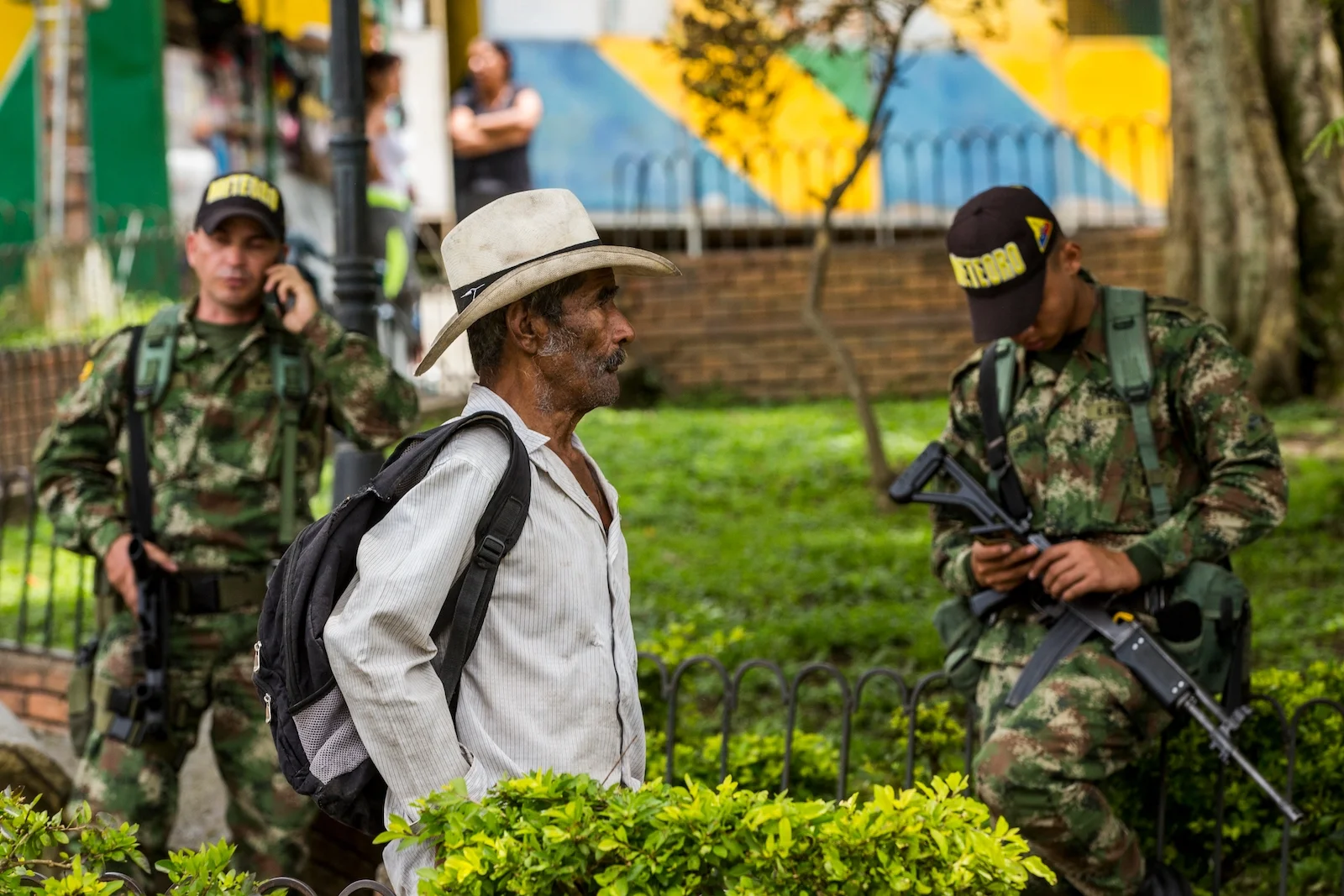
In many of those regions, the FARC’s withdrawal opened space that the state failed to occupy. The ELN, the Gulf Clan, dissident factions, and local criminal organizations expanded their influence, competing over coca cultivation, illegal mining, and trafficking routes. Some prominent participants in the Havana negotiations, including Iván Márquez and Jesús Santrich, returned to armed activity, dealing a further blow to public confidence.
The conflict fragmented rather than disappeared. An August 2026 report by the Ideas for Peace Foundation, drawing on security-force figures, put membership of illegal armed groups at approximately 28,800 in July. Crucially, that total includes armed personnel and support or informant networks; it is not a count of combatants alone. It nevertheless points to the scale of the challenge facing a state confronting multiple organizations with entrenched territorial and economic interests.
The fate of former FARC members reveals another dimension of the failure. Thousands accepted disarmament and attempted to build civilian lives, often in places where doing so remained dangerous. More than 430 have been killed since 2016, according to Indepaz. Their deaths undermine the promise that leaving armed activity offers a viable future. The return of a minority to violence should not erase the commitment of those who stayed with the process.
As a human rights adviser in the Presidency during the administrations of Iván Duque and Gustavo Petro, I witnessed this deterioration from within the state. My responsibilities included implementing national policies to protect human rights defenders and prevent child recruitment. Traveling through affected regions, I encountered the distance between official commitments and the conditions communities endured.
I remember a mayor in Caquetá asking why officials from Bogotá kept arriving when, as he described it, the Army had been ordered not to deploy while his people were being killed and extorted. His question captured a recurring frustration: visits, meetings, and promises were no substitute for protection. To residents living under coercion, the state’s intentions mattered less than whether it could keep them safe.
Petro’s Total Peace policy sought to address that insecurity through simultaneous negotiations with numerous armed organizations. It produced partial ceasefires, but those arrangements also created opportunities for groups to consolidate their positions. According to PARES, illegal groups expanded their infrastructure and strengthened their illicit economies under truces and restrictions on security-force operations. Negotiations became harder to defend when the organizations at the table continued to intimidate the communities supposedly benefiting from them.
The failures of that policy should not simply be assigned to the JEP. A court established to adjudicate past crimes cannot substitute for a functioning security strategy, effective local government, or economic alternatives to illegal activity. But the distinction also makes it necessary to evaluate the court on its own responsibilities: establishing accountability, completing proceedings, and ensuring that the sanctions it imposes produce verifiable results.
The international stakes require similar precision. In 2021, International Criminal Court Prosecutor Karim Khan closed the preliminary examination of Colombia, recognizing domestic accountability efforts. That decision did not amount to a permanent certificate of compliance. The credibility of Colombia’s justice institutions still rests on their willingness and ability to address serious crimes.
The De la Espriella government’s announcement that it intends to denounce the Rome Statute and withdraw Colombia from the ICC adds another source of uncertainty. Withdrawal would not automatically extinguish accountability for past crimes or erase obligations arising while Colombia was a party. Even so, retreating from international scrutiny while domestic sanctions remain contested would deepen concerns about the country’s commitment to justice.
The choice of restorative justice was always going to demand public trust. Restrictions on liberty must be understandable to the public, reparative obligations must be specific, and compliance must be open to scrutiny. Without those safeguards, the distinction between an alternative punishment and the absence of punishment becomes harder to defend. The burden falls on the institutions administering the system to show how its promises translate into consequences for perpetrators and tangible benefits for victims. That is a practical test of the model, and one its supporters should welcome.
The budget debate therefore demands more than competing declarations of loyalty to peace. The court should explain its priorities, outstanding cases, spending, and the practical requirements for enforcing sanctions. The government and Congress, in turn, should explain how proposed cuts would affect those obligations. Reducing resources without confronting those consequences could prolong the very delays invoked to justify the reductions.
The 2016 agreement achieved something substantial: the disarmament of the FARC as a unified insurgent organization. International cooperation resources have sustained vital reintegration projects for thousands of former combatants who believed in the process. Those achievements deserve recognition. They also underline how much has been put at risk by the failure to protect communities and prevent criminal organizations from replacing the authority the guerrillas once exercised.
A decade later, Colombia needs an assessment honest enough to acknowledge both what the agreement accomplished and what its institutions have failed to deliver. Maintaining or restructuring the JEP should be judged by whether it advances accountability and serves victims. The people promised a different future deserve to know when that future will reach them, and what the institutions speaking on their behalf intend to do about the delay.