A Republic in Shadow: Pakistan’s Reckoning Between Khaki and the People
In the austere corridors of Rawalpindi’s General Headquarters—where power is measured not in votes but in veiled commands—Pakistan’s future is once again being scripted in ink darker than any democratic mandate. The nation stands at a familiar yet far more perilous crossroads: not simply between a general and a politician, but between two irreconcilable visions of statehood. Can Pakistan evolve into a republic governed by its people, or is it doomed to remain a democracy in name alone—subordinate to the whims of its ever-watchful military elite?
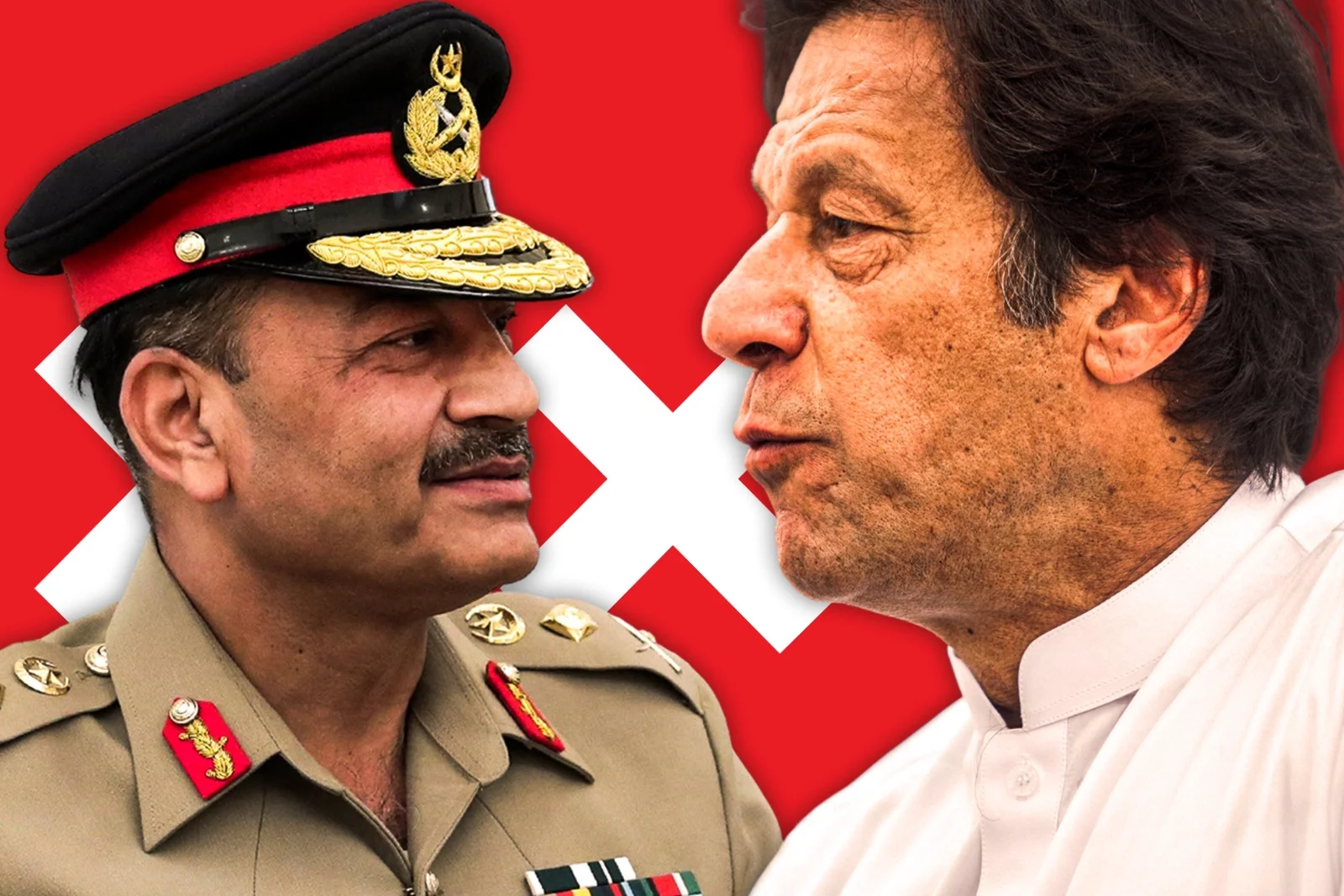
At one pole is General Asim Munir, a quiet man of iron discipline who now commands not just the military but, arguably, the country itself. At the other is Imran Khan—former cricket hero, once a darling of the same establishment that now seeks to erase his legacy. Though imprisoned, Khan remains a defiant echo in the national conscience, reverberating through street protests, encrypted apps, and the undimmed loyalty of millions.
What’s unfolding is not the routine fall of a prime minister or the reassertion of military dominance. It is the cracking open of Pakistan’s so-called hybrid regime—a brittle construct where civilian facades exist to give cover to military command, and where democratic rituals serve to bless, but never challenge, the entrenched architecture of power.
The Rise and Unmaking of a Populist Prototype
Imran Khan’s original heresy wasn’t that he defied the generals, but that he mimicked their methods too well. Installed in 2018 through what many believe was a carefully engineered political project—complete with judicial interventions, media choreography, and threats whispered into rival ears—Khan was meant to be a modernizing mascot, an anti-corruption figurehead who would clean house without redrawing the blueprint. And for a time, he played the part. But power inevitably awakens ambition.
By 2021, Khan had grown bolder—questioning the military’s hold on foreign policy, challenging its reach into civilian governance, and, most provocatively, turning directly to the people over the generals’ heads. His ouster by a parliamentary vote of no confidence in April 2022 was the establishment’s attempt to reset the script. Instead, it ignited a firestorm.
Khan swiftly metamorphosed from head of government to symbol of resistance. Every televised arrest, every legal obstruction, every defaced PTI banner seemed only to deepen the rift between the rulers and the ruled. When the February 2024 election came, and despite having its leaders jailed and its party symbol stripped, PTI-backed independents still won a remarkable plurality—a democratic mutiny against a system that believed it could choreograph the people’s will like a press conference.
Asim Munir’s Pakistan
General Munir has responded with surgical intensity. Unlike predecessors who cloaked their power in civilian robes, Munir sees no need for such disguises. A product of military intelligence, groomed in the shadows and trained in internal control, he sees Khan not just as an irritant but as an existential threat to the Army’s supremacy in national life.
Thousands of PTI workers have been detained. Military courts, operating behind veils of secrecy, have prosecuted civilians with dubious legal rationale. The judiciary—once seen as a fragile safeguard of rights—has fractured. Some judges have yielded to pressure; others have resisted at great personal peril. Pakistan’s press, long beleaguered, now kneels—its dissenting voices silenced or driven into exile. What remains of civilian governance is performance theater—written, directed, and stage-managed by the military.
Munir isn’t chasing public approval. His goal is absolute control: order restored, dissent quelled, hierarchy reaffirmed. Yet his greatest challenge may not be Khan at all. It is that the system itself—the myth that held Pakistan’s political duality together—is crumbling. Where once there was an illusion, now there is disillusionment: a public that no longer believes, and an Army unwilling to surrender its grip.
A House of Mirrors
This isn’t just a political crisis. It is an existential reckoning. The economy lurches from crisis to crisis—its currency battered, its IMF lifelines fraying, its citizens suffocating under the weight of inflation and despair. Yet, paradoxically, this is the most politically attuned generation in Pakistan’s history: smartphone-literate, social media-savvy, and acutely aware that electoral participation does not equal democratic power.
This generation’s bond with Khan isn’t rooted in naive hero worship. It stems from something more dangerous to the old order: a belief that he represents the first serious threat to the postcolonial consensus—a man from within who dared to break the rules of the game.
Pakistan’s tragedy lies in this brutal irony: a nation founded on democratic ideals has become the hostage of a military that claims to defend it, even from its own people. Jinnah’s vision of a modern Muslim democracy has been eclipsed by khaki paternalism and constitutional theater.
Nor is Pakistan alone in this choreography of democratic illusion. Across the Global South, elected governments navigate uneasy truces with unelected guardians. But few countries matter as much. With more people than Russia, a nuclear arsenal, and a precarious position amid India, China, Iran, and Afghanistan, Pakistan’s descent is not a regional affair—it is a global risk.
Toward a Reckoning
Three outcomes now seem possible.
The first is authoritarian consolidation: a hardened regime, stripped of real opposition, yet veiled in procedural legitimacy. It is a path Pakistan knows well. And it is unsustainable.
The second is a negotiated truce—a fragile bargain in which Khan or his proxies are allowed to reenter politics under heavy constraints, preserving both the military’s pride and the public’s demand for voice. It is the least destructive path, but it requires political courage and external pressure.
The third is collapse: intensified fragmentation, judicial implosion, even fissures within the Army itself. What was once unthinkable has become imaginable.
Who Owns the Republic?
This moment is not just about two men, though their rivalry provides its most compelling theater. It is about a nation that has never fully been allowed to be a republic. The Pakistani Army has long cast itself as guardian of the state. But what if it is also the barrier to the nation’s evolution?
For all his contradictions and imperfections, Khan has forced the country to confront this question. He may not be the solution—but he has demanded the reckoning.
In the tense quiet between state power and street defiance, Pakistan stands suspended on a razor’s edge. The world—so often content to look away—must now bear witness. For what happens when a nation built in khaki is asked, finally, to serve those in plain clothes?