Golda Vynogradska on How Ukraine’s Fashion Industry Adapted to War
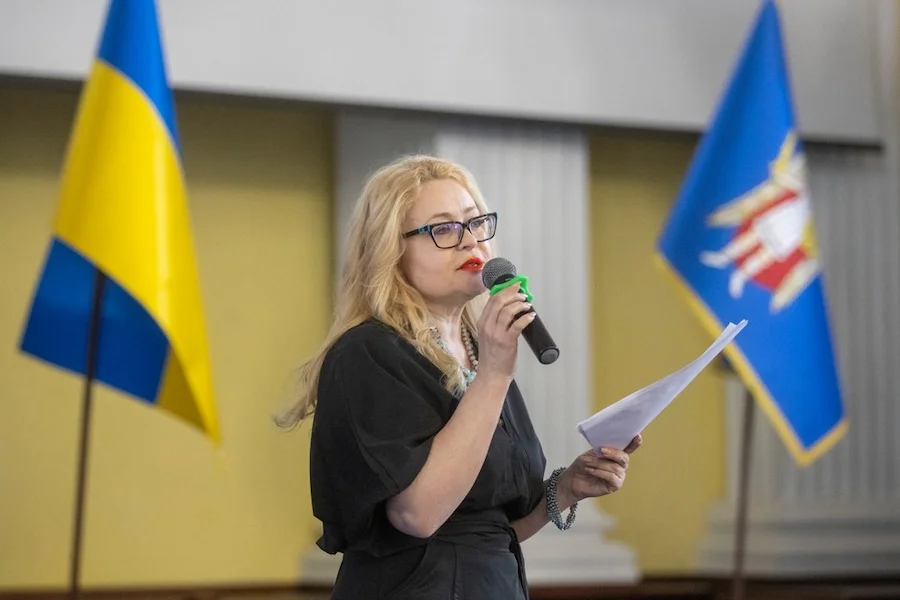
Golda Vynogradska is a Ukrainian fashion designer, founder of Fashion Globus Ukraine, head of the National Sectoral Partnership in Ukraine’s Light Industry, vice president of the Confederation of Designers and Stylists of Ukraine, and a postgraduate researcher at the Institute of Vocational Education of the National Academy of Educational Sciences of Ukraine. Her work spans fashion design, industrial development, education, cultural diplomacy, public advocacy, and international representation, making her one of the leading voices on the future of Ukraine’s fashion and manufacturing sectors.
Scott Douglas Jacobsen interviews Golda Vynogradska about how Ukraine’s fashion and light industries adapted to wartime through factory relocations, workforce displacement, military production, supply chain innovation, and remarkable manufacturing flexibility. Vynogradska argues that Ukrainian producers demonstrated speed, quality, and competitiveness that surprised international partners despite operating under the constant threat of bombardment. She also contends that corruption, weak industrial policy, and years of economic mismanagement continue to constrain the country’s broader technological and manufacturing potential. Ultimately, she presents the resilience of Ukraine’s fashion industry as part of a larger story about national ingenuity, economic renewal, and the country’s determination to shape its own future during and after the war.
The interview was slightly edited for clarity and length.
Scott Douglas Jacobsen: The war has fundamentally altered the way industries operate, including fashion. Under normal circumstances, a garment might be designed with sustainability in mind, produced in one country, sold in another, and eventually recycled or reused as part of a circular economy. Other products follow a more conventional path of mass production and disposal. How has that production cycle changed in Ukraine since the war began? Where do manufacturers source their materials, how are goods produced, and how do they reach domestic and international markets?
Golda Vynogradska: What has really changed is the location of our producers. Many manufacturers from eastern Ukraine relocated to other parts of the country. They moved their production facilities because it was the only way to survive. That is the reality.
Jacobsen: Beyond relocating factories, how did the war affect the people who work in the industry? Were workers displaced along with production?
Vynogradska: Yes, the workers relocated as well.
When we talk about change, I remember the moment when everyone tried to produce something for our army because it was urgently needed. Almost every family had relatives going to the front. We had to provide them with proper uniforms and equipment, and producers across the country looked for solutions.
There was a period when it was difficult to find zippers, fasteners, and other accessories. Very quickly, however, some Ukrainian companies began producing them themselves. We still have domestic companies manufacturing fabric—up to one million metres per year—here in Ukraine.
One example really demonstrates how flexible we became. After the war in Israel began, we received an inquiry from the Israeli Ministry of Defence. They needed military uniforms.
Israel produces relatively little in the textile sector, focusing instead on technology and innovation. Their challenge was finding a manufacturer capable of producing uniforms quickly while meeting very precise specifications.
I shared the request with contacts in India, China, and Pakistan. What surprised everyone was that Ukraine produced a better result in just three weeks. The quality was higher, the turnaround was faster, and the price was more competitive.
We were even prepared to manufacture 300,000 uniforms within a few months. Through our association, we divided the work among companies willing to participate. Unfortunately, due to internal issues in Israel, the tender process was never completed, and we did not receive the contract.
Still, they were genuinely surprised that a country under constant bombardment could outperform much larger textile producers such as Pakistan, India, and China. For me, that demonstrates Ukraine’s technology, speed, professionalism, and ability to adapt.
Jacobsen: Ukraine’s wartime innovation has extended well beyond fashion. We’ve seen similar examples in the country’s rapidly evolving drone industry, where necessity has accelerated technological development despite the pressures of fighting a war. Do you see Ukraine’s fashion and manufacturing sectors as part of that same story of innovation and adaptation?
Vynogradska: Yes, and it reflects a broader reality in Ukraine.
When our country needs drones or weapons, we cannot simply wait for other countries to help us. We have to find solutions ourselves. Many companies began developing new technologies on their own. Nobody was helping them.
Now that these innovations can be exported, however, the government wants to control who can sell them. I do not understand that approach. If a company invested its own money in research, development, and production, it should have the right to decide where it sells its products.
If I were in that position, I would create the conditions for these companies to succeed. Our entire economy should be aligned with the country’s defence needs. If every company specialized in producing one part of the supply chain rather than relying on imports from China, Ukraine could become one of the world’s strongest military manufacturing clusters.
The problem is that the government does not adequately support these businesses. Instead, we continually hear about corruption scandals. This reflects a broader reality in Ukraine. Many people are trying to build something not only for their companies or their families but for their country.
We survive under very unfair conditions. Yet this is not only about weapons. Ukraine has a strong technological foundation and exceptionally talented people. We could become a technology hub across sectors such as agriculture, manufacturing, and industry.
Unfortunately, for many years, successive governments failed to develop that potential. There was no long-term strategy to support the domestic industry or build on the capabilities Ukraine inherited after the Soviet period.
If you look at the large factories in Dnipro, much of their specialized equipment has been dismantled and sold for scrap. Engineers from Dnipro told me they were ordered during the Yanukovych government to destroy equipment worth millions of dollars. I asked them why they had not hidden it instead. It was too valuable simply to destroy.
Ukraine is a country of enormous potential, but it also faces enormous challenges.
What continues to make us strong is our determination to survive and improve. Competition is intense—even in drone manufacturing, there are now hundreds of producers. I know many of these people because I volunteer with frontline units and suppliers.
They invest their own money, believe in their products, and constantly improve them. That gives Ukraine a genuine opportunity to become one of the world’s technological leaders.
That is why I say this is not only about fashion. It applies to many sectors of our economy. Unfortunately, these are exactly the people who receive the least support from the state.
Jacobsen: Thank you very much for the opportunity and your time, Golda.