How Romanians View Ukraine, Russia, and Wartime Aid
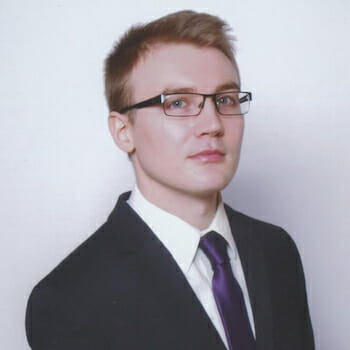
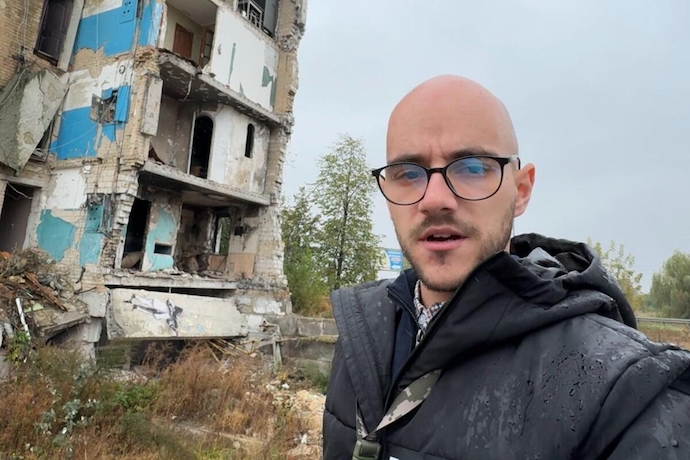
Alex Craiu is a Romanian war correspondent based in Ukraine, reporting from both the frontline and the rear areas for international audiences. Trained in documentary and cinematography production, he studied in the United Kingdom and the United States before turning to independent journalism. Craiu produces short-form video reporting for social platforms alongside written analysis, bringing a visually grounded perspective to the war’s human and political dimensions.
He completed an internship with the BBC in London in 2017 and expanded his field reporting during Russia’s full-scale invasion of Ukraine. His work has appeared in outlets including Veridica and In-Sight Publishing, with a focus on civilian life, information warfare, battlefield realities, and the humanitarian consequences of sustained conflict.
In this interview, Scott Douglas Jacobsen speaks with Craiu about Ukraine’s political trajectory under martial law and Romania’s evolving—and increasingly fractured—response to the war. Craiu argues that discussions of elections in Ukraine function less as an imminent plan than as a signal of democratic continuity under extreme conditions. Even so, he suggests that any leadership change would be unlikely to alter the country’s core strategic direction.
Turning to Romania, Craiu examines polling that shows both majority support for Ukraine and growing skepticism about continued aid. He critiques the rise of “Romania-first” sovereignty narratives and contends that documented Russian drone incursions into Romanian territory complicate claims that supporting Ukraine undermines national sovereignty.
 Scott Douglas Jacobsen: Politically, how has Ukraine evolved, if at all, under wartime conditions? The country remains governed under martial law, which precludes national elections, while its media landscape continues to operate under significant pressure—from security risks to economic strain and legal constraints. Although Ukraine has made incremental progress on anti-corruption by international measures, structural challenges persist.
Against this backdrop, how should we understand the broader political picture? There have been recurring discussions about the possibility of elections—what do these signals mean in a wartime context? How might questions of leadership, party representation, and public sentiment shape any future vote? And more generally, what is your assessment of Ukraine’s political trajectory at this stage of the war?
Alex Craiu: When Ukraine discusses the possibility of holding elections, it signals democratic intent under extreme conditions. Legally and practically, however, elections are suspended under martial law. It is more of a political statement than an immediate operational plan. Even if there were a change in leadership, the core ideological orientation—resistance to Russian aggression and alignment with the West—would likely remain.
From conversations with people last summer and autumn following corruption scandals, many expressed frustration with governance but did not articulate a fundamental shift in strategic direction. Some indicated that if leadership were to change, they would want a president who is firmer against Russia and more effective in advancing Ukraine’s position on the front line. I do not see a deep misalignment between the current administration’s ideological orientation and the broader public will. The message is that Ukraine would organize elections if doing so were feasible and beneficial.
Jacobsen: From a Romanian perspective, how are different political currents—whether broadly pro-Ukrainian, more skeptical, or influenced by pro-Russian narratives—currently positioning themselves? How are these orientations reflected across parties and in public opinion, particularly as the war continues to shape domestic debates about security, economic stability, and Romania’s role within NATO and the European Union?
Craiu: Romania shares a significant border with Ukraine and has been directly affected by the war’s spillover effects. Political positioning in Romania reflects domestic concerns about security, economic stability, and regional geopolitics, with varying degrees of support for Ukraine across parties, though mainstream political forces have largely supported Romania’s alignment with NATO and the European Union.
Given that other Ukrainian allies have donated hundreds of generators, we should consider how Ukraine’s southern neighbour views the situation. If we look at polling data, a majority—around 53 percent—believe that Vladimir Putin is responsible for the war in Ukraine and that Russia should withdraw unconditionally. At the same time, roughly two-thirds of respondents believe that Ukraine will ultimately be forced to make territorial concessions to Russia. Officially, polling suggests a majority aligns with the Ukrainian cause. However, Romania is politically divided.
Even if the current presidential administration aligns with the broader European position of supporting Ukraine, segments of the population have shown wariness. Russian propaganda has had some impact. I have observed an increasing number of people adopting narratives that blame NATO for what they call the “Ukrainian crisis,” echoing Russian terminology, rather than describing it as a full-scale invasion and war.
Support for additional aid to Ukraine appears limited. One recurring narrative suggests that any Romanian assistance would draw the country closer to direct conflict with Russia, framing support as equivalent to a declaration of war. This fear-based messaging has been a consistent tactic of Russian information campaigns.
I have seen similar reactions on social media, particularly in response to content discussing the assistance Ukraine has received. Increasingly, some argue that Romania should reduce its support. This discussion is especially salient given broader international shifts in aid levels.
In terms of figures, estimates from international trackers indicate that Romania’s total committed support to Ukraine is a relatively small share of its GDP—well below the levels of the Baltic states, which rank among the highest per capita and GDP-based contributors to Ukraine.
We are looking at Baltic states allocating figures in the range of 3 to 4 percent of GDP to support Ukraine. Romania has allocated significantly less as a share of GDP. One conclusion is that Romania is not among the leading countries in terms of proportional support to Ukraine. At the same time, there is vocal public dissatisfaction about providing further assistance.
In Central and Eastern Europe, one narrative that has gained traction over the past 12 to 15 months revolves around a reassertion of “sovereignty,” often framed in a Romania-first context. The argument is that prioritizing support for Ukraine comes at the expense of Romanian citizens and domestic needs. It promotes the idea that Romania should focus inward and disengage from external causes, including the war in Ukraine.
I consider this a misuse of the concept of sovereignty. If we examine which party between Ukraine and Russia has violated Romanian sovereignty, the record points to Russia. There have been confirmed incidents in which debris from Russian military drones, including Shahed-type drones used in strikes against Ukraine’s Danube port infrastructure, landed on Romanian territory in 2023 and 2024. Romanian authorities acknowledged several such cases along the Danube near the Ukrainian border.
There have also been reports and investigations into airspace violations and the discovery of drone fragments on Romanian soil. However, Romanian authorities have at times limited public disclosure, citing security and classification concerns. As a journalist, I have filed official requests to the Ministry of Defence regarding earlier drone incidents, including one in 2022. Years later, detailed findings have not been publicly released, and some information has been classified.
We see repeated incidents involving Russian military activity near or affecting Romanian territory, alongside limited transparency. In that context, if sovereignty is the principle at stake, the actor that has directly violated Romanian airspace and territorial integrity is Russia.
Jacobsen: Thank you very much for the opportunity and your time, Alex.