
Is the Ivory Flowing in Kenya Again?
It was, at first glance, a routine seizure—almost mundane in the grim arithmetic of the ivory trade. In the mid-afternoon of March 28, investigators from the Kenya Wildlife Service (KWS) arrested Nyamawi Rwanda Kulemba in the Lunga Lunga area as he transported four elephant tusks on the carrier of a Haojin motorcycle. The haul—39 kilogrammes—was modest by trafficking standards. Motorcycles, after all, are a favored method for moving loads of up to 90 kilograms, particularly along the rough back roads that cut through rural Kenya.
What made this seizure noteworthy was not its size, but its location. Lunga Lunga, a coastal border town along the Indian Ocean, sits astride the main highway linking Kenya with Tanzania and connecting Mombasa to Dar es Salaam. In recent years, ivory-related arrests in this corridor have become less an anomaly than a pattern.
Consider the recent past. In August 2025, KWS arrested three men in Lunga Lunga attempting to sell six pieces of ivory weighing 7 kilograms. They had traveled from Samburu County in north-central Kenya in search of a buyer. In January 2025, suspects in the same area fled arrest, abandoning 15 pieces of ivory weighing 106 kilograms along with a Tanzanian-registered motorcycle. They were never apprehended. The pattern repeats: in October 2024, two men were arrested transporting 58 kilograms of ivory—again by motorcycle.
The trail stretches further back. In January 2024, two women were arrested 30 kilometers east of Lunga Lunga with 112 kilograms of ivory in a van registered to a police officer. In November 2023, three men were arrested in Lunga Lunga attempting to sell 59.2 kilograms to an undercover buyer.
Lunga Lunga is not alone. Migori, in Kenya’s southwest corner, roughly 25 kilometers north of the Sirari/Isbania border crossing with Tanzania, has also seen a steady uptick in activity. In December 2025, two Tanzanian nationals were arrested there with 16 kilograms of ivory. Four months earlier, authorities recorded at least two seizures in the same area: one involving a foreign national carrying 19 tusk pieces, and another involving two men with 28 kilograms. In November 2024, three men—including a Tanzanian national—were arrested transporting 30 kilograms in a vehicle.
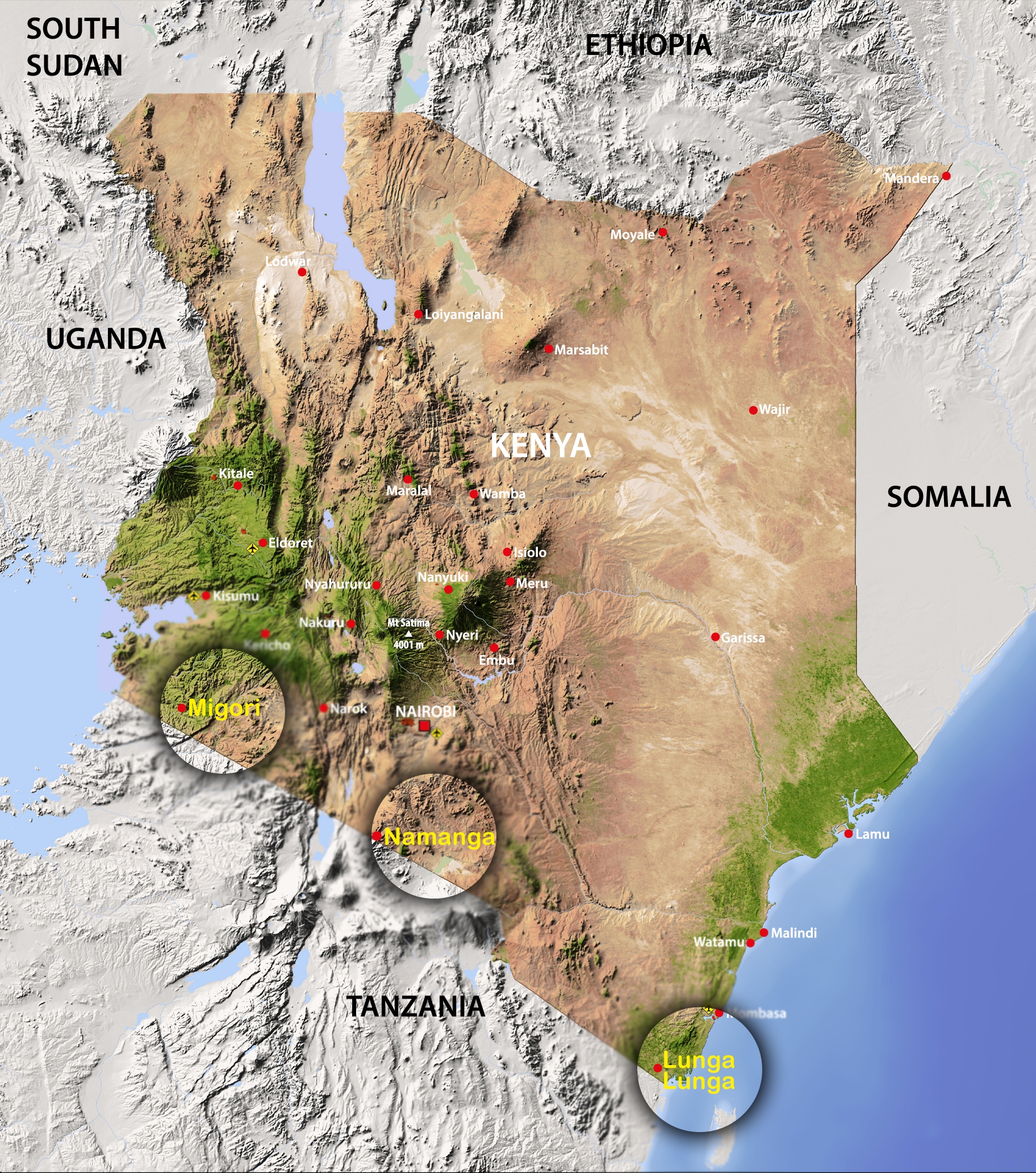
Perhaps the most revealing case unfolded near the Namanga border crossing, a critical artery between Nairobi and Arusha and geographically positioned between Lunga Lunga and Migori. On January 24, authorities arrested two Tanzanians at a hotel near the crossing. A subsequent search of their two Tanzanian-registered vehicles uncovered 110 kilograms of ivory and a weighing machine—a detail that suggested something more organized than opportunistic trafficking. The presence of KWS Deputy Director of Security Nancy Kabete at the ensuing press conference underscored the seizure’s importance; such appearances are rare.
Authorities indicated that the ivory likely originated in Malawi, with links to Zambia. DNA analysis has been proposed to confirm this. What remains conspicuously absent from official statements, however, is any serious discussion of destination. The standard refrain—that traffickers were “looking for buyers”—offers little insight into the broader networks at play.
Yet there are hints. In November 2024, just north of Mombasa, KWS and local police arrested two Tanzanian nationals, Paulo Kuya Moson and Paulo Telek Lazier, with 11 pieces of ivory weighing 32.9 kilograms. They had entered Kenya through the Namanga border crossing. The connective tissue between inland seizures and coastal exit points is difficult to ignore.
Foreign nationals, particularly Tanzanians, appear frequently in these arrests, though they are not alone. In August 2025, two Burundian nationals—Gakiza Sulemani and Nkunubumwe Celecius—were arrested in Mombasa with 27 pieces of ivory weighing 62.8 kilograms.
What is missing is a comprehensive national picture. Kenya does not publicly release countrywide ivory seizure statistics, and like many wildlife enforcement agencies across Africa, KWS guards such data closely. Still, a two-year wildlife crime court-monitoring initiative offers some perspective. In 2023, at least 2,037.17 kilograms of ivory were seized across 71 incidents. In 2024, that figure dropped to 1,521.80 kilograms across 45 incidents. The apparent decline—515 kilograms—may reflect not a reduction in trafficking but diminished court attendance and funding constraints.
What these figures cannot reveal is origin. The ivory could have come from poached elephants within Kenya, from natural deaths, or from outside the country altogether.
And yet, the pattern along Kenya’s borders points toward a troubling conclusion. Ivory is flowing through Kenya again. The country appears once more to be functioning as a conduit—a point of egress for transnational criminal organizations exporting African ivory to markets in Southeast Asia. It would be naïve to assume that Kenyan elephants are not part of that pipeline.
The seizures themselves are small, almost deceptively so. But this is how modern trafficking operates. These are not isolated transactions; they are fragments of a larger system. Transnational networks consolidate such “deliveries” at staging points near ports of exit. The 7 kilograms from Samburu, the 110 kilograms tied to Malawi, the 106 kilograms from Tanzania—all are likely destined for accumulation, waiting to be bundled into shipments large enough to attract buyers in China or Vietnam.
History offers precedent. In 2015, Abdulrahman Mahmoud Sheikh and associates amassed a stockpile of 7.8 tonnes of ivory in Nyali, a suburb of Mombasa, before the consignment was intercepted in Thailand and Singapore.
Routes, too, appear to be evolving. A 2024 analysis suggested that Mombasa’s port—long the primary exit point—might no longer be the preferred channel. Instead, traffickers could be using smaller, less conspicuous ports: Malindi, Lunga Lunga, and Lamu, moving ivory by fishing boats to Somalia and onward to Southeast Asia’s black markets. Shimoni, a modest fishing port less than an hour’s drive from Lunga Lunga, emerges as a plausible candidate for consolidation or departure.
Still, Mombasa cannot be dismissed. However much officials tout improvements in port security, no regulatory system is immune to corruption. Past major seizures linked to Mombasa have repeatedly implicated insiders within the Kenya Revenue Agency and the Kenya Ports Authority.
This raises the central question: do Kenyan authorities possess the capacity—and the will—to disrupt these networks before the ivory leaves the country?
The answer is complicated. On one hand, KWS, the Directorate of Criminal Investigations, and local police continue to make a steady number of arrests and seizures. Notably, there has been no major ivory seizure linked to Kenya since December 2016, which could be read as a sign of effective enforcement.
On the other hand, most seizures remain small, typically under 100 kilograms. Kenya has not recorded a major seizure—defined as over 500 kilograms—since the 2,152-kilogram Feisal case in June 2014, itself mired in allegations of corruption. The last major seizure by KWS occurred even earlier, in June 2012, when 601 kilograms were intercepted at Jomo Kenyatta International Airport en route to Nigeria.
It is a striking paradox. In an era of intelligence-led policing—where investigators can track small transactions in rural hotels or intercept motorcycles on remote county roads—authorities have yet to uncover a single consolidation point or intercept a shipment exceeding 250 kilograms in more than a decade.
The implications are difficult to avoid. Kenya’s public posture—embodied in campaigns like “Hands Off Our Elephants”—suggests a nation committed to ending the ivory trade. Yet the consistent failure to prosecute significant trafficking cases, especially those involving transnational networks, points to deeper structural problems. The repeated subversion of cases presents a strong circumstantial case that high-level state actors are complicit in the illegal trade and trafficking of ivory and rhino horn.
The prognosis is bleak. The flow of ivory is unlikely to be halted through systematic enforcement alone. More likely, it will take an accident—a chance discovery, a seizure born of coincidence rather than design.
There may well be investigators within KWS, the Directorate of Criminal Investigations, the Lusaka Agreement Task Force, or the National Intelligence Service who know where the ivory is being stockpiled, and through which ports it is leaving. But in such an environment, silence can be a form of self-preservation. Transfers, dismissals, or worse remain ever-present risks.
And so the trade continues, moving quietly along Kenya’s borders, in increments small enough to escape notice—until, perhaps, it doesn’t.