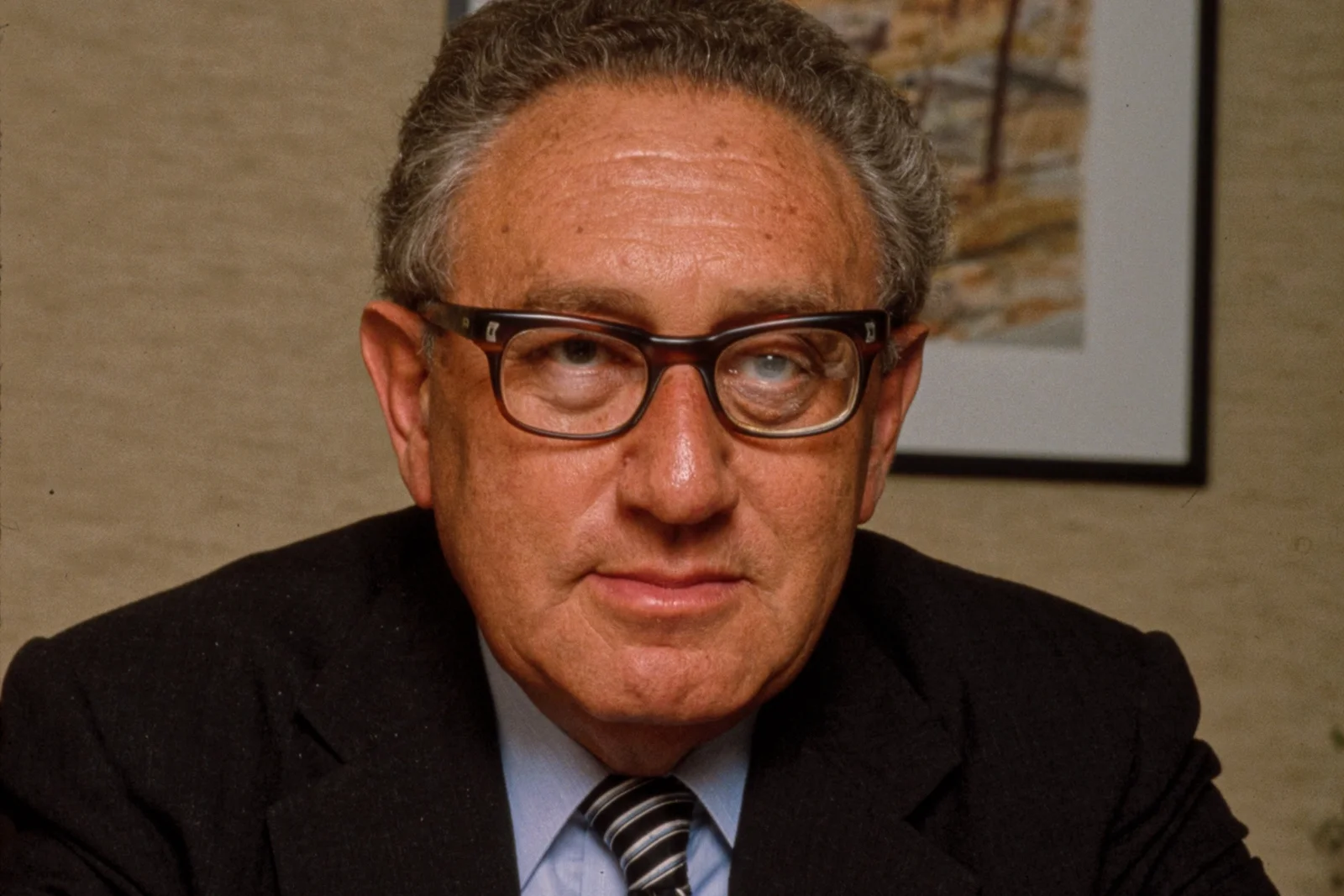

Kissinger’s Playbook for an Unstable East Asia
As the Shanghai Cooperation Organization (SCO) tightens its cohesion under Chinese and Russian leadership, East Asia is slipping back into the logic of bloc politics. The U.S., Japan, and South Korea have responded by building a trilateral framework designed to deter aggression and stabilize the region. Left unchecked, however, that framework risks hardening into a mirror image of the very alignment it is meant to balance. If Henry Kissinger were advising today’s leaders, he would likely argue that a fragmented region cannot be managed through ideology or neat symmetry alone. He would urge them instead to pursue equilibrium through realism, flexibility, and sustained diplomacy rather than by simply reacting to events.
One of Kissinger’s central insights during the Cold War was that stability rests not on the dominance of a single bloc but on a fluid balance among competing powers. In the 1970s, he deployed “triangular diplomacy” to exploit the rift between Moscow and Beijing, creating strategic room for the U.S. In contemporary East Asia, that geometry has inverted. China and Russia are drawing closer, while the U.S. and its allies are trying to hold a defensive line.
Kissinger would likely caution against treating the SCO as a monolith. He would see fault lines running through it: the gap between Moscow’s hunt for an economic lifeline and Beijing’s hierarchical ambitions, and the tension between Central Asian states’ desire for autonomy and China’s expanding influence. For Washington, Tokyo, and Seoul, the challenge is whether they can exploit these internal contradictions through deft policy rather than deepen them through reflexive overreaction.
Kissinger believed that diplomacy’s first task is to prevent catastrophe, not to reward virtue. From that vantage point, he would probably encourage the democratic trilateral to sustain disciplined engagement with Beijing and Moscow even as they strengthen deterrence. Building a robust summit architecture is essential, but it should be complemented by quiet bilateral channels. Japan’s ability to leverage pragmatic economic ties with China and South Korea’s latitude to maintain selective contacts with Moscow could help manage tensions as U.S.–China rivalry hardens into an ideological confrontation.
At the same time, Kissinger would likely insist on credible deterrent capabilities while warning against turning them into theater. He might argue for closer command-and-control integration, joint undersea surveillance, enhanced missile defense, and tighter coordination across the Sea of Japan and the Korea Strait. Yet he would insist these arrangements remain transparently defensive. In his logic, deterrence without restraint easily drifts into coercion. Signaling intent is as important as showcasing capability. Reframing trilateral exercises as “stability operations”—centered on protecting sea lines of communication, disaster response, and air-sea crisis management—would underscore that the goal is preserving stability rather than rehearsing confrontation. By pairing readiness with restraint, the three democracies could reduce the risk that their own actions accelerate the very bloc formation they are trying to contain.
Kissinger warned repeatedly about the widening gap between an integrated global economy and a world still governed by nation-states. Applied to East Asia today, he would almost certainly urge the trilateral partners to turn their combined technological strength into a strategic asset. A shared consortium on semiconductors, quantum computing, and rare-earth processing could alter the regional balance of power more effectively than another destroyer group. Over time, those who set the standards for critical technologies will also shape the limits of coercion.
Yet Kissinger would also resist calls for full-scale economic decoupling from China and Russia. He would favor a selective interdependence approach, in which economic ties serve as leverage rather than sources of vulnerability. Maintaining limited commercial links preserves channels for communication, influence, and intelligence. For Japan and South Korea, both heavily reliant on Chinese energy and trade, such an approach is not idealism but hardheaded realism: the aim is to structure competition, not to retreat into self-imposed isolation.
In Kissinger’s worldview, inclusivity is not an act of charity but a tool of control. He would likely see the 2023 Camp David framework not as an endpoint but as a hub from which concentric circles of engagement extend outward. The more exclusive an alliance becomes, the more it invites counter-coalitions.
A second concentric circle—an Indo-Pacific resilience forum—could bring together Australia, India, and key ASEAN states to address specific issues such as maritime security, supply-chain resilience, and crisis communication. A third, more delicate circle would focus on keeping minimal communication channels open with Russia and preventing its complete subordination to China.
Such a layered structure could help recast the trilateral from a counter-bloc into a regional mediator. By cultivating ties in multiple directions, Washington, Tokyo, and Seoul would preserve the capacity to loosen rival alignments from within, a method Kissinger honed in dealing with both Mao and Brezhnev.
What would most alarm him, however, is the prospect of simultaneous crises in the Taiwan Strait and on the Korean Peninsula. The impulse to fight on two fronts at once would strain allied capabilities and heighten the risk of uncontrolled escalation. Kissinger’s advice would likely be to design integrated but differentiated plans: the U.S. and Japan focusing on maritime blockades, sea-lane security, and protection of key nodes, while South Korea assumes primary responsibility for defending the peninsula and providing rear-area support. Crisis-management mechanisms—clear rules of engagement, de-escalation hotlines, and pre-arranged intelligence-sharing protocols for gray-zone scenarios—would need to be drilled regularly. For Kissinger, strategy is not only about winning but also about containing disaster when events begin to spin out of control.
To follow Kissinger’s strategic logic today is not to revive détente but to apply his hierarchy of priorities: equilibrium over ideological purity, dialogue over moral grandstanding, stability over triumphalism. The SCO’s unity is real but fragile; the U.S.–Japan–South Korea alignment is strong but politically sensitive at home and abroad. The essence of Kissinger’s statecraft lies in turning such vulnerabilities into sources of strength by managing, and at times exploiting, the internal tensions of both adversaries and allies.
If Washington, Tokyo, and Seoul hope to honor that legacy, they should resist the urge to build an Asian NATO and judge their success by organizational symmetry. Instead, they should treat their partnership as a mechanism for institutionalized flexibility: coordinated enough to deter aggression, but calibrated so as not to lock the region permanently into opposing camps. That means deepening military interoperability while preserving diplomatic options, integrating economic statecraft into security planning, and preparing for crises without surrendering national discretion.
In his final years, Kissinger warned that great-power relations were drifting toward self-fulfilling confrontation. He argued that the mark of statesmanship is the ability to preserve equilibrium in a world where moral crusades can be destabilizing. His advice for East Asia would echo his counsel to Richard Nixon in the 1970s: the U.S. should aim to shape events rather than endure them.
For today’s trilateral partners, that means seeing their cooperation not as an ideological wall but as a platform for practicing diplomacy backed by strength. If they can reconcile deterrence with prudence, power with restraint, and institutional consolidation with strategic flexibility, they will not merely react to the SCO’s rise; they will help manage it. That is the essence of the Kissingerian craft of strategy: to endure and adapt among rivals, rather than seek to vanquish them outright.