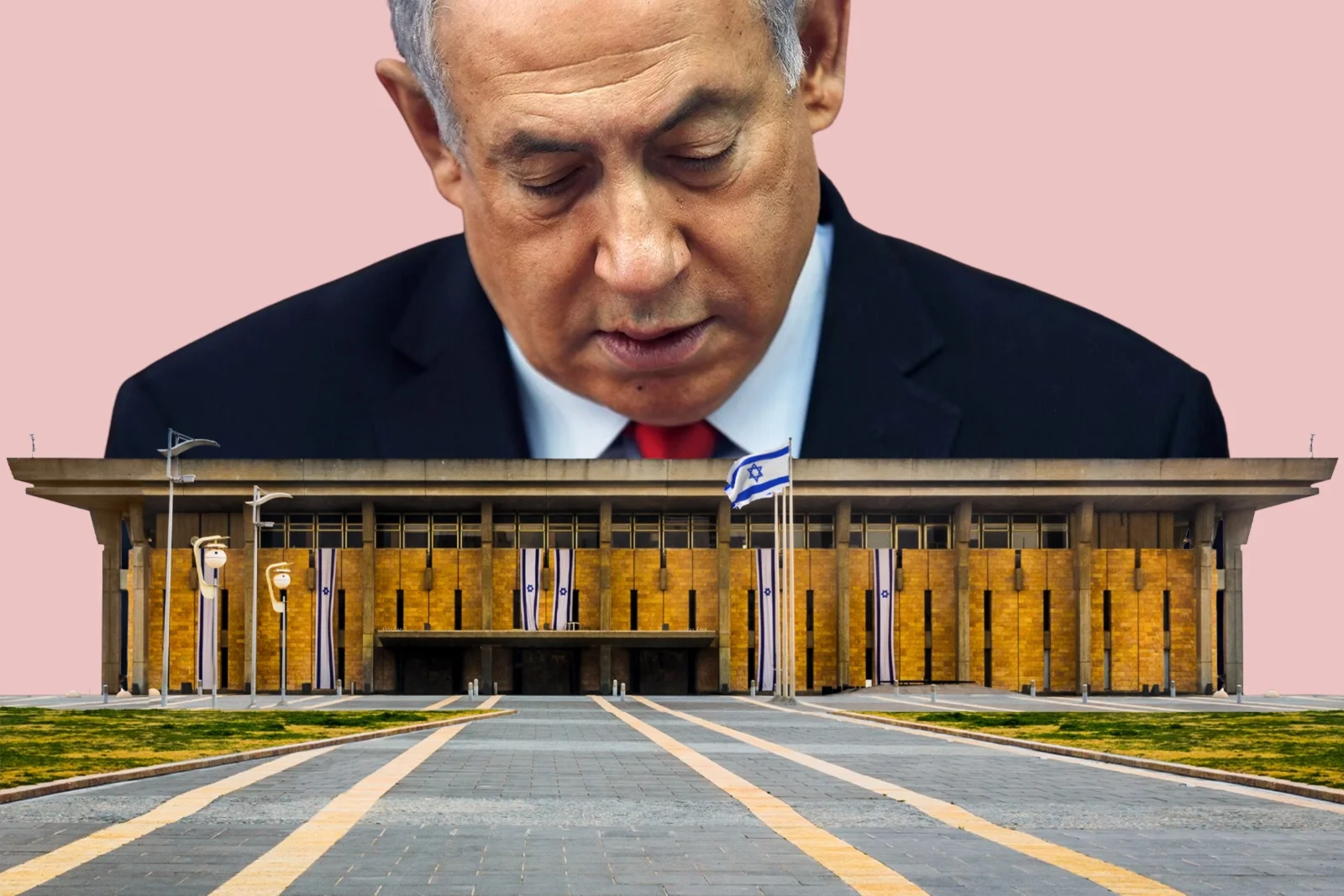

The Knesset Revolt Netanyahu Couldn’t Prevent
Israeli Prime Minister Benjamin Netanyahu has long asked the public to accept political instability in exchange for security. For years, that bargain formed the foundation of his appeal. Yet the latest crisis surrounding the Knesset suggests the arrangement is beginning to unravel. The attempt to dissolve parliament feels less like a calculated maneuver and more like evidence that the machinery of government is struggling to function. Rather than reinforcing Netanyahu’s authority, the war that has dominated Israeli politics is increasingly exposing the vulnerabilities within his coalition.
Even if the parliamentary procedure itself is familiar, the outcome remains remarkable. An 110–0 vote reflects an almost complete absence of resistance, an unusual spectacle in one of the world’s most contentious and fragmented political systems. Reuters and Al Jazeera have focused on the procedural dimensions of the vote, but the larger story lies in what the result reveals. A coalition that once appeared resilient through repeated crises now looks increasingly incapable of holding itself together.
The immediate trigger was the long-running dispute over military service exemptions for ultra-Orthodox communities, a controversy that has simmered for years but has acquired new urgency during wartime. What was once treated as a politically manageable compromise has evolved into a profound test of national cohesion. In a country carrying the immense burden of an extended conflict, the perception that some citizens are exempt from obligations borne by others has become politically combustible.
This is not merely a disagreement over legislation or coalition arithmetic. It is a dispute that strikes at the heart of the social contract. Wartime inevitably raises questions about shared sacrifice, civic responsibility, and fairness. For many Israelis serving in reserve units, as well as for their families, the continuation of longstanding exemptions appears increasingly difficult to justify. What once functioned as a pragmatic political arrangement is now viewed by many as a symbol of inequality.
Netanyahu has spent much of his political career navigating precisely these kinds of contradictions. His success has often rested on his ability to reconcile competing constituencies through carefully negotiated bargains. Yet the war has altered the political environment. Agreements that once ensured stability are increasingly being perceived as liabilities. The very transactional relationships that sustained his governments now risk undermining them.
That is why the crisis feels larger than a routine coalition dispute. The debate over military service has become a moral and political fault line running through Israeli society. Secular Israelis, reservists, and many center-right voters increasingly question whether a wartime government can continue defending a system that distributes obligations so unevenly. Previous Reuters reporting noted that budget battles and disputes over conscription repeatedly strained the wartime coalition, exposing the fragile compromises that kept Netanyahu’s governing alliance intact.
Those compromises are now buckling under pressure. The significance of the moment is not simply that Netanyahu faces another difficult parliamentary vote. Rather, it is that war, which has often functioned as the ultimate shield for his political survival, is beginning to produce the opposite effect. Instead of muting domestic disagreements, the conflict has intensified them.
Earlier Reuters reporting suggested Netanyahu could struggle in a future election and noted that even the prospect of parliamentary dissolution had already destabilized the coalition before the latest confrontation. The lesson is difficult to ignore. The war did not suspend political debate. It amplified existing grievances and deepened old divisions.
That outcome should not surprise anyone who has followed Israeli politics over the past several years. Wars can generate moments of national unity, but they also subject leaders to extraordinary scrutiny. As conflicts drag on, the burdens multiply. Reserve service becomes more demanding. Economic pressures intensify. Social divisions deepen. International criticism grows louder. Eventually, voters begin asking whether their leaders are guiding the country through a crisis or merely managing its consequences.
In that sense, Netanyahu’s long-standing reliance on a politics of permanent emergency may be approaching its limits. For years, security concerns have dominated Israeli public life, often pushing other questions to the margins. Accountability, institutional reform, and long-term governance frequently took a back seat to immediate threats. Yet a state cannot indefinitely define itself through crisis management alone.
The irony is increasingly difficult to miss. By repeatedly presenting himself as the indispensable leader capable of navigating existential threats, Netanyahu has often focused public attention outward. Yet the political deterioration now confronting his government is largely domestic. The challenge is no longer simply how Israel confronts its enemies. It is whether its governing institutions can withstand the pressures generated by years of polarization, political dependency, and unresolved internal disputes.
There is a broader lesson here about the limitations of governance built primarily around security concerns. A country can maintain military superiority, conduct military operations, and rely on strong international alliances while still struggling to sustain domestic legitimacy. Political stability ultimately depends on more than battlefield success. It requires public trust, functioning institutions, and a sense that sacrifices are being shared fairly across society.
Increasingly, Netanyahu’s critics argue that his government has transformed insecurity into a mechanism of political survival. Whether one accepts that characterization or not, it resonates because it captures a growing frustration among segments of the Israeli public. Many voters see little evidence of a coherent long-term strategy beyond managing the next crisis. Security policy, in this view, appears detached from any realistic pathway toward stability or political resolution.
That frustration extends beyond the immediate dispute over military exemptions. Critics increasingly portray the government not as a guardian of national strength but as an administration focused primarily on preserving its own survival. As the costs of the war continue to accumulate—in human lives, economic strain, diplomatic pressure, and social cohesion—the absence of a convincing vision for what comes next becomes more difficult to ignore.
The lack of a credible “day after” strategy has become a recurring theme in debates about Israel’s future. Governments can often withstand public frustration if citizens believe there is a larger plan guiding difficult decisions. What becomes harder to sustain is a sense of permanent sacrifice without a clearly articulated destination. A coalition unable to resolve the contradictions within its own ranks may struggle to persuade voters that it can successfully navigate the far more complex challenges of regional security and postwar reconstruction.
The international context only sharpens these concerns. Israel’s relationship with the United States remains a cornerstone of its security architecture, and American support continues to be enormously significant. Yet even the strongest alliance cannot substitute for domestic legitimacy. Foreign backing may strengthen a government’s strategic position, but it cannot resolve internal political grievances.
The more Israeli leaders rely on the language of existential threat, the greater the risk that ordinary frustrations become obscured rather than addressed. Questions about unequal military obligations, institutional trust, judicial disputes, economic pressures, and government competence do not disappear because security concerns dominate the headlines. If anything, prolonged conflict tends to magnify those issues rather than suppress them.
The parliamentary vote suggests that many Israelis are increasingly skeptical that the current arrangement can continue indefinitely. The debate is no longer confined to coalition negotiations or procedural maneuvering inside the Knesset. It has evolved into a broader argument about governance, accountability, and the future direction of the state.
Ultimately, any move toward dissolving the Knesset would represent more than a judgment on Netanyahu personally. It would also serve as a referendum on an era in which perpetual crisis often substituted for long-term political solutions. Netanyahu has repeatedly demonstrated extraordinary political instincts and a remarkable capacity for survival. Few leaders in Israeli history have navigated political turbulence as effectively.
Yet political endurance is not the same as political renewal. Even the most skilled tactician eventually confronts the accumulated consequences of his own governing model. If the coalition ultimately collapses, it may reflect not only dissatisfaction with one leader but also growing exhaustion with a security-first approach that many critics argue has ceased delivering either stability or security.
The clashes unfolding in the Knesset are therefore not separate from the war. They are, in many ways, a direct consequence of it. The crisis highlights a fundamental reality of democratic politics: even during periods of conflict, governments cannot indefinitely rely on fear, urgency, and emergency measures as substitutes for effective governance. Netanyahu was once widely viewed as the figure holding Israel’s competing forces together. Today, an increasing number of Israelis appear to be asking whether the same leadership that promised stability has instead become a source of instability itself.