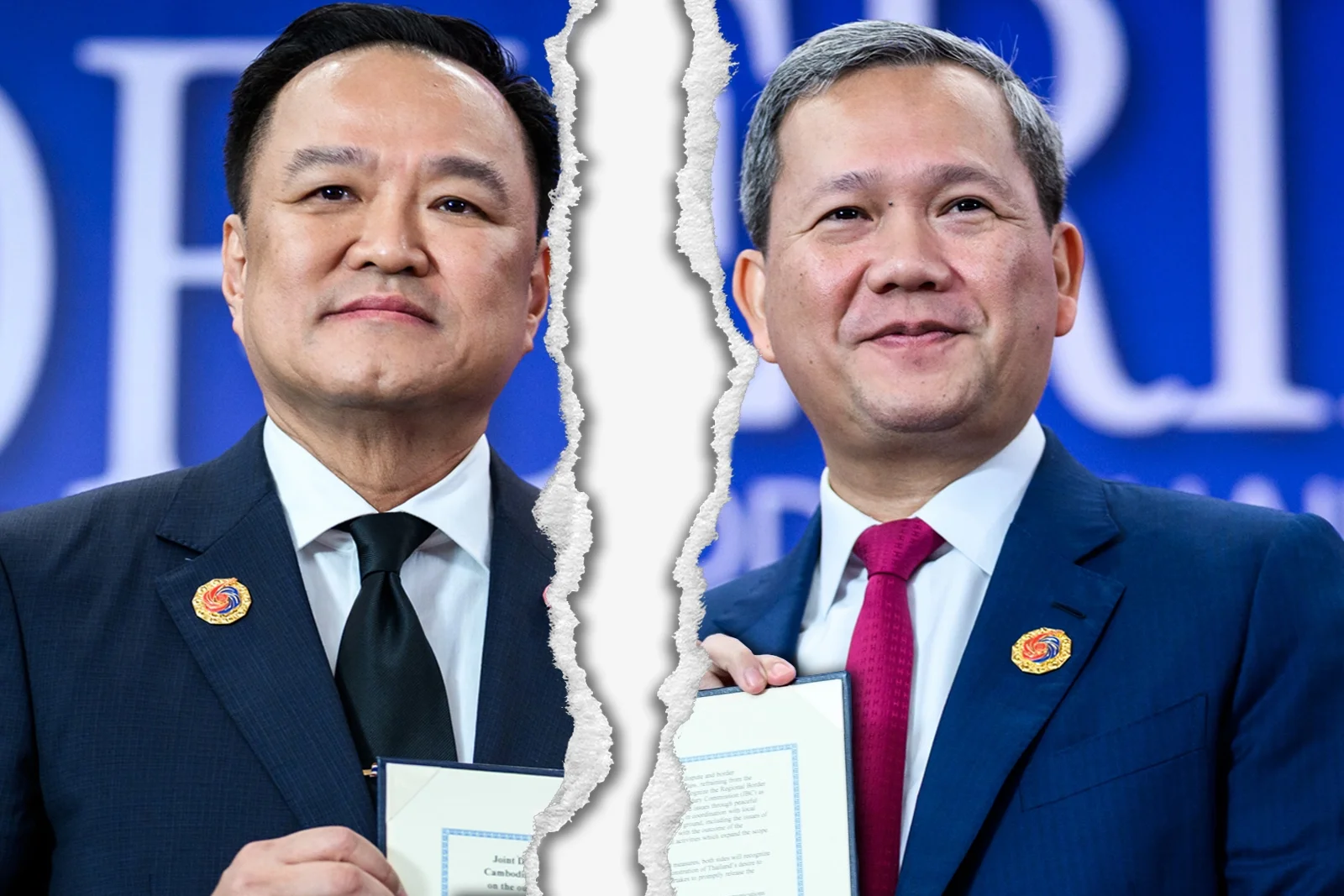

Trump Declared a Victory; Southeast Asia Got a Border War Instead
Southeast Asia’s tight lattice of historical grievances and modern power plays has a way of undoing even the most celebrated diplomatic breakthroughs. The latest eruption between Thailand and Cambodia—punctuated by Thai airstrikes on December 8—underscores how brittle “peace” becomes when it rests on unresolved border trauma and resurgent nationalism. Barely six weeks after U.S. President Donald Trump presided over the Kuala Lumpur Peace Accords, the deal already stands on precarious ground. The clash along the Thai-Cambodian frontier exposes both the deep origins of the conflict and the flimsy scaffolding beneath Trump’s self-branded peacemaking, with sobering implications for U.S. influence in mainland Southeast Asia.
The border dispute is far older than any present-day political drama. It is a colonial inheritance—a century-old wound etched by French surveyors who favored straight lines over cultural and geographic realities. The frontier, running more than 800 kilometers across mountains and thick forests, was fixed on early 20th-century maps drawn from Paris. These borders disregarded the lived landscape of Khmer and Siamese communities, slicing through regions that had long been culturally intertwined. Thailand, then Siam, never fully accepted these colonial cartographies, viewing them as imposed boundaries that left generations arguing over where sovereignty truly begins and ends.
At the symbolic core of the conflict sit ancient Hindu-Buddhist temples that once represented shared heritage and now act as rallying points for national identity. Chief among them is Preah Vihear, a ninth-century clifftop complex perched along the Dangrek escarpment. In 1962, the International Court of Justice awarded the temple to Cambodia but sidestepped the surrounding 4.6 square-kilometer tract, leaving a legal gray zone that Thailand has contested ever since. That ambiguity hardened nationalist narratives on both sides. Other temples—Ta Muen Thom, Ta Krabey—became similar battlegrounds, where the layers of archaeology, religion, and irredentism intersect in combustible ways.
Border violence has erupted repeatedly. Between 2008 and 2011, clashes sparked by UNESCO’s recognition of Preah Vihear as a Cambodian World Heritage site killed dozens and displaced thousands. Shelling, sniper fire, and landmine detonations became familiar grim markers. Domestic politics inflamed the situation: Thai nationalists blasted any perceived concession to Phnom Penh, while Cambodia’s ruling family treated the dispute as a tool for consolidating support. By 2025, Thailand remained politically fractured after years of turbulence, while Cambodia was now under the command of Prime Minister Hun Manet, son of the long-ruling Hun Sen. Conditions for renewed conflict were already in place.
Tensions simmered through the year until May 28, when a clash near Preah Vihear left a Cambodian soldier dead. Each side accused the other of provoking the firefight. The skirmish set off a cascade of retaliation. Cambodia responded with economic bans on Thai products—from fruit to films to fuel—stifling a multibillion-dollar trade relationship. Thailand countered by closing border points, cutting electricity and Internet access to Cambodian communities, and deploying more troops. Nationalist fervor surged. Thai social media brimmed with anti-Cambodian rhetoric; Cambodian state media framed Thailand as the aggressor threatening national survival.
By July 24, the border resembled an active battlefield. Cambodian rocket attacks targeted Thai positions in Surin and Sisaket provinces, prompting Thai F-16 strikes on Cambodian artillery in Oddar Meanchey and Preah Vihear. Over five days, villages and military posts were hit by heavy weapons. At least 41 people were killed, and more than 300,000 civilians fled. Thailand placed eight border districts under martial law. Highways in Sisaket and Battambang were filled with families escaping toward temporary shelters. The United Nations Security Council convened an emergency session on July 25, urging restraint and supporting mediation led by Malaysia under ASEAN.
Economic fallout was immediate. Roughly $5 billion in annual trade collapsed. Schools across 1,200 sites closed. Hundreds of thousands of Cambodian migrant workers in Thailand—essential to agriculture, construction, and service industries—found themselves facing harassment and racing to return home. Politically, the crisis upended both countries. In Bangkok, the conflict toppled Prime Minister Paetongtarn Shinawatra after a leaked call with Hun Sen raised accusations of weakness. Anutin Charnvirakul assembled a more strident nationalist coalition in her wake. In Phnom Penh, Hun Manet portrayed the conflict as a defense of sovereignty, galvanizing public sentiment.
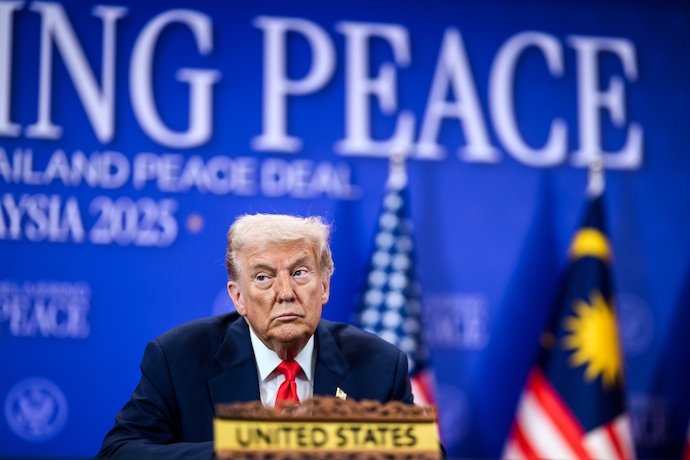
Into this turmoil stepped Donald Trump. His second-term foreign policy has fused “America First” instincts with theatrical, transactional diplomacy. On July 26, as the fighting intensified, Trump—fresh off a golf outing in Scotland—tweeted that he had spoken directly with Hun Manet and Thailand’s Acting Prime Minister Phumtham Wechayachai. He threatened tariffs and warned that U.S. trade deals would be frozen unless firing ceased. Phumtham welcomed the intervention publicly but insisted that Cambodia demonstrate “sincerity.” Hun Manet, mindful of U.S. markets and investment, signaled openness.
A ceasefire soon followed. Negotiators gathered in Putrajaya, where Thailand and Cambodia agreed on an “immediate and unconditional” halt to hostilities, supported by the United States, China, and ASEAN. Trump quickly heralded the agreement as his eighth “ended war,” attaching it to reciprocal trade concessions involving Cambodian textiles and Thai agricultural goods. Critics observed that ASEAN diplomats had done most of the substantive work. Cambodia nevertheless amplified the spectacle by pushing for a Nobel Prize nomination.
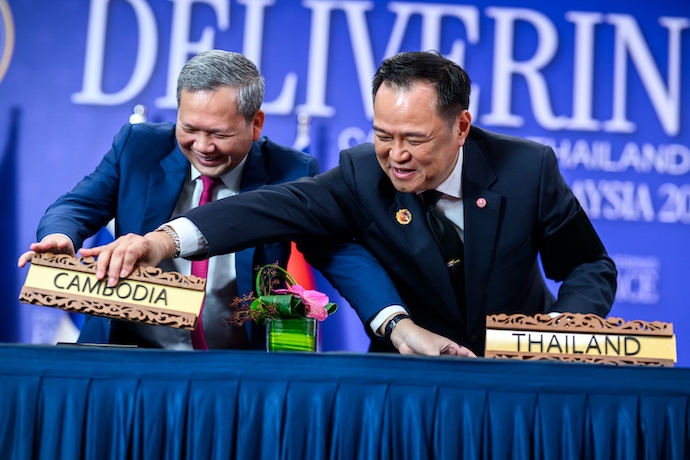
The crescendo came on October 26 at the ASEAN Summit in Kuala Lumpur. Trump disembarked and performed a brief celebratory dance before joining Hun Manet, Anutin, and Malaysian Prime Minister Anwar Ibrahim for the signing of the expanded Kuala Lumpur Peace Accords. The agreement called for heavy-weapons withdrawals, beginning with rocket systems; a phased de-mining campaign; ASEAN observer deployments; and Thailand’s release of 18 detained Cambodian soldiers. Trump labeled the deal “historic,” claiming it saved “millions of lives,” while linking it to broader U.S. trade initiatives. Thai diplomats, wary of domestic scrutiny, rebranded the document as a “joint declaration,” downplaying Trump’s imprint.
For Washington, the optics were ideal: a display of peacemaking abroad while domestic politics churned at home. Strategically, Thailand remains a key U.S. partner, hosts the Cobra Gold exercises, and is central to Indo-Pacific planning. Cambodia, meanwhile, has drifted deeply into China’s orbit. A stabilized border, on paper, could help Washington rebalance regional alignments.
But the fragility of the Kuala Lumpur framework was immediately apparent. Thai complaints about Cambodian reconnaissance patrols undermined trust. Though de-mining and weapons withdrawal began on November 1, a landmine blast on November 10 that injured Thai soldiers near Pairachan led Bangkok to suspend its obligations. Thailand accused Cambodia of altering maps; Phnom Penh accused Thailand of fabricating pretexts.
From there, the dispute devolved into an information war. Cambodian media circulated fake images of downed Thai aircraft. Thai nationalists staged public burnings of Cambodian goods. ASEAN observers recorded eight landmine incidents after the ceasefire—evidence of deteriorating control. Political pressure mounted: in Thailand, protesters accused Anutin’s coalition of capitulating; in Cambodia, Hun Manet risked appearing weak if he conceded territory or accepted arbitration.
The fragile peace finally ruptured at dawn on December 8. Thai F-16s struck Cambodian positions in Preah Vihear and Banteay Meanchey provinces after Thailand claimed it came under renewed rocket fire. Thai units advanced into disputed areas, seizing Pairachan village and framing the move as a defensive necessity. Casualties rose quickly, and new waves of displaced civilians streamed toward the interior. Bangkok accused Phnom Penh of “premeditated aggression”; Cambodia described the incursion as an outright invasion.
Is Trump’s agreement collapsing? Nearly so. The Kuala Lumpur framework is barely operational. Observer missions are stalled, bilateral commissions are inactive, and compliance mechanisms are ignored. Without sustained American enforcement or a broader coalition willing to invest political capital, the accord exists mostly on paper. Trump’s rhetorical pressure carries limited weight against entrenched nationalism. China, Cambodia’s primary patron, has urged calm while resisting U.S. involvement. ASEAN, once again led by Malaysia, is attempting to restart talks but lacks the tools to compel either side.
For the United States, the unraveling complicates regional strategy. Thailand faces internal strain and external insecurity; Cambodia remains deeply embedded in Beijing’s system of loans, infrastructure, and political backing. A prolonged conflict could ripple across regional supply chains, invite outside interference, and embolden other revisionist actors, from Myanmar’s junta to maritime militias in the South China Sea. Trump’s “ended war” risks becoming a case study in diplomatic overstatement.
Rehabilitating the accords would require more than presidential theatrics. A durable settlement would likely include U.S.-supported arbitration through the ICJ or comparable forums to clarify contested borders; joint temple preservation and tourism arrangements to recast cultural sites as shared heritage; and economic incentives linked to demilitarization, such as cross-border industrial zones and regulated infrastructure initiatives. ASEAN could move toward a more structured border-management pact with monitoring and rapid-response mechanisms. These steps, however, demand sustained commitment—something notoriously scarce during election seasons and under centralized, strongman-style governments.
As the Dangrek range echoes once more with shellfire, the Thailand-Cambodia conflict delivers a familiar lesson: diplomacy endures not through spectacle but through persistence. The Kuala Lumpur Accords, launched amid Trumpian fanfare, now require exactly the kind of steady, unglamorous follow-through they were never assured. Without it, they risk becoming yet another fleeting chapter in the era of performance-driven peacemaking.