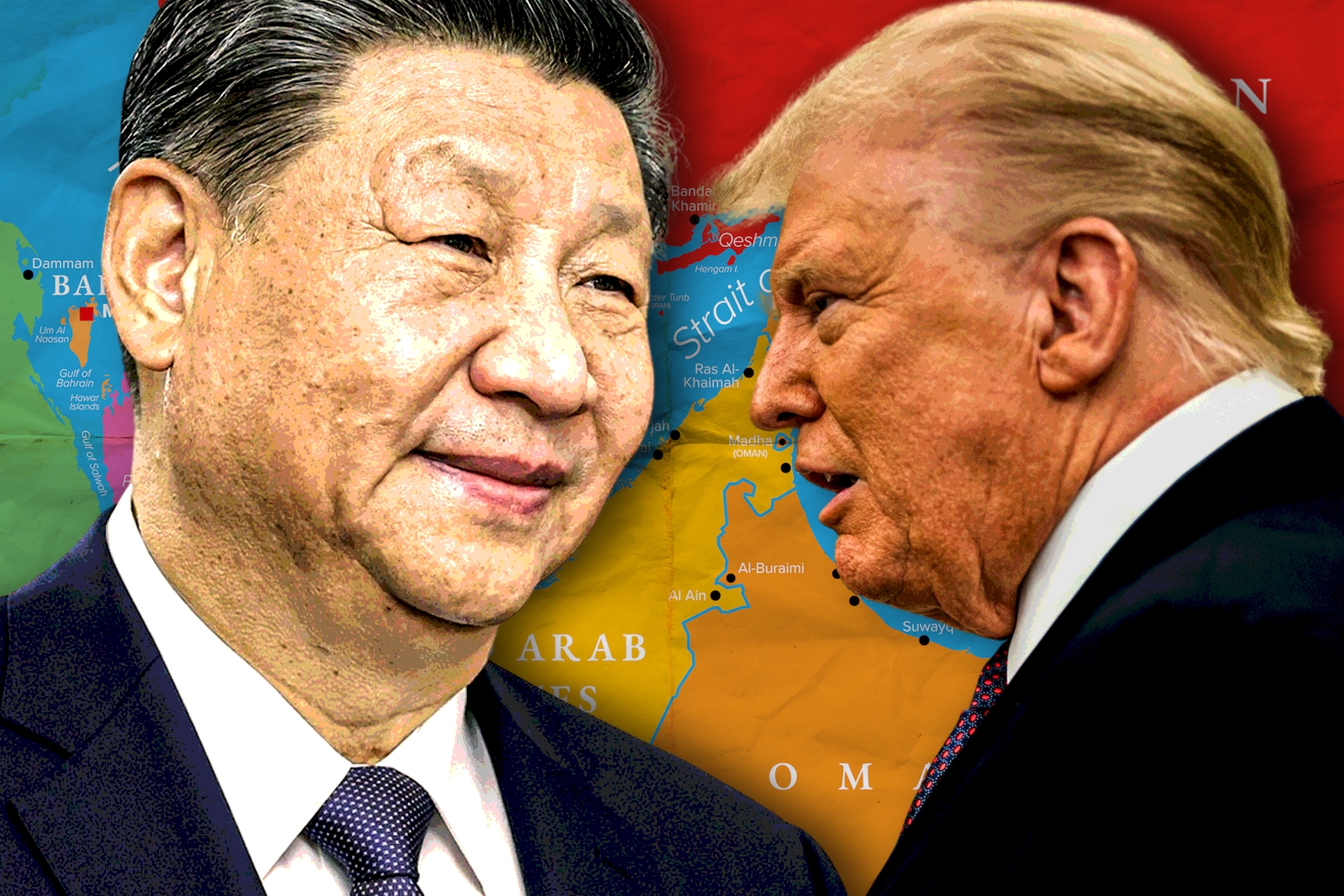

Trump’s Iran War Has a China Problem
The war in Iran is often discussed as though its strategic meaning begins and ends with Israel. That misses a larger question: What does the campaign mean for the contest between the United States and China? Israel is a participant with its own reasons for confronting Tehran. Beijing, meanwhile, has built an economic relationship with Iran that gives it a stake in the war’s outcome, even as the fighting threatens China’s access to energy.
Some commentators argue that Israel dragged Washington into a war it did not want. That claim assigns Israel more control over American decision-making than the evidence supports and risks reviving an old antisemitic trope. The United States chose to fight. It is responsible for that choice, whatever role Israel played in shaping it.
The China dimension does not prove that Washington went to war because of Beijing. The administration has given other reasons for attacking Iran, and its private calculations are not public. Still, the conflict has exposed a strategic relationship that American policymakers can hardly ignore.
For years, sanctions pushed Iran toward China. Chinese buyers purchased most of the oil Iran exported, often through trading networks that obscured its origin. Official Chinese customs figures showed little direct trade in Iranian crude, while ship-tracking data told a different story. In 2025, Iran supplied roughly 1.4 million barrels a day to China, according to Kpler data cited by Reuters. That amounted to a significant share of China’s seaborne oil imports and provided Tehran with a vital source of revenue.
Those figures describe the relationship before the war disrupted it. By August 2026, provisional tracking data showed Chinese intake of Iranian oil falling sharply amid a renewed U.S. blockade. The decline illustrates both how much Iran depended on Chinese customers and how vulnerable the trade is to military pressure. China has alternative suppliers, but replacing discounted Iranian crude carries a cost.
The relationship extends beyond barrels of oil. Beijing and Tehran have cultivated diplomatic and economic ties while opposing U.S. sanctions. China has condemned the U.S.-Israeli strikes. Its foreign ministry said the attacks lacked UN Security Council authorization and violated international law; Foreign Minister Wang Yi called for an end to the war and offered to work with Middle Eastern states on a regional security initiative. That is a diplomatic position, not evidence that China is preparing to intervene militarily.
Military cooperation is harder to assess because much of it is opaque. In February, Reuters reported, citing people familiar with the negotiations, that Iran was nearing a deal to buy Chinese CM-302 supersonic anti-ship missiles. Such weapons could complicate operations for U.S. warships in and around the Persian Gulf. China’s foreign ministry said it was unaware of the talks, and the report did not establish that the missiles had been delivered. A possible sale is consequential; it should not be described as an existing Iranian capability.
The geography explains the concern. Iran sits beside the Strait of Hormuz, through which Gulf energy shipments reach buyers across Asia. Its ability to threaten vessels or disrupt passage affects not only U.S. forces and American allies but also China’s own energy security. Beijing has reason to preserve access to Iranian oil and reason to fear a prolonged regional war. Those interests do not always point in the same direction.
This tension makes the description of Iran as a Chinese “forward base” too neat. China benefits from ties with Tehran, but Iran has its own interests and its own capacity to impose costs on Beijing. The war has damaged the trade on which both countries rely. Nor has a Chinese military installation on Iranian territory been established by the evidence presented here. Strategic alignment should not be mistaken for command and control.
The United States faces a similar contradiction. Weakening Iran could reduce the income that sustains its military and narrow China’s access to discounted crude. But a drawn-out war can raise oil prices, strain U.S. forces, unsettle Gulf partners and divert Washington’s attention from the Indo-Pacific. China may lose a favored supplier while gaining an opportunity to portray the United States as a destabilizing power. Neither outcome can be read off a map of Iranian oil routes.
The debate over Taiwan sharpens the question. American naval resources and political attention are finite. Any campaign in the Middle East has implications for Washington’s posture in Asia, even if China was never its principal target. The issue is whether the war leaves the United States better placed to compete with Beijing, or exhausts resources it will need elsewhere.
Iran is thus part of the U.S.-China rivalry without being reducible to it. Beijing’s oil purchases helped sustain Tehran under sanctions, and prospective arms transfers could have made the Gulf more dangerous for American ships. Yet the fighting has also hit China’s supply lines. To call the war a deliberate American move against China is an argument about motive, not an established fact. The more defensible conclusion is that Washington’s war with Iran will reshape its competition with Beijing, whether that was the plan or not.