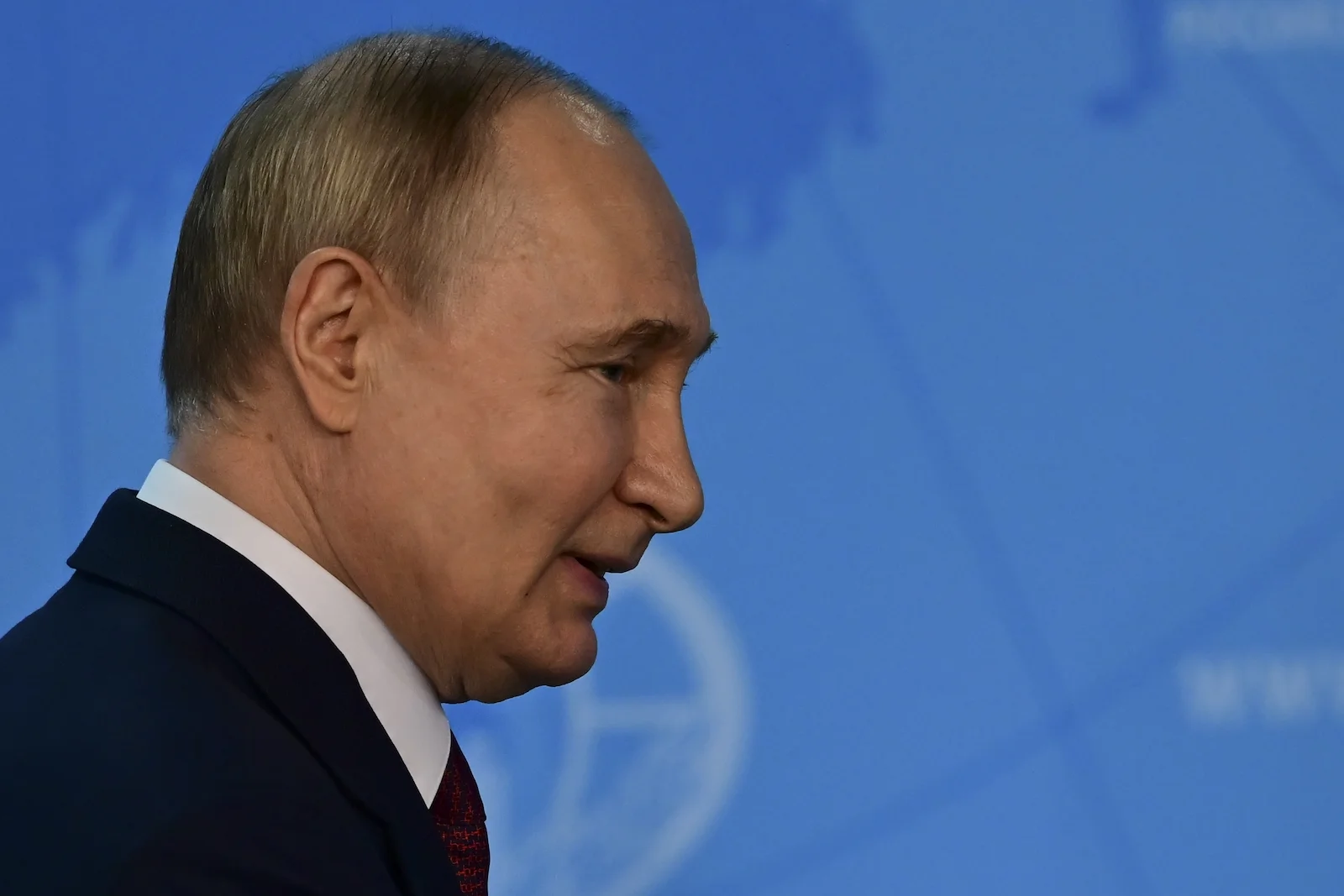

Putin Is Failing in Ukraine. NATO Could Be His Escape Hatch.
Over the past several months, Russia has intensified its hybrid warfare campaign across Europe, combining sabotage, suspected terrorist plots, espionage, and information operations. Moscow has pursued such tactics for years, but the escalation in 2026 carries a sharper risk: It could draw NATO and Russia into direct confrontation.
Russia’s military is exhausted after nearly five years of full-scale war in Ukraine, and the Kremlin remains far short of its original objectives. Ukraine’s government still stands. Every regional capital Russia claimed to have annexed remains under Kyiv’s control. Moscow is still struggling to conquer the Donbas, despite suffering an estimated 1.6 million casualties in the attempt.
Recent reporting suggests that Vladimir Putin fears ending the war without a symbolic victory, particularly the seizure of the entire Donbas. A settlement that looks like defeat could, in this telling, expose him to retribution from hardliners within his own system. Putin therefore confronts an existential danger to his regime, but one largely of his own making.
As the Kremlin considers another round of mobilization to replace its losses, it has several reasons to stoke tensions in Europe: to probe NATO’s defenses, widen the conflict beyond Ukraine, or manufacture the justification for nationwide mobilization if a NATO member becomes directly involved in the war.
Russia’s Escalating Hybrid War in Europe
In August, several armed drones were discovered on a runway at Leipzig Airport in Germany. Additional drones were found near the airport in the weeks that followed.
On September 1, the German government said Russia was responsible for the drones, describing them as part of a broader pattern of hybrid attacks and information operations against Germany. The Bundeswehr has also reported multiple incidents of espionage and sabotage at German military installations, especially those involved in training Ukrainian forces and staging logistics for Ukraine.
The pattern predates the latest incidents. In July 2024, U.S. intelligence uncovered a Russian plot to assassinate Armin Papperger, the chief executive of Rheinmetall, a major German defense manufacturer and an important producer of artillery for Ukraine. German authorities have also documented fires and incendiary devices linked to suspected sabotage between 2024 and 2026.
Denmark faces a similar threat. The country’s security services recently warned that the Kremlin was recruiting Danish citizens to carry out sabotage operations, targeting a state that has become one of Ukraine’s most committed military supporters.
The United Kingdom, Estonia, Latvia, Lithuania, Poland, Romania, and other European countries have likewise reported sabotage, information warfare, espionage, or other forms of hybrid escalation. What once seemed episodic is becoming a regular feature of Europe’s security landscape.
What Is the Kremlin Trying to Achieve?
After years of offensives in Ukraine, the Kremlin has absorbed losses that cannot easily be replaced while securing only limited territorial gains. Its principal wartime objectives remain out of reach, and Moscow is now under growing pressure from Kyiv.
Russia’s war economy is strained. Its navy and maritime shipping face increasing pressure from Ukrainian forces, while a localized Ukrainian counteroffensive has helped stabilize parts of the front. Recruitment has stagnated, casualty rates remain punishing, and the military is struggling to replenish its ranks.
The most difficult battles may still lie ahead. Russia has yet to begin a full assault on the Donbas fortress-belt cities of Kramatorsk and Sloviansk, where Ukraine has established some of its strongest defensive positions. Any attempt to capture them would likely drive Russian casualties sharply higher.
CIA Director John Ratcliffe has reportedly tried to convince Moscow that the costs will only grow the longer the war continues. Putin nevertheless appears convinced that Russia can keep fighting. The problem is political as much as military: The Kremlin needs a powerful justification to expand a war effort that has already made mobilization deeply unpopular. A confrontation involving NATO could supply precisely such a casus belli.
A Pretext to End the War in Ukraine
The Economist recently reported that Putin fears ending the war without taking the whole of the Donbas because an obvious failure could threaten his survival, whether at the hands of hardliners within the regime or an increasingly disillusioned public. Yet continuing the war carries its own dangers. Russia risks exhausting what remains of its capacity to project power, not only in the looming battles for Ukraine’s fortress belt but also amid setbacks in Africa and the South Caucasus.
Without an existential threat to justify another mobilization or several more years of fighting, Putin may face an increasingly unstable regime. For years, he has promoted ultranationalist rhetoric that dehumanizes Ukrainians and denies the legitimacy of their state. That same ideological fervor may now constrain him. If Russia’s military stalls or accepts a settlement that falls short of victory, the hardline constituency Putin cultivated could turn against him.
Throughout the invasion, Putin has insisted that Russia is fighting not merely Kyiv but NATO as a whole. Provocations against European states could help transform that propaganda claim into a political pretext, allowing him to cast an optional war of conquest as a defensive struggle for Russia’s survival.
A limited strike or incursion against a NATO member could serve several purposes at once. The likeliest targets would be smaller, more exposed states such as Estonia or Lithuania, or a country experiencing political turmoil, such as Germany. Each also has a significant Russian-speaking population that Moscow could invoke as part of its familiar narrative of grievance and protection.
Such an attack could generate the domestic support Putin needs for a broader mobilization. It might also give him a face-saving route out of Ukraine if NATO retaliated: The Kremlin could claim that it had withdrawn to confront a larger Western threat rather than admit that its original invasion had failed. At the same time, Moscow would be testing whether NATO’s Article 5 guarantee is as solid in practice as it appears on paper.
With Russian casualties potentially approaching 2 million in 2027, the danger is not that the Kremlin has discovered a path to victory. It is that Putin may seek a controlled confrontation with NATO to escape the political consequences of defeat. A limited attack on a European ally could become the pretext for either widening the war or retreating from Ukraine under cover of a supposedly greater struggle.
That is what makes Russia’s hybrid campaign so dangerous. Sabotage, drones, and covert plots are not merely instruments of disruption. They can also prepare the public narrative for escalation. Putin’s war has trapped his regime between an unwinnable campaign and a peace that could expose its weakness. In that trap, provoking NATO may look less like reckless adventurism than a strategy for political survival.