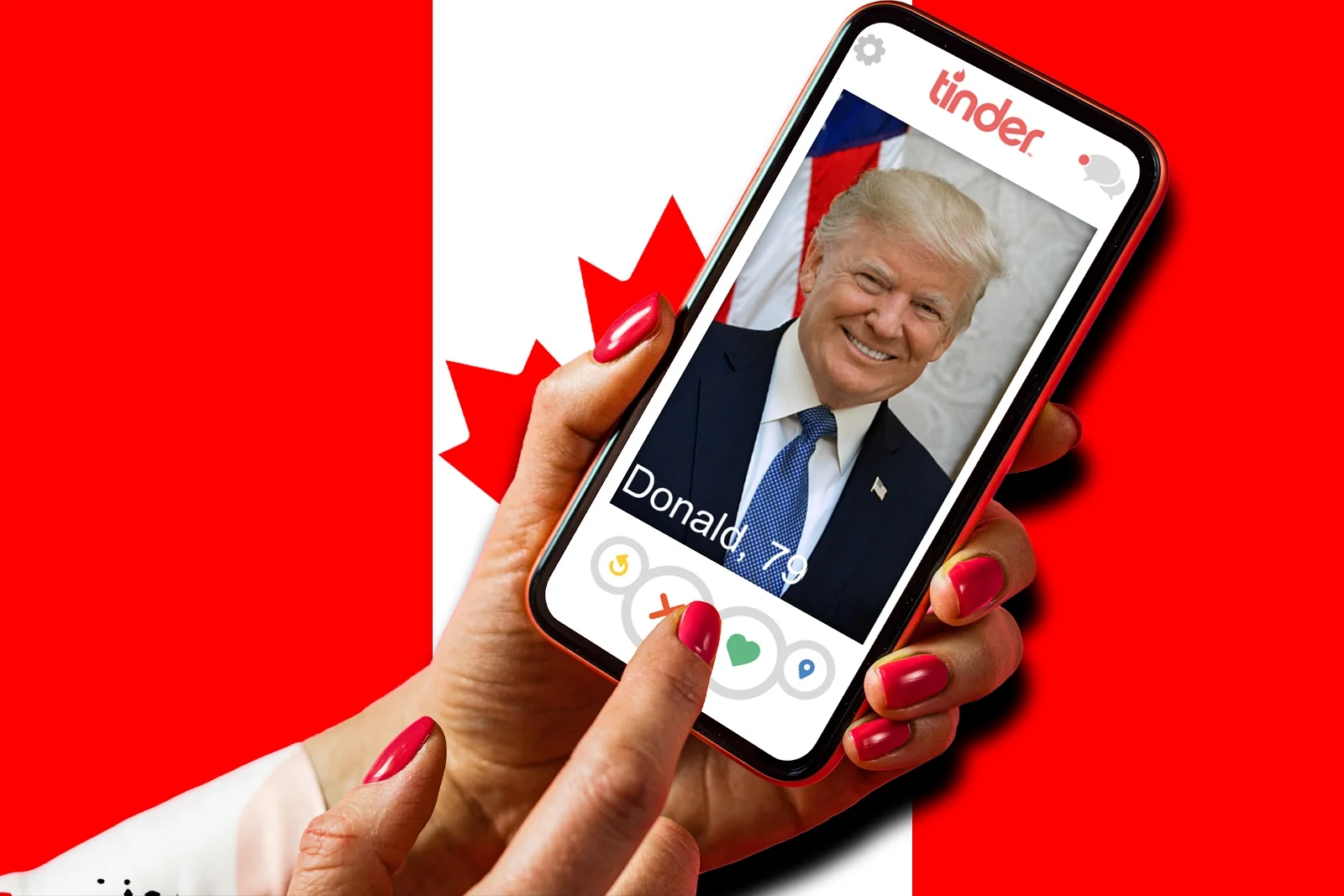

Breaking Up with Uncle Sam: Canada Swipes Right on Brussels
In a move that underscores growing global volatility and rising doubts about U.S. reliability under President Donald Trump, Canada has inked a landmark security and defense agreement with the European Union—marking a notable pivot in Ottawa’s international orientation.
Prime Minister Mark Carney stood alongside European Commission President Ursula von der Leyen and European Council President António Costa in Brussels to sign the historic pact. The agreement not only solidifies mutual commitments to Ukraine but also sets the stage for deeper collaboration on climate change, artificial intelligence, and global security. Framing Canada as “the most European of the non-European countries,” Carney declared that “looks first to the European Union to build a better world,” positioning Canada as a transatlantic stakeholder in preserving the rules-based international order.
Costa echoed Carney’s sentiment, noting the shared values and strategic alignment between Canada and the EU. “The European Union and Canada are among the closest allies in the transatlantic space. We see the world through the same lens. We stand for the same values,” he said.
At the heart of the new partnership is Canada’s access to the EU’s €150 billion Strategic Technologies for Europe Platform—known as Safe. The deal enables joint procurement, streamlined interoperability, and collaborative innovation in cyber, maritime, and space security. “The door is open,” von der Leyen announced, signaling Canada’s entry into one of Europe’s most ambitious defense initiatives.
The agreement mirrors a recent EU-UK arrangement signed by British Prime Minister Keir Starmer and builds on similar pacts with Norway and Japan. But it is the first of its kind with a country in the Americas—making the symbolism as significant as the substance. The pact encompasses cyber defense, arms control, maritime coordination, space policy, and continued military support for Ukraine.
The timing is no accident. Carney’s trip comes just days before the NATO summit in The Hague, where members are expected to commit to spending 5% of GDP on defense. Canada’s defense expenditure remains well below target—1.37% of GDP in 2024—drawing scrutiny from NATO allies. Carney, however, argued that the EU agreement would allow Canada to “deliver on our new capabilities more rapidly and more effectively.”
This diplomatic maneuver also comes in the shadow of Trump’s increasingly dismissive stance toward traditional allies. In a characteristically provocative remark, Trump recently floated the idea that Canada should join the U.S. as its 51st state. Carney, who came to power in April after campaigning against precisely such annexationist rhetoric, pushed back forcefully.
Analysts view the pact as a strategic recalibration—one that acknowledges the shifting tides in Washington and hedges against further U.S. retrenchment. Erika Simpson, an international relations professor at Western University, put it bluntly: “Canada has more in common with Brussels than with certain Washington administrations.”
The EU–Canada Security and Defence Partnership arrives at a moment of heightened global peril—most notably, Russia’s war on Ukraine. The agreement speaks to an urgent need for democratic allies to coordinate across both traditional and emerging domains: cyber warfare, space operations, hybrid threats, and next-generation technology. Rooted in a shared belief in international law and the UN Charter, the pact is also a reaffirmation of multilateralism in an era when it is increasingly under siege.
Von der Leyen welcomed Canada’s role and confirmed that technical talks would soon begin to finalize Canadian access to the EU’s joint defense procurement mechanisms. Countries with a security pact can participate in jointly funded weapons development through the €150 billion Safe program—but each must still negotiate a technical agreement to gain full access.
Beyond defense, trade remains a sturdy pillar of EU–Canada relations. Their economic partnership, currently valued at €125 billion, is built on the 2016 Comprehensive Economic and Trade Agreement (CETA). However, full ratification of CETA remains stalled in ten EU member states, including France and Italy—highlighting the complexities still facing transatlantic economic integration.
Symbolism was not lost on Carney during his visit. Ahead of the summit, he and his wife visited the Schoonselhof military cemetery in Antwerp, where 348 Canadian soldiers are buried. “Brave young soldiers who ventured across the Atlantic to defend the freedom of Europe,” Carney wrote in a reflective social media post.
Implementation of the new partnership will be guided by an annual EU–Canada Security and Defence Dialogue, with supporting consultations focused on issues ranging from counterterrorism and cybersecurity to regional flashpoints. The partnership will be reviewed regularly to measure progress and adjust to the shifting global landscape.
As alliances realign and threats evolve, Canada is clearly rethinking its place in the world. The pact with Europe is not just about defense—it’s about direction.