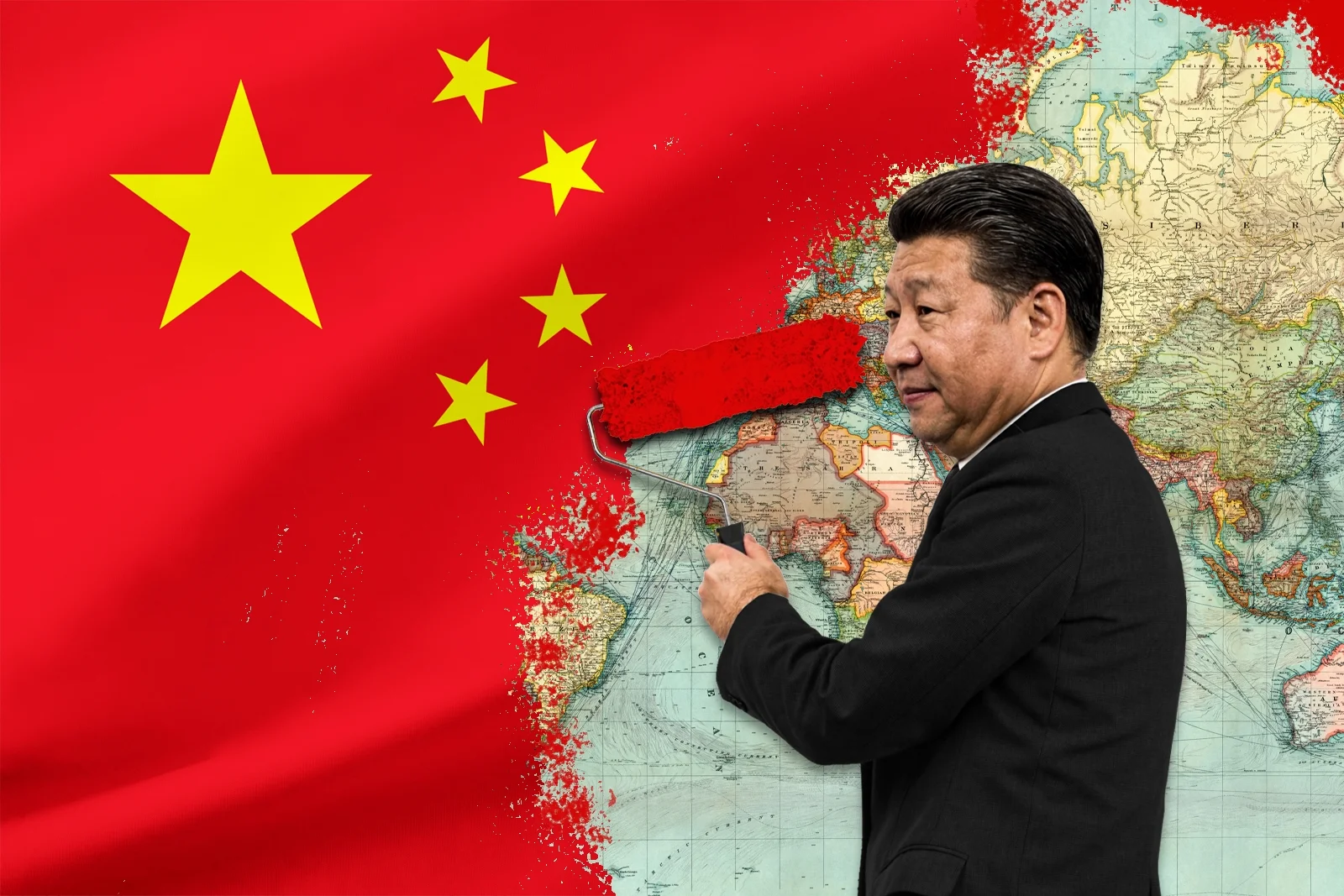

China’s Moment for Shaping the World Order
For decades, students of international politics have debated whether the Cold War was ever truly bipolar. Beneath the tidy narrative of Washington versus Moscow lay a more complicated reality: a triangular contest in which Beijing was never merely a junior partner. From 1949 onward, the United States, the Soviet Union, and China maneuvered for global influence. The so-called liberal democratic order that emerged after 1945 did not simply confront one rival; it faced two.
More than 80 years have passed since that order was codified in the charter of the United Nations. Its intellectual foundations were laid not only by President Franklin D. Roosevelt but also by his 1940 opponent, Wendell Willkie. Despite their political rivalry, both men converged on a conviction that American power should be harnessed to prevent another global catastrophe. Willkie, after his defeat, became one of the most ardent advocates for a supranational body capable of deterring territorial aggression through collective legal remedies and sanctions. He imagined an international community unified enough to forestall the kinds of expansionism that had fueled Nazi Germany and Imperial Japan.
Both Roosevelt and Willkie died before the end of the Second World War, leaving the task of institutional consolidation to Harry S. Truman. Under Truman, the architecture of postwar interventionism hardened into doctrine. International law, humanitarianism, and alliance politics were woven together into what became the Western-led order. For decades, it endured.
Today, that architecture shows signs of strain. The transatlantic alliance is fraying. The collapse of the Soviet Union in 1991 removed one pillar of the old rivalry, but it also cleared space for China’s rapid ascent. The liberal order that once defined global governance now finds itself wrestling with self-doubt.
At the recent Munich Security Conference, Secretary of State Marco Rubio assured European counterparts that Washington would resist Western decline. Yet he also made clear that the United States would no longer subordinate itself to what he described as “globalist” commitments. Echoing President Donald Trump, Rubio questioned the asymmetries of NATO financing and the perceived imbalance in U.S.-EU relations. National interest, not multilateral idealism, would guide American policy. The result is an alliance grappling with its own identity.
In Beijing, meanwhile, Xi Jinping has consolidated power to a degree unseen in China since Mao. As general secretary of the Communist Party and chairman of the Central Military Commission, Xi has drawn authority inward, dissolving term limits and tightening political discipline. His sweeping anti-corruption campaigns have neutralized rivals and reinforced party loyalty, while expanding surveillance and state control over civil society.
Xi’s evolution is striking. Early in his tenure, he presented himself as a technocrat shaped by Deng Xiaoping’s pragmatic reforms. China’s accession to the World Trade Organization and its deep integration into global markets provided a springboard for unprecedented growth. Out of that momentum emerged the Belt and Road Initiative, marketed as a natural extension of China’s historical centrality in Eurasian trade networks.
Internationally, Xi continued to leverage Dengist economic openness. Domestically, however, governance took on a more austere cast. The expansion of digital surveillance, tighter censorship, and assertive policing have evoked comparisons to Maoist political control. This fusion—Dengist globalization abroad, Maoist discipline at home—has concentrated extraordinary power in Xi’s hands.
That concentration coincides with opportunity. The tremors running through the Western alliance create openings for Beijing to project influence more assertively. In nuclear policy, the expiration of New START and the earlier collapse of the Intermediate-Range Nuclear Forces Treaty have weakened the arms-control framework that once constrained superpower competition. As U.S.-Russian guardrails erode, nuclear modernization accelerates.
China has expanded its arsenal at a pace that has unsettled Washington and New Delhi alike. The breakdown of bilateral arms control between the United States and Russia reduces diplomatic pressure on Beijing to exercise restraint. In this environment, China can enlarge and diversify its deterrent with fewer institutional obstacles. The liberal order’s role as nuclear watchdog has diminished, and Beijing appears determined to capitalize.
Geopolitics extends beyond warheads. In the Arctic, melting ice has unlocked access to shipping lanes and natural resources, prompting competition among Arctic states and external stakeholders. China’s “Polar Silk Road,” announced in 2018 as an extension of the Belt and Road Initiative, relies heavily on Russian infrastructure and geography. Moscow provides the physical gateway; Beijing supplies capital and long-term commercial ambition.
Energy politics deepen the partnership. As the world’s largest importer of fossil fuels, China has long diversified supply chains. But tensions in Venezuela and shifts in Western policy have pushed Beijing to rely even more on Russian energy. Economic interdependence increasingly binds the two powers, even when their interests diverge in theory. Beijing traditionally opposes territorial fragmentation and separatism. Yet pragmatism has guided its response to Russia’s war in Ukraine. The Sino-Russian alignment has hardened into a strategic counterweight to a West preoccupied with its own cohesion.
The logic of spheres of influence is resurfacing with renewed clarity. The United States has historically invoked the Monroe Doctrine and its later corollaries to justify interventions in the Western Hemisphere—from Guatemala and Nicaragua to Chile and Panama. Critics abroad see in these precedents a template for regional enforcement of stability.
Russian officials have openly argued that Washington cannot claim moral authority to oppose Moscow’s actions in Ukraine while maintaining its own history of hemispheric intervention. Beijing, observing this rhetoric, may conclude that precedent favors assertiveness. If major powers are again defining security in regional terms, China will seek to consolidate its own perimeter.
Nowhere is this clearer than in the South China Sea and across the Taiwan Strait. Taiwan’s unresolved political status has rankled Beijing since the Chinese Civil War. The island’s democratic system and distinct political identity stand in tension with mainland claims of sovereignty. Meanwhile, Chinese military installations across contested reefs and islands signal an intent to entrench control.
In this emerging era, interventions by regional powers—whether in Eastern Europe or Latin America—risk normalizing a more muscular understanding of sovereignty. Stability becomes something to be enforced, not negotiated. For China, the lesson is unmistakable: hesitation forfeits advantage.
Beijing thus stands at a pivotal juncture. The transatlantic alliance is divided over burden-sharing and strategic priorities. U.S.-Russian arms control has frayed. Arctic governance remains unsettled. Economic interdependence coexists with ideological rivalry. These conditions do not guarantee Chinese ascendancy, but they offer latitude.
Xi’s consolidation of authority at home, paired with expansive economic statecraft abroad, positions China to exploit this fluid moment. The post-1945 order was built on liberal institutionalism and American primacy. The emerging landscape is defined less by universal norms than by calibrated competition among great powers.
Whether this shift proves durable remains uncertain. But as alliances recalibrate and treaties lapse, Beijing finds itself unusually well situated. The convergence of internal centralization and external fragmentation may mark not merely a passing opportunity, but a formative chapter in the remaking of global order.