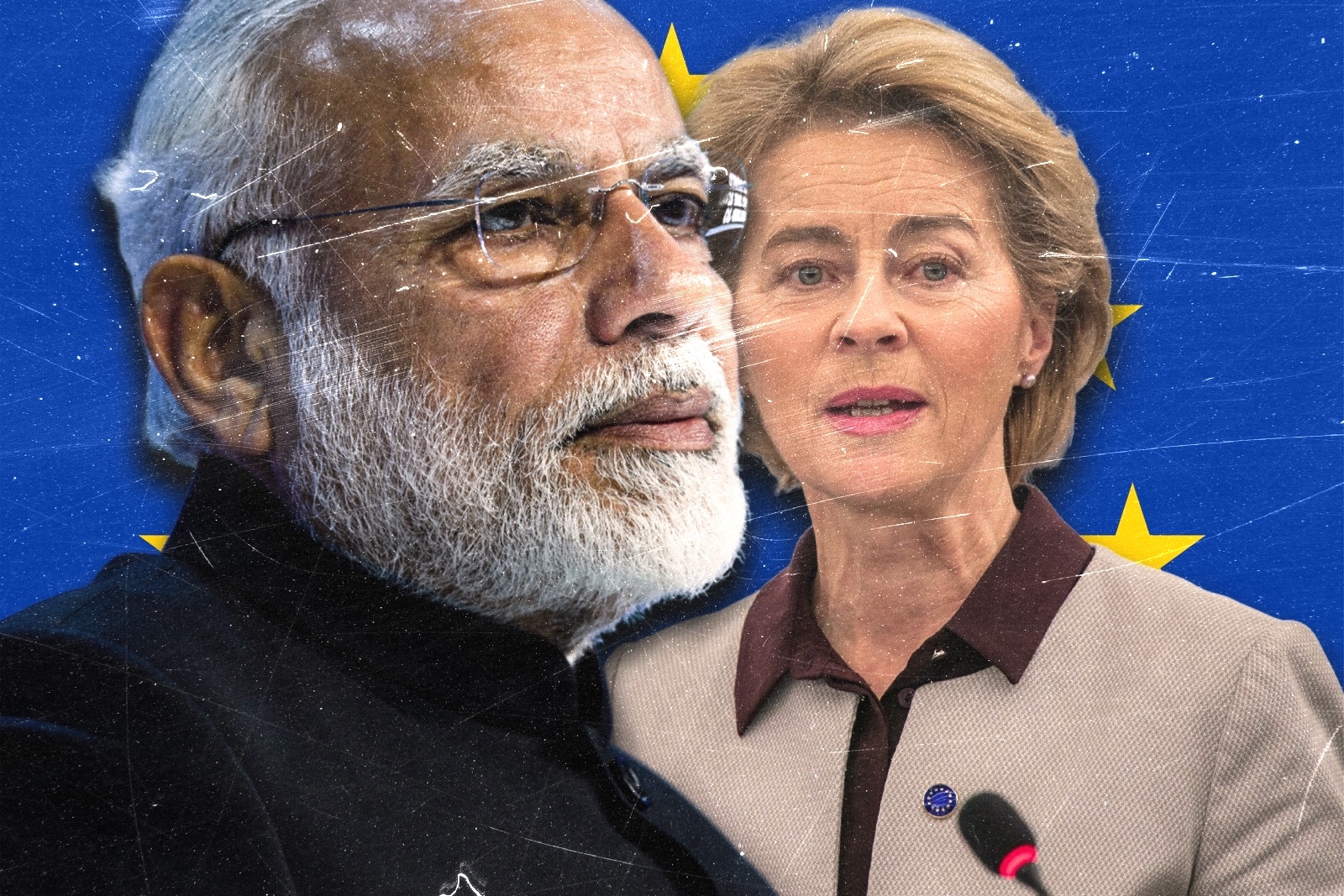

Europe Can’t Ignore Democratic Backsliding in India
As European Commission President Ursula von der Leyen visits India to take part in the country’s 77th Republic Day celebrations—marking the adoption of a Constitution that defines India as a sovereign, secular, and democratic republic—the timing could hardly be more symbolic. Even as Europe seeks closer economic and strategic cooperation with New Delhi, India is confronting a quiet but consequential weakening of its democratic institutions.
Von der Leyen’s agenda will understandably focus on trade, supply chains, and geopolitics. Strengthening economic ties with the world’s fastest-growing major economy makes strategic sense amid global uncertainty and geopolitical fragmentation. Yet if Europe’s engagement with India is reduced to commerce alone, it risks overlooking a deeper issue with long-term consequences: the steady erosion of democratic checks and balances in the world’s largest democracy.
India’s democratic decline has not taken the form of coups or emergency rule. Instead, it has unfolded through the gradual hollowing out of institutions designed to safeguard constitutional governance—a pattern familiar to Europeans who have watched similar developments in Hungary. Democratic backsliding, in this model, advances incrementally, through legal changes, administrative pressure, and the quiet normalisation of executive dominance.
Independent assessments underline this trajectory. CIVICUS has classified India’s civic space as “repressed” for six consecutive years. The Election Commission of India (ECI), once widely respected at home and abroad, now faces persistent allegations of politicisation and bias. India’s media landscape has narrowed sharply: journalists face raids, lawsuits, and intimidation, while concentrated ownership and political alignment have reduced space for independent reporting. Reporters Without Borders now describes press freedom in India as being in crisis.
Republic Day is meant to commemorate India’s founding promise of pluralism, the rule of law, and institutional independence. Yet the gap between that promise and present reality continues to widen.
Recent elections in the eastern state of Bihar illustrate how institutional erosion manifests in practice. In the weeks before voting, the Election Commission launched a “Special Intensive Revision” of electoral rolls, ostensibly to update voter lists. The timing and execution of the exercise triggered widespread criticism from opposition parties, civil society groups, and election observers.
A leading civil society election monitoring panel concluded at the end of the Bihar elections in November 2025 that “the conduct of the Election Commission of India throughout the Bihar election was deeply concerning, and raised troubling questions about its impartiality and institutional integrity.”
Allegations included centralised voter-roll manipulation, targeted deletions disproportionately affecting minorities, and unresolved concerns about transparency, data protection, and accountability. The controversy reinforced fears that the ECI, like several other national institutions, has become increasingly vulnerable to political influence.
The ECI was once among India’s most trusted institutions, admired globally for managing elections in a vast and diverse democracy. Critics trace its decline in credibility to legal changes introduced in 2023 that gave the executive effective control over appointments to the Commission, replacing a more independent selection process. The weakening of one institution has been mirrored across others.
India’s Supreme Court, long regarded as a cornerstone of constitutionalism, has also come under scrutiny. Most recently, the Court again denied bail to student leaders detained for more than five years without trial for peacefully protesting discriminatory citizenship laws. International legal experts have warned that opaque judicial appointments, executive influence, and post-retirement incentives risk undermining both the real and perceived independence of the judiciary.
Other accountability institutions have fared no better. Concerns over politicisation have led to the downgrading of India’s National Human Rights Commission in international accreditation processes. Meanwhile, UN human rights bodies have expressed “significant concerns” about restrictions on freedom of expression and assembly, as well as sustained pressure on NGOs and human rights defenders.
Pressure on land and environmental defenders has also intensified, further narrowing democratic space. Last week, climate activist Harjeet Singh, co-founder of the organisation Satat Sampada, had his home raided by police over claims that his advocacy for a treaty to reduce fossil fuel use was undermining the national interest. Singh has challenged industrial projects affecting local communities. As development initiatives are fast-tracked in the name of growth and strategic necessity, environmental dissenters are increasingly branded as anti-national.
India is not just another trading partner. It is a regional power, a strategic actor, and home to nearly one-fifth of the world’s population. Democratic erosion in a country of this scale carries global consequences. An India drifting toward autocracy would weaken democratic norms internationally, embolden illiberal leaders elsewhere, and complicate Europe’s efforts to defend a rules-based international order.
European leaders often argue that engagement, not isolation, is the most effective way to influence partners. That principle holds—but engagement without clearly articulated expectations is unlikely to strengthen democracy. The European Union retains leverage through market access, investment, technology cooperation, and political legitimacy. Using that leverage judiciously would be prudent, not punitive.
As Ursula von der Leyen deepens economic cooperation with India, Europe’s message should be clear. A strong EU–India relationship is not only about growth figures and supply chains; it is also about democratic resilience. Encouraging India to reinforce, rather than hollow out, its democratic institutions is in Europe’s strategic interest—and ultimately in India’s own.