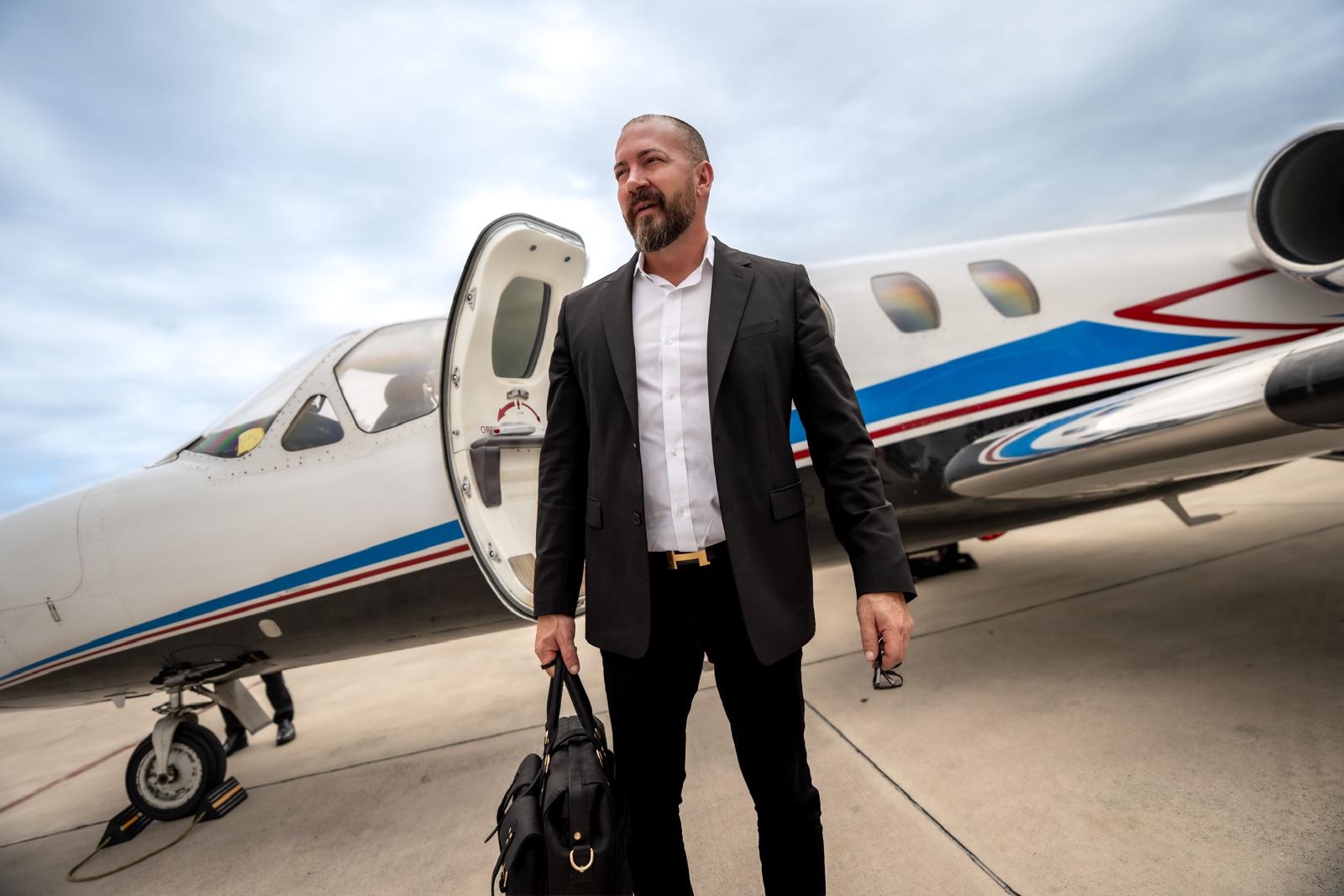
Is Jason Herring the Elon Musk of Hydrogen Energy?
The biggest challenge facing artificial intelligence may not be intelligence at all.
It is electricity.
The world is racing toward an era defined by AI data centers, autonomous factories, humanoid robots, military automation, and always-on computing. Yet beneath every breakthrough model, every server rack, every robot, and every automated system lies a stubborn physical constraint that software alone cannot solve: power.
The numbers are already daunting. The International Energy Agency projects that electricity consumption from data centers will more than double, reaching roughly 945 terawatt-hours by 2030. In the United States, the Department of Energy has cited estimates suggesting that data centers could consume as much as 9 percent of the nation’s annual electricity generation by the end of the decade.
And that is before the robotic economy arrives in full force. Morgan Stanley has projected that the global population of humanoid robots could approach one billion units by 2050. Another forecast from the firm estimates that the United States alone could have 8 million working humanoid robots by 2040.
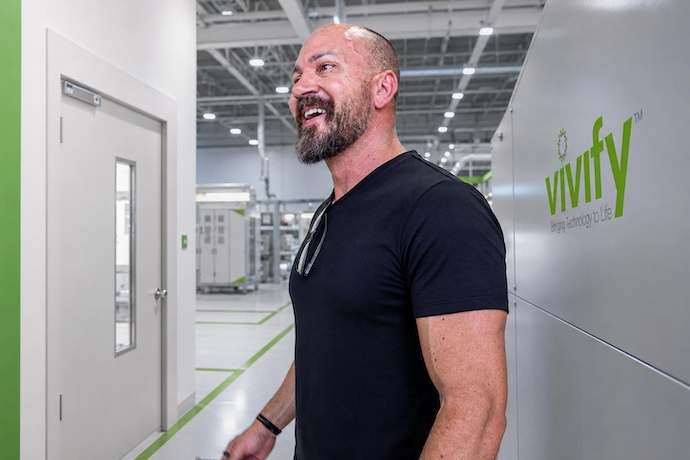 The AI revolution is not merely a software story. It is an energy story.
The strain is already becoming visible. Across the United States and elsewhere, data center projects have been delayed, challenged, or abandoned because sufficient power simply is not available. Utility Dive reported that data center project cancellations climbed sharply in 2025, while other industry forecasts have warned that between 30 and 50 percent of large facilities scheduled for completion in 2026 could face delays because of power shortages, equipment constraints, and growing public opposition.
This is the problem Jason Herring believes he has spent much of his career preparing to address.
Herring, the founder of VIVIFY Technology, has been described by some supporters as a potential Elon Musk for the hydrogen era. It is an ambitious comparison, though not an entirely baseless one. Musk built his reputation by targeting large-scale bottlenecks that others accepted as permanent: digital payments, electric vehicles, commercial spaceflight, satellite communications, and energy storage.
Herring’s target is different but arguably just as fundamental. He is focused on what may become one of the defining constraints of the AI age: the availability of reliable, scalable, and cleaner sources of power.
Yet Herring is not a first-time entrepreneur armed with little more than a pitch deck.
His first major business success came in 2015 when he sold his software company for approximately $70 million. The company emerged from a problem he noticed inside country clubs and hospitality operations. Software systems existed for golf, tennis, hospitality, and management functions, but many operated independently, unable to communicate with one another. Herring built a platform that connected those disconnected systems and transformed a persistent industry frustration into a successful business.
By his own account, his software company became the first to truly matter in his professional life because it solved a problem that many organizations had simply learned to live with.
Retirement was never the next step.
 In 2017, Herring founded Syzygy, a manufacturing and design-focused company that he continues to own. According to company background information, Syzygy now generates approximately $50 million in annual revenue. More significant than the revenue itself, however, was what the company taught him. Herring has described Syzygy as the place where he learned how to build infrastructure, manufacturing systems, organizational culture, operational processes, and global business relationships from the ground up.
In many respects, he sees Syzygy as the proving ground that ultimately made VIVIFY possible. That history shapes how VIVIFY should be viewed.
This is not the story of an entrepreneur seeking a first success or a quick financial windfall. Herring has already built companies, generated wealth, and completed a significant exit. In interviews, he has suggested that his motivation now extends beyond financial outcomes. What interests him, he says, is creating something durable—an enterprise capable of outlasting its founder and leaving a lasting impact.
The roots of VIVIFY stretch back long before the recent AI boom. According to company materials, VIVIFY was originally established in 2013 but was later set aside while Herring concentrated on scaling Syzygy. The project remained in the background for years. Herring describes it as a long-term effort that many people considered unrealistic or impossible before a working system finally began to emerge.
By 2024, however, circumstances had changed dramatically. Artificial intelligence had ignited a global infrastructure race. Data center operators, technology firms, and investors suddenly found themselves discussing electricity with the same urgency that semiconductor companies discuss chip supply chains. The industry was confronting a simple reality: computational power is only as valuable as the energy that supports it.
So Herring returned to VIVIFY full-time. A key figure in the effort is Buddy Paul, VIVIFY’s Distinguished Engineer and Chief Systems Architect. Public records indicate that Paul has experience with NASA, while patent databases list him as an inventor on aerospace-related patent applications associated with Lockheed Martin.
Together, Herring and Paul have spent years developing what VIVIFY describes as a new approach to hydrogen-powered energy generation.
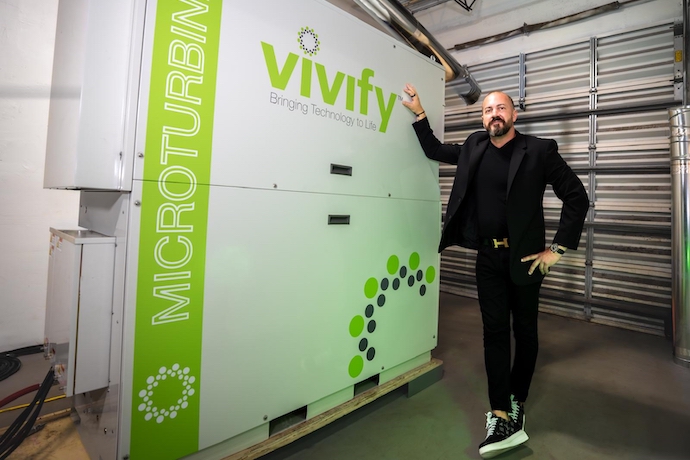
At the center of that effort is the HOG, or Hydrogen Oxygen Generator, the company’s flagship closed-loop system. According to VIVIFY, the platform generates hydrogen on-site using water as its primary input. Approximately two tonnes of water are loaded into the system, where a proprietary Pulsar array performs electrolysis to produce hydrogen on demand. That hydrogen is then used to power high-efficiency, multi-stage turbines capable of generating electricity and heat.
The company states that the system operates without a traditional external fuel supply chain and can achieve emissions reductions approaching 99 percent under certain operating conditions. The concept becomes easier to visualize through VIVIFY’s most visible product: the Flying Pig.
Introduced on May 21, the Flying Pig is a containerized, hydrogen-powered energy platform designed to fit inside a standard shipping container. According to the company, each unit is capable of generating one megawatt of power, with additional capacity achieved by connecting multiple modules together.
VIVIFY envisions applications ranging from AI data centers and industrial facilities to disaster-response operations, military deployments, and eventually highly remote environments. Company materials and product announcements describe the system as an effort to provide scalable energy independence where conventional infrastructure may be unavailable or impractical.
This is where comparisons to Musk become most relevant. Tesla did not invent the electric vehicle, but it accelerated the industry’s commitment to electrification. SpaceX did not invent rockets, but it challenged longstanding assumptions about launch costs and reusability.
If VIVIFY’s technology performs as promised, it could force a similar reconsideration within the energy sector. The underlying premise is straightforward but potentially disruptive: large-scale power generation may not always require centralized fuel supplies, extensive infrastructure networks, or years of waiting for grid connections.
The vision is, in essence, power delivered in a box. A data center facing years-long delays for grid access could deploy modular generation. A disaster zone could restore electricity without relying on fuel convoys. Military units could reduce exposure to vulnerable supply lines. Remote industrial operations could operate without diesel dependence. Communities could strengthen resilience through localized backup power.
Those possibilities are significant. They also require careful scrutiny. Technologies that promise to transform the energy landscape must ultimately prove themselves through rigorous testing, safety evaluations, third-party validation, successful deployments, and sustained real-world performance. History is crowded with energy breakthroughs that generated excitement at the prototype stage but struggled when confronted with the realities of manufacturing, economics, and scale.
Whether VIVIFY ultimately joins that list—or becomes one of the rare companies that fundamentally alters how energy is produced and distributed—remains an open question.
What is clear is that the coming AI era will demand extraordinary amounts of power. The race to build the future is increasingly becoming a race to energize it. And entrepreneurs who can solve that problem may prove just as important as the technologists building the machines that consume it.