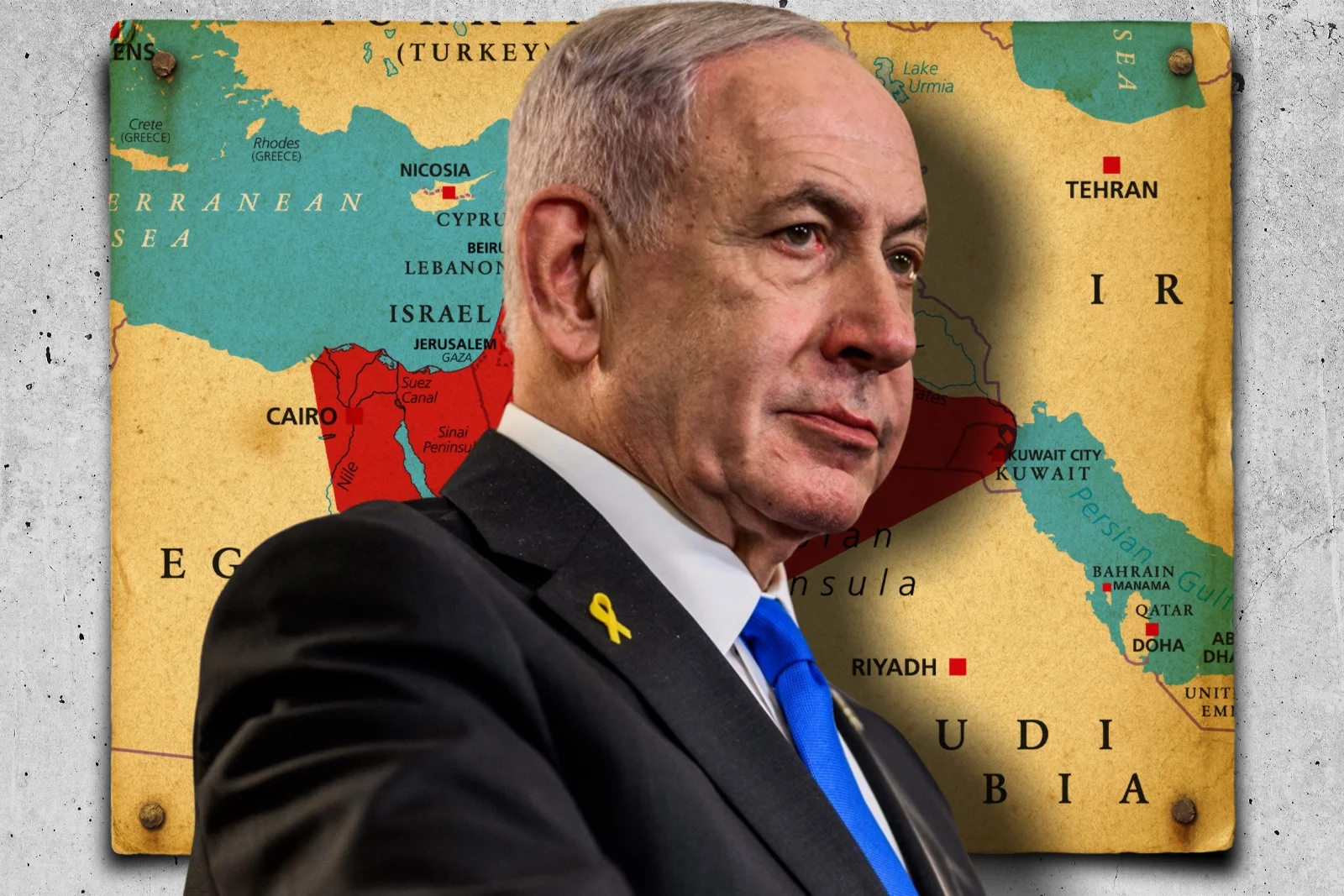

Israel’s Grand Design Collides With Reality
The phrase “Greater Israel” requires analytical care. It does not describe a formally declared Israeli doctrine with a universally accepted territorial map. Rather, it encompasses a constellation of maximalist ideas rooted in Revisionist Zionism, religious nationalism, and the pursuit of permanent strategic depth. Its contemporary significance lies less in political slogans than in observable practices: settlement expansion, military buffer zones, prolonged occupations, and administrative measures that steadily make Palestinian statehood more difficult to achieve. In this sense, the project is not necessarily a single blueprint. It is a method of turning temporary security arrangements into durable political and territorial facts.
The Hamas-led attacks of October 7, 2023, supplied Israeli hardliners with an extraordinary casus belli. Israel had the right to defend its citizens and seek the release of the hostages, but its military campaign soon assumed a geography considerably broader than the dismantling of Hamas. Israeli operations spread across Gaza, the West Bank, Lebanon, Syria, and eventually Iran. Calls by influential Israeli figures for Palestinian “relocation,” permanent military control of Gaza, and accelerated settlement construction reinforced fears that an emergency war was becoming an instrument of territorial reengineering.
Yet the defining story of 2025 and 2026 is that this regional transformation was obstructed—not by a single battlefield defeat, but by a diplomatic coalition that denied expansionist forces the strategic vacuum they required.
The first obstacle was the diplomatic codification of unmistakable political red lines. President Donald Trump’s Gaza peace framework opposed the displacement of Palestinians and pledged that the West Bank would not be annexed. Pakistan, Saudi Arabia, Turkey, Qatar, Egypt, Jordan, Indonesia, and the United Arab Emirates endorsed those safeguards. Their collective position transformed broad expressions of Muslim solidarity into specific conditions: no depopulation of Gaza, no legalized annexation of the West Bank, and no regional settlement that disregarded Palestinian political and national rights.
Those safeguards remain essential because expansionist pressure has been contained diplomatically, but not eliminated on the ground. By July, Israeli forces controlled approximately 70 percent of Gaza, while the United Nations estimated that rebuilding the territory would cost nearly $70 billion. Most of Gaza’s roughly two million residents remained displaced. More than 1,080 Palestinians had reportedly been killed by Israeli fire even after the October 2025 ceasefire.
Conditions in the West Bank were scarcely less ominous. The UN Office for the Coordination of Humanitarian Affairs reported that settler attacks and demolitions had displaced more than 3,200 Palestinians during 2026—an average of 17 people each day and twice the rate recorded over the preceding three years. In June alone, Israel advanced plans for more than 2,000 additional settlement homes.
The second obstacle was the refusal of regional governments to allow security vacuums to harden into permanent Israeli frontiers. In Lebanon, Israel established a military-control zone extending several kilometers beyond the internationally recognized border, while the conflict displaced more than 1.2 million people. Syria likewise faced repeated Israeli strikes and territorial incursions following the fall of Bashar al-Assad.
The emerging strategic pattern was difficult to miss: weaken neighboring military structures, occupy commanding territory, and then present continued control as indispensable to Israeli security. Lebanese state institutions, American mediators, and regional diplomats, however, began developing “pilot zones” through which the Lebanese army could restore sovereign authority. The initiative challenged the assumption that Israeli occupation would inevitably become permanent.
The most consequential obstacle emerged during the 2026 Iran war. Israeli hardliners appeared to anticipate that attacks on Iran would provoke a much wider confrontation involving Hezbollah, the Gulf monarchies, Kurdish armed organizations, and Turkey. Such a war could have fragmented major Muslim states and created precisely the kind of regional disorder in which territorial gains become easier to consolidate.
The Strait of Hormuz, through which roughly one-fifth of the world’s oil and liquefied-natural-gas supplies normally pass, became the principal pressure point. But instead of joining a broader anti-Iran war, Saudi Arabia and the smaller Gulf Cooperation Council states avoided direct military escalation. In doing so, they denied the conflict the sectarian and geopolitical momentum it needed to engulf the region.
Pakistan was central to this strategic denial. Islamabad combined close security ties with Saudi Arabia, longstanding diplomatic channels with Tehran, working relations with Washington, and credibility across much of the Muslim world. It coordinated with Saudi Arabia, Turkey, Egypt, and Qatar to prevent the conflict from becoming a Sunni–Shia or Arab–Iranian confrontation.
On March 29, Islamabad hosted the foreign ministers of Saudi Arabia, Turkey, and Egypt for discussions on a ceasefire and the reopening of the Strait of Hormuz. Pakistan subsequently facilitated direct American–Iranian engagement during the Islamabad talks and helped secure an extension of the ceasefire as negotiations continued.
Those diplomatic efforts culminated in the 14-point Islamabad Memorandum of Understanding in June, which formally ended hostilities and sought to reopen Hormuz to commercial shipping. The agreement is now under severe strain, exposing the fragility of diplomatic settlements that lack robust enforcement mechanisms. Nevertheless, it interrupted the cycle of escalation at a decisive moment. Pakistan did not resolve every disagreement between Washington and Tehran. What it accomplished was arguably more urgent: preventing the conflict from becoming the region-wide state-collapse scenario that expansionist forces could have exploited.
Pakistan also resisted attempts to turn its mediation role into a vehicle for political normalization with Israel. When President Trump sought to link an Iran settlement to the collective accession of Muslim states to the Abraham Accords, Pakistan rejected the proposal, maintaining that the two issues could not be merged. The refusal preserved a fundamental principle: Recognition of Israel cannot substitute for Palestinian self-determination, legitimize territorial faits accomplis, or reward policies that erode the possibility of an independent Palestinian state.
The deeper lesson is that the “Greater Israel” project was thwarted through what might be called counter-vacuum diplomacy. Pakistan and its partners prevented regional polarization, kept Gulf territory from becoming a launchpad for attacks against Iran, defended the Gaza framework’s provisions against annexation, and supported the restoration of Lebanese sovereignty.
The danger has not disappeared. Gaza remains largely under Israeli military control. West Bank annexation continues to advance incrementally, settlement by settlement and decree by decree. Israel’s presence in southern Lebanon also remains unresolved. These are not insignificant qualifications; they are reminders that diplomatic containment is not the same as political settlement.
But the effort to transform regional warfare into an uncontested new territorial order has, at least for now, been checked. Coordinated diplomacy among the region’s middle powers achieved what military balancing alone could not. It denied an expansionist strategy the chaos, legitimacy, and political fragmentation it needed to succeed.