The Next Supreme Leader? What Pahlavi is Really Proposing
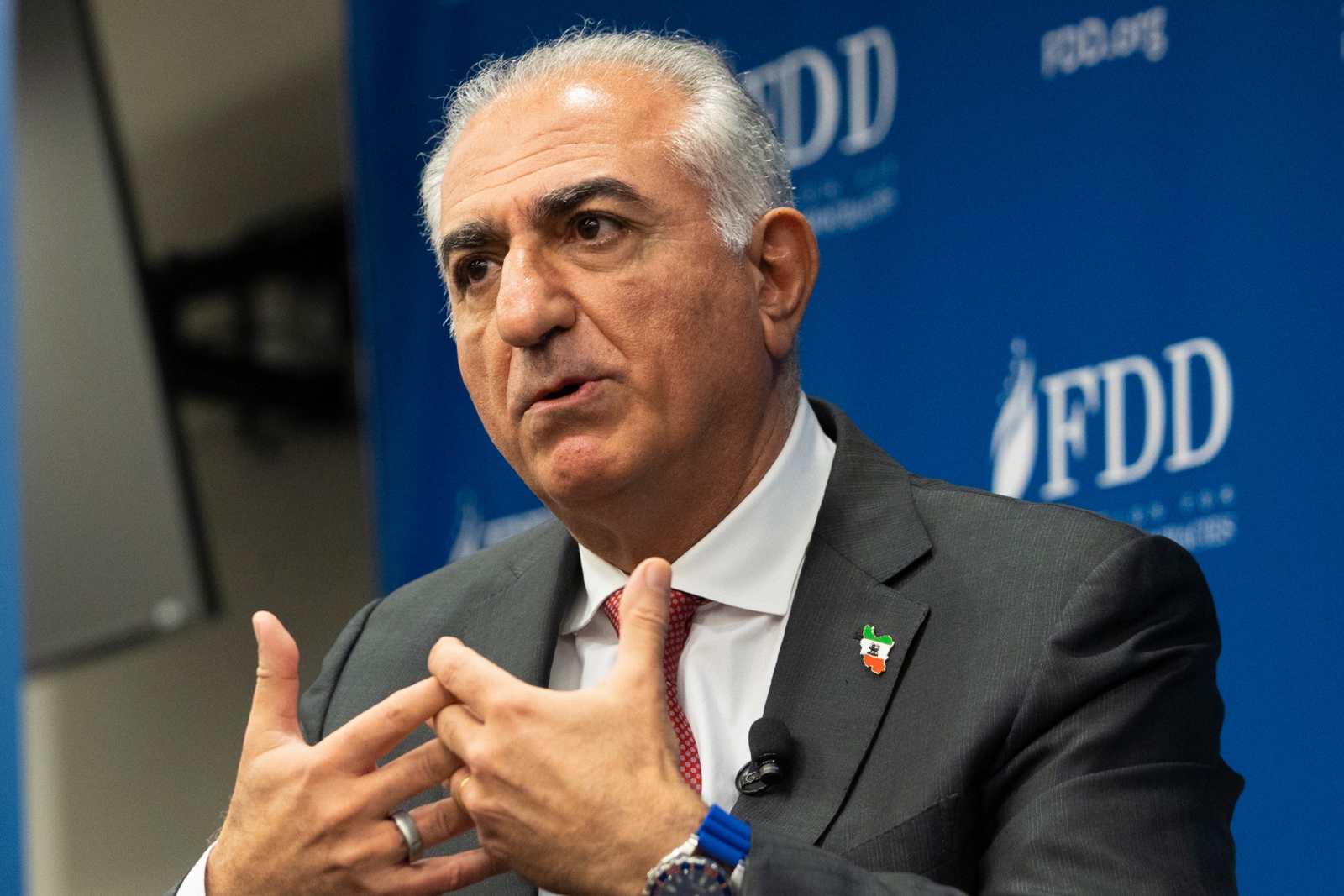
Adolf Hitler once observed, “By means of shrewd lies, unremittingly repeated, it is possible to make people believe that heaven is hell – and hell heaven. The greater the lie, the more readily it will be believed.” Crown Prince Reza Pahlavi, son of Iran’s ousted Shah, appears to be drawing from that dark playbook. On August 1, he unveiled a plan for Iran’s future following a hoped-for collapse of the clerical regime. The “Pahlavi Plan,” as set out, centers on a transition in which he presides with sweeping, personal authority for at least three years—appointing the heads of the executive, legislature, judiciary, and intelligence services, and answering to no one. The architecture resembles rule by decree.
Each time the theocracy looks unsteady, Pahlavi—now 64—reemerges from his home outside Washington, D.C., to remind Iranians of his claim to the Peacock Throne. His father, Mohammad Reza Shah Pahlavi, was toppled in 1979 amid mass anger over repression, corruption, and an extractive political economy. The Shah’s rule—marked by SAVAK, the feared secret police—left an indelible record of human-rights abuses and public loathing that helped fuel the revolution.
Untroubled by that history, Pahlavi has acknowledged contact with the Islamic Revolutionary Guard Corps (IRGC), ostensibly to secure order in a post-clerical interregnum. His plan folds IRGC personnel into new institutions rather than dismantling them. The analogy practically writes itself: it would be as if Churchill had pledged to keep the Gestapo to maintain stability after the fall of the Third Reich.
Inside Iran, critics say Pahlavi’s standing is minimal. Jokes about a “Crown Prince” in exile have become a kind of coping mechanism for citizens ground down by inflation, unemployment, and state violence. As tens of millions struggle, detractors argue that Pahlavi’s gilded exile—wealth and property linked by critics to fortunes siphoned off under his father—underscores the distance between his project and public sentiment.
The manifesto itself is explicit. After “the overthrow of the Islamic Republic in a national revolution” and the “joining” of the armed forces with the people, a Transition System would run the country “under the leadership of the Leader of the National Uprising [Reza Pahlavi],” comprising three bodies: the National Uprising Body, a Transitional Government, and a Transitional Judiciary. The program insists on an assertively secular nationalism centered on cultural revival and unity. It is also unmistakably hierarchical: Pahlavi would sit at the apex, directing every lever.
The theory of governance on offer is simple: only a strong, centralized authority can restore order. In practice, that means constraining pluralism and concentrating power in one leader’s hands—an approach long associated with authoritarian movements. The resonances with the 20th-century dictatorships Pahlavi’s critics reference are hard to miss: contempt for liberal democracy, suspicion of dissent, and the belief that political consolidation is synonymous with stability. The echo of his father’s one-party dominance is audible throughout.
Security is not incidental to this design; it’s core to it. The plan stresses a muscular internal order apparatus and an expansive role for the armed forces in governance. History offers a cautionary note: regimes that exalt the military as the foundation of national identity tend to normalize emergency rule. In Iran’s own past, the Shah’s reliance on the security state was precisely what radicalized broad swaths of society against him.
Pahlavi also casts himself as the singular tribune of a wounded nation—an anti-regime champion whose message of national resurrection will unite Iranians across divides. The strategy is unmistakably populist: a direct leader-people relationship that sidelines mediating institutions and political parties. As with other modern strongman projects, information control looms in the background. Propaganda—whether monopolized by the state or enforced by aligned power centers—becomes a tool to delegitimize opponents and manufacture consent.
The document’s mechanics are revealing. A Transitional Government would be formed with ministers “appointed by the head of the government [himself appointed by Reza Pahlavi] after approval by the National Uprising Body (all appointed by Reza Pahlavi).” Its size and structure would be settled “in consultation with the National Uprising Body and with the Leader’s approval.” Embedded in the security plank is an openly coercive measure: the imposition of martial law in 20 ‘critical and high-risk’ cities to “maintain law and order and prevent social unrest.” That is not a democratic transition; it is emergency rule by design.
Take the blueprint as a whole, and its character is unmistakable. It consolidates extraordinary power in a single figure; suspends normal politics; and replicates the theocracy’s worst instincts—centralization, opacity, and the erasure of public participation—without the veneer of clerical oversight. Where today’s system fuses religion and security, Pahlavi’s model fuses monarchic nostalgia and security. Both marginalize citizens.
Bad ideas are best defeated by better ones. Pahlavi’s manifesto, in its premises and particulars, is a plan for an illiberal transition that risks entrenching a new autocracy. The better idea is simpler and harder: back the people of Iran and their organized, democratic opposition—those building accountable institutions, independent courts, and a civil state that belongs to its citizens rather than to a supreme leader by any other name.