
Who Really Runs Iran After Khamenei?
For decades, the stability of the Islamic Republic rested on a single assumption: that a powerful Supreme Leader, ruling under the doctrine of Velayat-e Faqih, or Guardianship of the Islamic Jurist, would remain the regime’s principal source of cohesion. The office stood at the center of the state and underwrote its resistance to what Tehran has long portrayed as its foremost adversary, the United States.
But after the killing of Ali Khamenei and the failure of a commanding successor to emerge, Iran’s military and security institutions have taken an increasingly prominent role in decisions ranging from diplomacy to military operations. The shift raises a fundamental question: If the machinery of decision-making has changed, does the Islamic Republic still need a Supreme Leader to preserve unity at the top of the state?
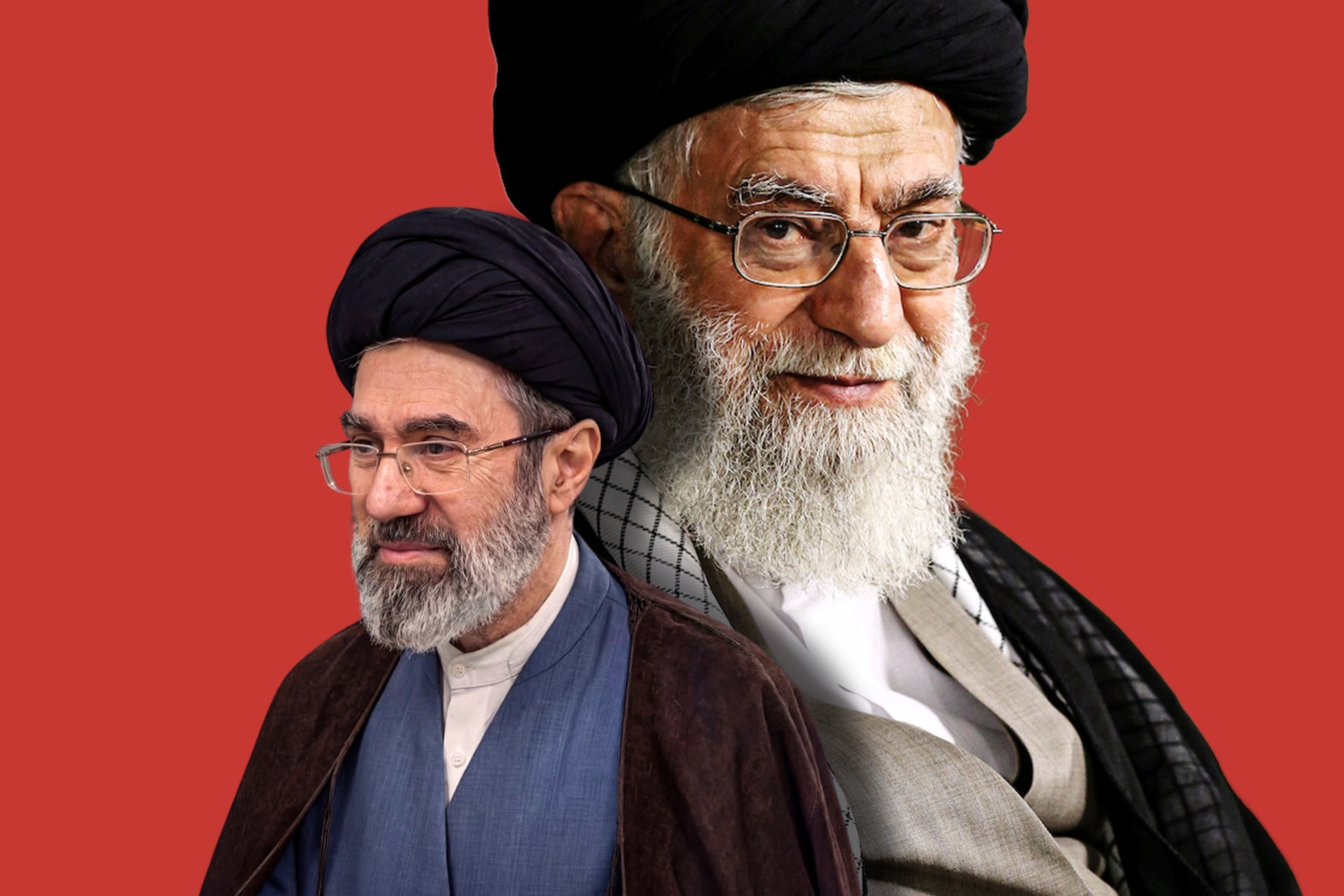
Ali Khamenei was assassinated in a joint U.S.-Israeli strike on February 28. The Assembly of Experts subsequently appointed his son, Mojtaba Khamenei, as Supreme Leader. Shortly afterward, he too reportedly came under attack, and Iran’s domestic media have published no recent image of him. Nearly four months later, the country’s most consequential political and military decisions appear to rest with the regime’s hard-power core: the Islamic Revolutionary Guard Corps, Khatam al-Anbiya Central Headquarters, and the Supreme National Security Council. Authority over matters of national importance may be shifting quietly from the office of the Supreme Leader to the military and security institutions created to serve it.
The Supreme Leader occupies a unique place in the constitutional architecture of the Islamic Republic. Article 110 grants him sweeping authority: He determines the state’s general policies, commands the armed forces, declares war and peace, resolves disputes among the branches of government, and appoints senior judicial, broadcasting, and military officials, including the chief of the armed forces’ general staff and the commander of the IRGC. Taken together, these powers make the Supreme Leader the state’s ultimate arbiter of domestic and foreign policy. In the absence of an authority capable of exercising them, competition among Iran’s military and political institutions is likely to intensify.
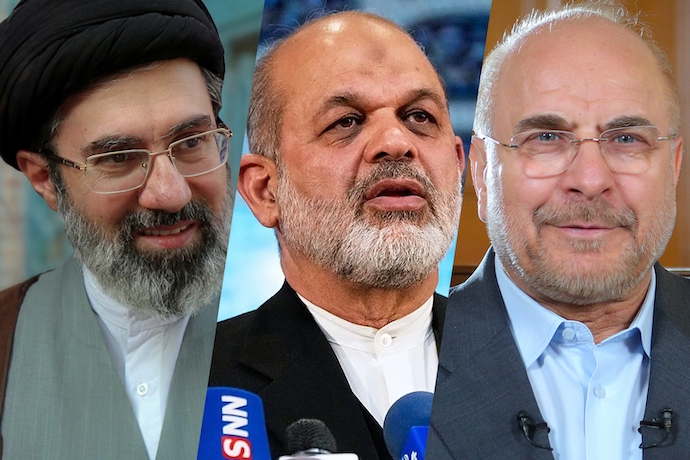
Yet since Khamenei’s death, important decisions have increasingly been made elsewhere. Responsibility for diplomacy and negotiations has fallen largely to the Supreme National Security Council and, more specifically, to Mohammad Bagher Ghalibaf, the speaker of parliament. A former commander of the IRGC Air Force and former chief of Iran’s national police, Ghalibaf is one of the few figures who commands the confidence of both the security establishment and the civilian government.
Foreign policy is now being shaped less by the president or foreign minister—neither of whom was ever the system’s principal decision-maker—than by the Supreme National Security Council. The IRGC has assumed responsibility for military affairs, while Khatam al-Anbiya Central Headquarters coordinates operations and functions as the armed forces’ principal operational command and public voice. Decisions that Ali Khamenei once made personally, and that drew legitimacy from his authority, are now being reached collectively, often through coordination within the security council. Power has not disappeared. It has been dispersed among institutions that once operated beneath a single commanding figure.
Two explanations could account for this change. The first is that the present arrangement is temporary—a response to a sudden leadership vacuum. On this reading, an authoritative Supreme Leader will eventually consolidate power and restore the office as both the regime’s ultimate decision-maker and the source of its political legitimacy. Iran’s military institutions, particularly the IRGC, have expanded their influence during crises before. Their current prominence may therefore reflect the emergency rather than a durable redistribution of power.
The second explanation is more consequential. Iran may be witnessing not merely the transfer of authority from one individual to a collective body, but a transformation of the decision-making system itself. If the Supreme Leader’s absence has not visibly impaired the state’s ability to formulate and execute strategic policy, then Ghalibaf and other security elites cannot be understood simply as caretakers filling a temporary vacuum. The question is no longer whether the IRGC has grown more powerful. It is whether the organization remains the executive arm of the Supreme Leader—or has become the regime’s true center of decision-making.
Comparisons with other authoritarian systems help illuminate the change, but they also reveal what makes Iran distinct.
At first glance, the Islamic Republic’s evolving power structure may resemble China’s, where political authority flows primarily from the Communist Party rather than from any single officeholder. The analogy soon breaks down. In China, the formal political order and the actual distribution of power broadly reinforce one another. In Iran, by contrast, a widening gap has opened between the authority prescribed by the constitution and the institutions exercising power in practice.
The constitutional order remains anchored in the Supreme Leader even as effective power shifts toward the security establishment. Military institutions may make decisions, but they must still claim legitimacy through an office they have increasingly displaced.
Russia offers another useful comparison. The Russian Constitution places the president at the apex of the political system, but the influence of the siloviki—the officials and networks rooted in the security services—over strategic policy is well established. Iran differs in one crucial respect. Even as the condition and role of its Supreme Leader have become increasingly uncertain, the security establishment continues to rely on Velayat-e Faqih as the source of political legitimacy.
The doctrine grounds the state in the guardianship of an Islamic jurist and ties the regime’s authority to its interpretation of Shiite religious rule. Russia’s security elites exert much of their influence through informal networks and political leverage. Iran’s military institutions, by contrast, have openly assumed responsibility for central military and strategic decisions. Their power is more visible, but it is not self-legitimizing.
Iran’s trajectory also invites comparison with Pakistan. In both countries, the military and security establishment shapes the most consequential foreign-policy and national-security decisions more decisively than formally elected institutions do. Pakistan’s Corps Commanders Conference has long provided a forum through which the army’s senior leadership establishes priorities that influence the work of the foreign and finance ministries. That intervention has often been justified by political instability, economic weakness, and the imperatives of national security—rationales familiar in Tehran as well.
But here, too, the similarities have limits. Pakistan’s military derives authority from its own institutional position and historical role within the state. It does not require validation from a higher political or religious office, even if it often seeks democratic cover as an expression of the national will. Iran’s security establishment cannot so easily dispense with Velayat-e Faqih. However extensive its practical authority becomes, it still invokes the Supreme Leader to justify its decisions and presents its actions as the execution of his guidance. The IRGC may be able to rule, but it cannot yet explain why it has the right to do so without him.
In Militarization and War, published in 2007, Julian Schofield argues that regimes under acute security pressure often alter their decision-making structures to reduce two recurring dysfunctions: delays and cybernetic errors. In the decade before the First World War, the militaries of the major European powers assumed increasingly important roles in crisis management, often sidelining diplomats. Israel’s cabinets have likewise featured historically high levels of military representation, in part because experienced officers are thought to shorten the time required to formulate policy during emergencies.
But the same concentration of authority can produce cybernetic errors: By elevating military voices during a crisis, governments diminish the influence of ministries responsible for diplomacy and of civilian agencies capable of measuring domestic political support. Pakistan’s decision-making before the 1971 Indo-Pakistani War illustrates the danger. Its foreign ministry was reduced largely to procuring weapons, while India seized the diplomatic initiative and isolated Pakistan by assembling a broad international coalition. The IRGC’s disproportionate influence carries a similar risk. Tehran has concentrated on its regional armed allies while devoting less energy to diplomatic outreach farther afield. A system designed to act quickly can become less capable of seeing the political landscape in which it acts.
Iran is therefore evolving into neither a post-Velayat-e Faqih order nor a conventional military dictatorship. Instead, the Supreme Leader’s role appears to be undergoing a fundamental transformation: from the institution that makes the state’s most consequential decisions to the institution that legitimizes decisions made elsewhere.
The IRGC consequently has little incentive to govern openly without reference to the Supreme Leader. At a moment when the Leader’s status is itself uncertain, invoking his authority continues to serve three essential purposes. It supplies constitutional legitimacy, preserves the regime’s religious claims, and helps maintain unity among its competing factions, particularly within the hard-line establishment. Without that symbolic authority, the IRGC would have to assume direct political responsibility for the state’s successes and failures alike. It is no coincidence that major decisions continue to be announced in the Leader’s name. Removing the regime’s principal source of legitimacy would leave the security establishment powerful but politically exposed.
Senior political and military figures repeatedly demonstrate this dependence. Members of Iran’s negotiating team have said that talks were conducted at the Supreme Leader’s direction and that Ghalibaf assumed responsibility for the diplomatic portfolio only with his explicit authorization. Ghalibaf has similarly declared that the negotiating team is acting according to the Leader’s instructions. Even the IRGC has justified strikes against U.S. bases in the region by referring to the Leader’s statements, describing them as a “wise message” that strengthened public awareness and national unity against what it called an aggressive enemy.
Such claims point to a broader reality. Despite their growing operational authority, Iran’s security institutions remain unable to generate political legitimacy independently of the Supreme Leader’s office. The central transformation underway is therefore not a straightforward transfer of power from the Supreme Leader to the IRGC. It is a division between two forms of power: the authority to make decisions and the authority to validate them. For the first time in the history of the Islamic Republic, the institution directing strategic policy may no longer be the institution that gives that policy its legitimacy.
The issue is not simply the expanding reach of the IRGC, but the changing relationship between effective power and political legitimacy. The organization may be capable of commanding forces, conducting negotiations, and directing state policy. What it cannot yet do is manufacture consensus—or a durable claim to rule—on its own. The most important question facing Iran is therefore no longer who will succeed Ali Khamenei. It is whether the regime can survive if Velayat-e Faqih ceases to function as its ultimate source of legitimacy.