
Inside the Luxury Resort Mongolia’s Fuel Crisis Never Reached
At a luxury resort on Mongolia’s Khyargas Lake, the country’s rich and powerful spent the summer chartering helicopters, cruising aboard Italian yachts, and riding jet skis. Beyond the resort’s secluded shores, ordinary Mongolians were struggling through one of the country’s worst fuel crises in decades.
Khyargas Aurum Resort offered Mongolia’s elite an escape seemingly untouched by the shortages gripping the rest of the country. But the property’s connections extend well beyond luxury tourism. It is tied to the family of Jononbayar Erdenesuren, a central figure in Mongolia’s $1.1 billion Lex Oil fuel-fraud scandal, whose network of companies continues to control a significant share of the country’s fuel imports.
The resort announced its opening on July 9, 2026. Days later, Gankhuu Gendendaram, a musician and former politician, posted a 19-minute video documenting his stay. Comparing the experience to living like an Arab sheikh, he showed his family cruising aboard one of the resort’s Italian-made Pardo yachts, riding dune buggies, and enjoying Italian wine. They returned home aboard a privately chartered helicopter.
Within weeks, Khyargas Aurum had become one of the summer’s most fashionable destinations. Uka, one of Mongolia’s biggest pop stars, was photographed paddleboarding and relaxing aboard one of the resort’s two yachts. Models and social media influencers documented similarly extravagant visits throughout July.
By early August, the contrast between life at the resort and conditions elsewhere in Mongolia had become impossible to ignore.
On August 4, the country’s Emergency Headquarters imposed fuel restrictions in Ulaanbaatar. Motorists could purchase fuel only on designated days, determined by their license plate numbers, while the use of portable petrol containers was prohibited.
Tourism operators, however, received an exemption. On August 7, the Ministry of Industry and Mineral Resources announced that tourism businesses traveling outside Ulaanbaatar could purchase fuel without the ordinary limits by presenting industry identification. The land occupied by Khyargas Aurum is officially registered for use as a tourism camp.
The restrictions appeared to have little effect on the resort’s operations. On August 9, six days into the rationing measures, Kazakh influencer Kanat Aynur posted 21 photographs from Khyargas Aurum. They showed a helicopter parked outside the resort’s terrace, a Pardo yacht being moored, jet skis, and a dune buggy. Meanwhile, helicopter charters operated by Alpha Aurora Aviation continued carrying guests to the property.
The resort’s fleet of helicopters, yachts, jet skis, and recreational vehicles showed no visible signs of being constrained by the shortages affecting ordinary motorists.
The family behind the resort is closely connected to Jononbayar Erdenesuren, a businessman whose name has become associated with the Lex Oil scandal. Even before Khyargas Aurum formally opened, social media users were identifying it as his project. One commenter described it in late July as the famous Jononbayar’s business, while another referred to it as belonging to “thief Jononbayar.”
The family connection was hardly concealed. Within weeks of the resort’s launch, five-star Google reviews had appeared from Jononbayar’s aunt, his reported girlfriend, and 108 Oil, another fuel importer linked to the family’s business network.
 Despite the publicity surrounding its opening, it remains unclear whether Khyargas Aurum has ever operated as a conventional resort open to the general public. No nightly rates have been published. Across four of the resort’s social media posts, 20 commenters asked about prices or reservations without receiving any public response.
Nor was July 2026 the property’s true beginning.
As early as 2024, Mongolian media reported that Jononbayar already maintained a tourist camp on Khyargas Lake, traveling there aboard helicopters operated by Alpha Aurora Aviation. Earlier reporting also claimed that he had imported three Italian Pardo yachts in 2020 for use at the property. Khyargas Aurum’s own social media accounts indicate that development of the resort had been underway since 2023.
The property’s origins lead back to 2021, when the land was awarded to Good Future LLC, a company with its own connections to the Lex Oil network.
Good Future was registered in 2017, with Dorjgochoo Erdenetuyaa as its sole shareholder. Before acquiring the resort land, its only recorded business venture was connected to fuel. On April 3, 2019, Good Future became a shareholder in Petroleum Production, a company licensed to import and wholesale petroleum products.
Two days earlier, VS Oil, founded by Erdenetuyaa’s brother-in-law, Dashnyam Chinbat, the husband of Dorjgochoo Erdenetuul, had acquired a stake in Lex Oil.
Mongolian reporting has identified Good Future among 12 companies allegedly controlled by five members of the same family, describing them collectively as part of a counterfeit fuel network. Petroleum Production has also faced scrutiny. In January 2025, Mongolia’s Deputy Speaker of Parliament named the company during a State Palace press conference as an example of an alleged counterfeit fuel operation.
Good Future disposed of its stake in Petroleum Production in January 2021. Five months later, the company applied for possession rights to approximately two acres of lakeside property where Khyargas Aurum would eventually be built.
The circumstances surrounding that land allocation raise questions of their own.
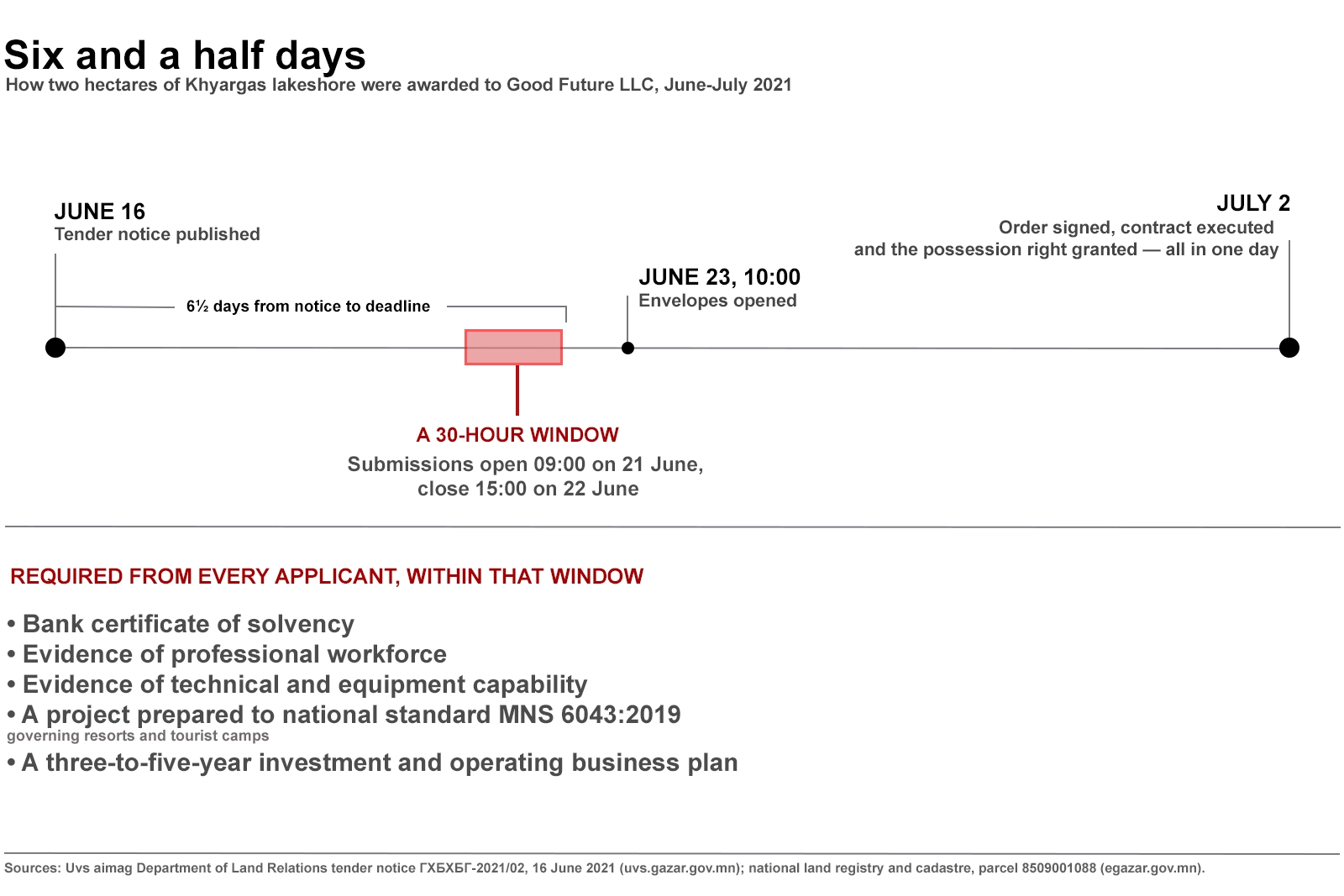
On June 16, 2021, the Uvs provincial land department published a notice offering 12 parcels across four districts, including five sites along the shores of Khyargas Lake. One of those parcels, specifically designated in the 2021 allocation process, would become the resort.
Applications opened at 9 a.m. on June 21 and closed just 30 hours later. During that narrow window, prospective applicants were required to submit bank solvency certificates, evidence of qualified personnel and equipment, and a comprehensive resort development plan meeting national standards.
Nine days later, the provincial governor approved the allocation. The land contract was executed, and the possession right was registered, all on the same day.
At the time, Good Future had no director listed in its company records and no licenses recorded in the public register.
Although the official documents listed an opening auction price of $4,446.93, no auction took place. Instead, Good Future obtained the land through a project-selection process in which officials evaluated development proposals rather than awarding the property to the highest bidder.
The company secured possession rights lasting until 2041, with an annual payment of just $110.
The officials responsible for the allocation subsequently became embroiled in a separate criminal case involving allegedly improper land grants in Uvs province.
U. Bolor-Erdene, the cadastral specialist who registered Good Future’s possession rights, was charged with abuse of office three years later, alongside the provincial governor and the acting head of her department. Prosecutors alleged that land had been allocated outside the approved land-management plan, including to relatives and political associates.
Those charges concern a separate case and do not, by themselves, establish wrongdoing in Good Future’s allocation. Nevertheless, the resort’s unusually compressed application process, favorable terms, and connections to an influential business network warrant closer scrutiny.
The resort that emerged on the shores of Khyargas Lake was not simply an isolated luxury development. Its corporate connections reveal an interconnected family business empire spanning fuel imports, aviation, construction, food, and luxury retail.
Good Future is registered at an apartment in Ulaanbaatar’s Emerald Residence complex. The same address has been used by several other companies owned or formerly controlled by Erdenetuyaa. Among them is Uptown Place, a construction company she acquired five months before Good Future received the Khyargas land.
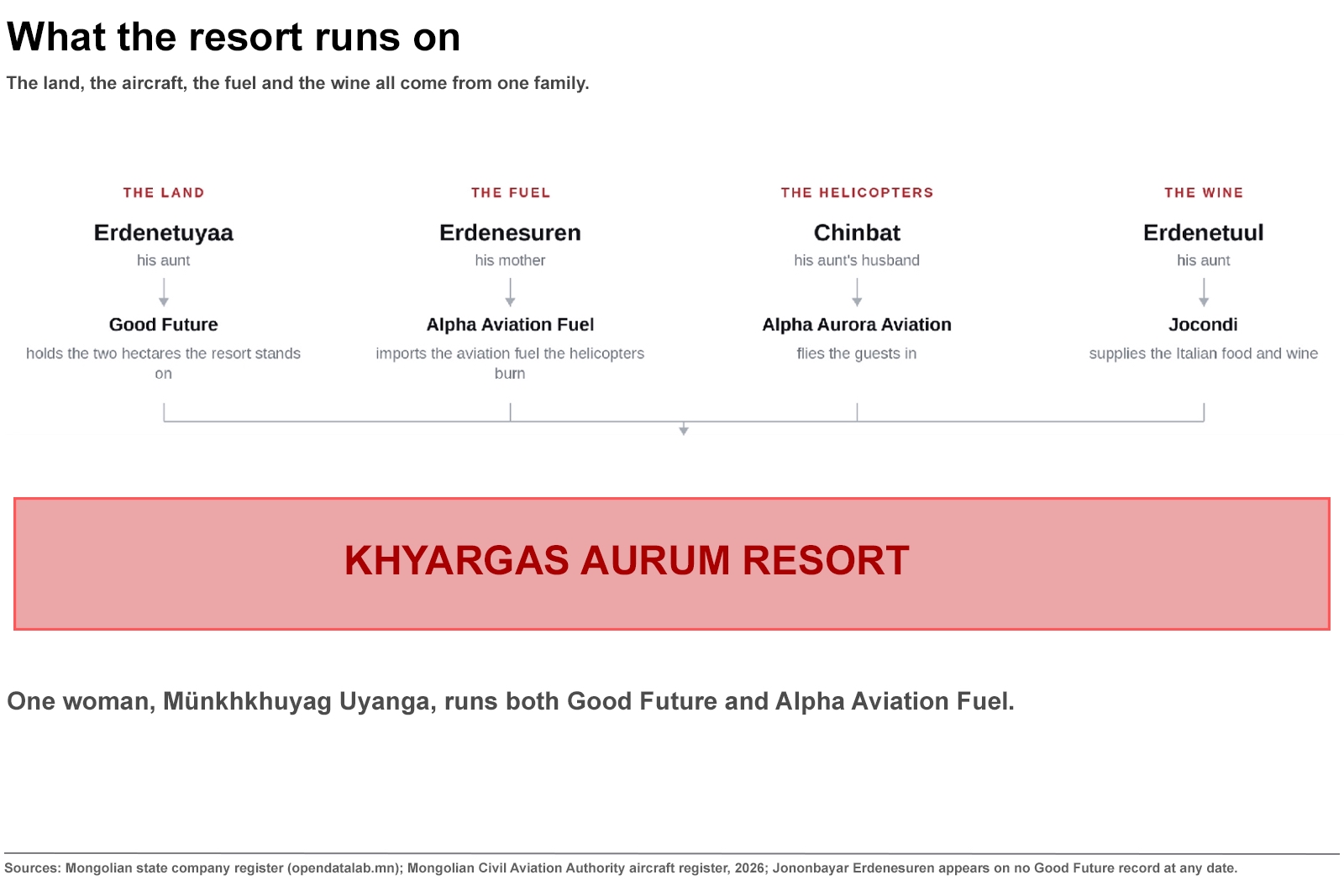
Good Future’s executive director, Münkhkhuyag Uyanga, also manages Alpha Aviation Fuel, a licensed petroleum importer and wholesaler supplying aviation fuel in Mongolia.
Alpha Aviation Fuel was founded by Jononbayar’s mother, Dorjgochoo Erdenesuren, and his aunt, Dorjgochoo Erdenetuul. Erdenesuren remains its registered ultimate beneficial owner.
The helicopters transporting guests to Khyargas Aurum are operated by Alpha Aurora Aviation, another company with ties to the same network. Established in 2023 by VS Oil, Alpha Aurora has already attracted national attention for its connections to Mongolia’s political elite.
In 2025, one of the company’s helicopters appeared in photographs of an extravagant marriage proposal involving the son of then-Prime Minister L. Oyun-Erdene.
The images became part of a broader controversy over the wealth and lifestyles of Mongolia’s political establishment. Public anger helped fuel three weeks of anti-corruption protests, culminating in Oyun-Erdene’s loss of a parliamentary confidence vote and his resignation on June 3.
Even the Italian food and wine served to guests at Khyargas Aurum can be traced through the family’s network of businesses.
Jocondi, a company registered in another building within the Emerald Residence complex, has been owned and managed since 2018 by Dorjgochoo Erdenetuul, a family member implicated in the Lex Oil affair.
During Mongolian court proceedings, Jocondi’s accountant testified that the company operated the Smeraldo food store at Emerald Residence, along with two luxury fashion outlets.
The Italian brand Redoro is associated with the Smeraldo store and Jocondi. Promotional leaflets featuring the brand, complete with QR codes allowing guests to make purchases, can be seen on tables in photographs taken at Khyargas Aurum.
During his video tour of the property, Gankhuu described the Italian importer as a subsidiary belonging to the resort’s owners.
The connections are revealing. From the land beneath the resort to the helicopters flying guests there, the aviation fuel used to power them, and the imported products offered once visitors arrive, Khyargas Aurum sits at the intersection of businesses controlled by members of the same family.
And despite the exposure of the alleged $1.1 billion Lex Oil fraud, the family’s commercial reach appears to have continued expanding.
 Of the 34 licenses Mongolia issued for the importation of various types of fuel during 2025 and 2026, seven went to companies connected to Jononbayar’s network.
That figure underscores the extraordinary contradiction at the heart of Khyargas Aurum.
While ordinary Mongolians were being told when they could purchase fuel and how much they were permitted to buy, the family connected to this luxury retreat remained deeply involved in the business of importing it.
And as motorists elsewhere confronted rationing and shortages, the helicopters continued arriving, the Italian yachts continued cruising, and the jet skis continued carving through the waters of Khyargas Lake.
For the guests of Khyargas Aurum, Mongolia’s fuel crisis might as well have been happening in another country.