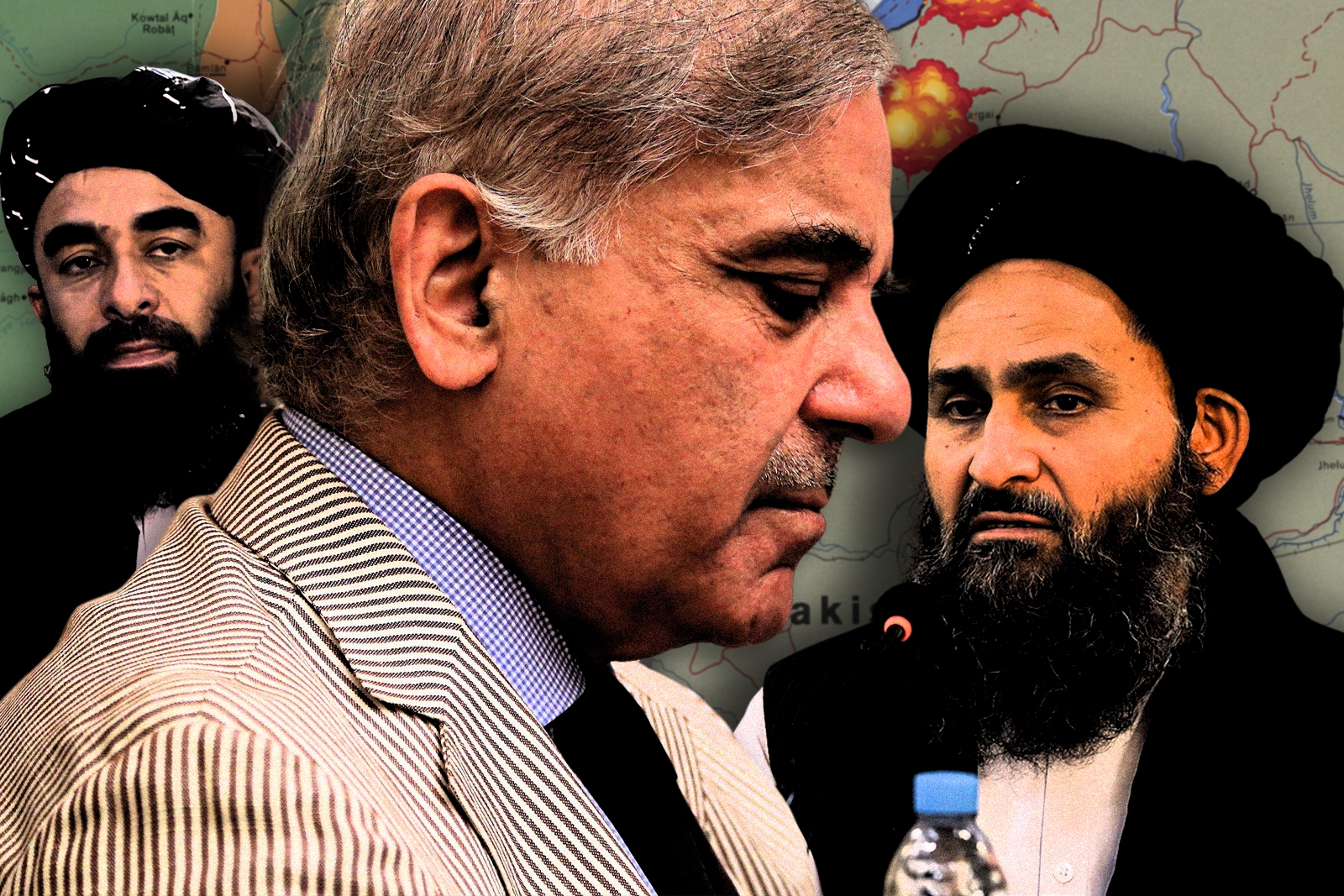

Parsing Zabihullah Mujahid’s Broadside Against Pakistan
The Taliban government’s chief spokesman, Zabihullah Mujahid, recently accused Pakistan of shirking responsibility for cross-border security and of failing to cooperate on the fate of Afghan migrants. It’s a sharp charge, and a politically useful one in Kabul, but it glosses over years of Pakistani counterterrorism efforts, the Taliban’s own unfulfilled commitments under the Doha Agreement, and Islamabad’s long, costly history of hosting Afghans displaced by war. Put plainly, Mujahid’s remarks invert the problem: much of what he faults Pakistan for is the very thing the Taliban has failed to do.
Mujahid’s framing of cross-border militancy is especially off the mark. For years, Pakistan has been the one pressing the issue of Afghan-based militants, not the other way around. Islamabad has repeatedly warned that groups such as Tehrik-i-Taliban Pakistan (TTP) and the Baloch Liberation Army (BLA) continue to find sanctuary inside Afghanistan — a problem that only deepened after the U.S. withdrawal in 2021, when the Taliban consolidated power and many militants enjoyed freer movement.
Pakistani intelligence services, as well as international monitoring bodies, have documented the presence and activity of these groups on Afghan soil, and reports from the United Nations and the Special Inspector General for Afghanistan Reconstruction have echoed those concerns. These are not vague allegations; they are assessments grounded in years of regional counterterrorism reporting. Pakistan, in other words, has been trying to stop attacks launched from Afghanistan, not ignoring them.
Against that record, Mujahid’s suggestion that Pakistan “hasn’t taken responsibility” looks detached from reality. Islamabad’s security establishment has spent years trying to plug the Afghan frontier, including fencing long stretches of the border, upgrading surveillance, and raising the issue through diplomatic channels. Pakistani officials have pushed the matter in every available forum, because for Islamabad, the issue has been singular and consistent: stop militants from crossing over, staging attacks, and retreating back into Afghan territory. That is the opposite of passivity.
The Doha Commitments, Unmet
This is where the 2020 Doha Agreement matters. The deal between the Taliban and the United States was sold as a pathway to a more stable Afghanistan and a less permissive environment for transnational militancy. The Taliban undertook to break with terrorist groups, start intra-Afghan talks, and prevent released fighters from cycling back into violence. Yet most of those benchmarks remain unmet.
One of the most consequential provisions was the Taliban’s pledge to ensure that the roughly 5,000 prisoners released as part of the deal would not rejoin the battlefield. Subsequent reporting has shown that many did exactly that, contributing to the insecurity that now spills across borders. For Pakistan, which shares an often-porous frontier with Afghanistan, that failure was not academic — it translated into real threats to Pakistani soldiers, civilians, and state installations. When Kabul does not restrain militants operating from its territory, it is Pakistan that absorbs the blowback.
Just as troubling has been the Taliban’s refusal to move toward an inclusive political order. The movement’s leadership, still dominated by Pashtun ex-combatants, has systematically sidelined non-Pashtun communities from meaningful representation. That exclusion runs directly counter to the Taliban’s assurances to the international community and to the expectations created around Doha: that a post-war Afghanistan would not be monopolized by one faction. The result is a government that lacks broad legitimacy at home and credibility abroad — and one that is poorly positioned to lecture neighboring states on regional responsibility.
Pakistan, meanwhile, has continued to try to manage the relationship. Since the Taliban returned to Kabul in August 2021, Islamabad has opted for engagement over isolation — sending foreign and defense officials, dispatching special representatives, and maintaining working-level contact to prevent the border from becoming even more combustible. By Pakistan’s own count, there have been eight meetings of the Joint Coordination Committee, more than 225 border flag meetings, hundreds of formal protest notes, and over a dozen demarches to Afghan authorities on cross-border attacks. That is what a sustained diplomatic effort looks like. It is difficult to reconcile such a record with Mujahid’s portrayal of an uncooperative Pakistan.
What has made these efforts falter is not Pakistan’s reluctance but the Taliban’s. Kabul has been unwilling or unable to decisively curb the TTP, and elements within the Taliban remain intertwined with networks such as the Haqqanis. So long as Afghan territory remains a springboard for anti-Pakistan militancy, Islamabad will struggle to secure its western flank — no matter how much fencing it puts up or how many meetings it convenes. In that sense, it is Afghanistan under the Taliban, not Pakistan, that has failed to meet the basic obligations of a responsible neighbor.
The Refugee and Migrant Question
Mujahid’s criticism on the migrant issue is just as selective. Few countries have carried the Afghan refugee burden as long or as extensively as Pakistan. Over four decades, through repeated phases of conflict in Afghanistan, Pakistan has hosted more than 4 million Afghans, at times with international assistance but often while straining its own infrastructure, schools, and health system. Afghan families enrolled their children in Pakistani schools and universities; many Afghans worked and ran businesses; entire communities put down roots. That hospitality persisted even as Pakistan faced its own economic headwinds and security concerns.
Given that history, Mujahid’s call for Pakistan to “recognize” and “assist” Afghan migrants lands oddly. Pakistan has been assisting them for years, at scale, and at considerable cost. What Mujahid leaves out is that a durable solution for Afghans ultimately requires stability and rights inside Afghanistan itself. Yet since 2021, the Taliban has presided over an environment in which Afghan women and girls have been systematically stripped of access to secondary education, most forms of employment, and public life. A government that bans girls from school while tolerating or failing to control armed groups on its territory is not in a strong position to moralize about humanitarian responsibilities in neighboring states.
Humanitarian responsibility is not only about sheltering those who flee; it is also about creating the conditions that make flight unnecessary. On that count, Afghanistan under the Taliban lags far behind. Pakistan, by contrast, is still carrying the downstream consequences of Afghan instability — people seeking safety, militants seeking sanctuary, and an international community that increasingly expects regional states to absorb the shocks.
Misplaced Accusations
Seen in full, Mujahid’s accusations ignore the core dynamic at work. Pakistan has, for years, tried to stop militants from operating out of Afghanistan and crossing its border. It has tried to keep a diplomatic channel open with the Taliban government despite serious provocations. It has housed millions of Afghans for decades. The Taliban, for its part, has failed to fully implement its Doha promises, has not built an inclusive political order, has not convincingly reined in anti-Pakistan militant groups, and has presided over some of the harshest restrictions on women and girls anywhere in the world.
That does not make Pakistan blameless; border management remains tense, and Islamabad’s own policies toward Afghans have fluctuated with domestic politics and security pressures. But the picture painted by Mujahid, of an uncooperative Pakistan obstructing Afghan security and humanitarian needs, is the inverse of what the record shows. If Kabul wants to ease tensions with Islamabad, the most effective step is not to issue public broadsides, but to do the one thing Pakistan has been asking for all along: stop Afghan territory from being used to attack Pakistan, and start governing in a way that gives Afghans fewer reasons to leave.