

The Long Shadow of America’s Response to 9/11
This Friday marks the twenty-fifth anniversary of the 9/11 attacks, a tragedy that has profoundly shaped Americans’ perceptions of the world and the country’s relationship with it ever since. First and foremost, the attacks on the Twin Towers and the Pentagon were an unspeakable act of brutality and mass violence. That day upended innumerable American lives and became a generational dividing line for those who came of age at the turn of the millennium, much as the Kennedy assassination had for an earlier generation.
I had family in both New York City and Washington, D.C., that day. Although I thankfully lost no relatives or friends, the immediate and lingering fears were real, as were the residual post-traumatic effects. Beyond the deeply personal toll, however, the attacks left an indelible mark on the American political psyche, shaping the worldview of many citizens and leaders ever since.
With the benefit of twenty-five years of hindsight, it seems to me that the two most enduring political consequences of 9/11 have been the rise of American militarism and unilateralism. The fervent faith in militarism rests on the belief among American leaders that nearly every problem can be solved through overwhelming force. When you have the world’s biggest hammer, every problem begins to look like a nail. That military might, in turn, encouraged the fallacy that we could do it all alone.
Americans’ unwavering faith in military power has been accompanied by the near-veneration of the military in our society. Not only can we supposedly solve our problems through airstrikes, cruise missiles, and special operations, but the military itself can apparently do no wrong and must remain beyond reproach. Criticizing the institution or its members is treated as blasphemous and wildly unpatriotic. This taboo against criticism, or even honest assessment, allows mistakes to be glossed over and abuses to be concealed.
Certainly, the vast majority of American service members have served with honor. They have given their time, talent, and sometimes their lives to these fights. But their sacrifice does not exempt the institution or its leaders from scrutiny and hard questions.
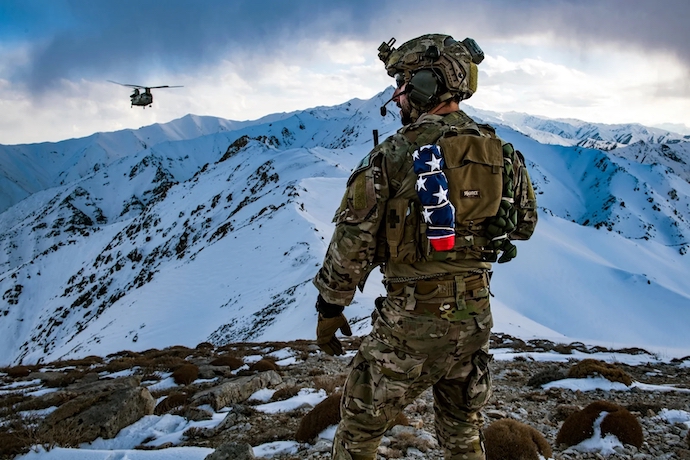
“Thank you for your service” has become such a reflexive platitude that, as a veteran, I genuinely dislike hearing it, despite the good intentions behind it. What I hear is: “I support our military blindly and in all things.” Rather than thanking me, I would prefer that people vote for politicians who support veterans’ benefits and medical care; who do not instinctively deploy our overtaxed troops to the ends of the earth in response to every international crisis; and who care more about the people in uniform than the institution’s reputation.
I was living in Switzerland during 9/11, and when I returned to the United States that Christmas, the country was noticeably different. Many families had tied yellow ribbons around the trees in their yards. People commented on military service and made a much bigger deal of it. But the most visible change was the ubiquitous, often gaudy display of the American flag. It appeared in every front yard, on every pickup truck, and across sports uniforms. This made me deeply uncomfortable because history has shown the abuses and human rights violations that flag-waving societies can rationalize in the name of nationalism.
Torture prisoners? Sure. Waterboarding? Whatever gets the job done. Secret prisons, the erosion of habeas corpus, warrantless surveillance of citizens? If such measures prevented another 9/11, they were deemed necessary evils. We sacrificed our liberties, ideals, and decency at the altar of performative patriotism.
The collective faith in militarism and in the infallibility of the U.S. military lay at the heart of this decay.
Alongside militarism emerged an intertwined conviction in American unilateralism. Having our allies on board was useful, but supposedly not essential. Yes, every NATO member invoked Article 5, under which an attack on one member is treated as an attack on all, in the immediate aftermath of 9/11. But if those allies would follow us into Afghanistan and not Iraq, Washington increasingly regarded them as surplus to requirements. This was a fallacy of the highest order.
The strength of our alliances helped us win the Cold War. We did not cement those relationships through threats or bullying, but through sustained commitments: stationing young American men and women in Germany, Japan, and South Korea for decades; providing financial and trade support as those countries rebuilt, developed, and prospered; and committing ourselves to liberal democratic principles in word and theory, even if our conduct did not always live up to them. The Iraq War, prosecuted above all by Dick Cheney and Donald Rumsfeld, was a revenge fantasy born of militarism and an emblem of unilateralism.
The dangerous nationalism that 9/11 fomented, and that the Bush administration exploited in the wars in Afghanistan and Iraq, has now come home to roost in the nativism and ugly exceptionalism of the Trump administration. If we are stronger, better, and more unique than everyone else, the logic goes, why should we need the talent, trade, or cooperation of other nations? Why not simply take what we want if we are powerful enough? Greenland and its strategic position? Sure. Venezuela and its oil? Sure. Iran and its oil? Well…
American history has endured two traumatic attacks of comparable political consequence: Pearl Harbor and 9/11. Above all, they should teach us that leadership matters.
After the underhanded attack on Pearl Harbor, the country had Franklin D. Roosevelt. Speaking to Americans by radio in his fireside chats, he pressed for unity and common purpose. He brought the country together and made the case for defending international freedom and democracy. At his urging, Americans fought and sacrificed not only for themselves, but for others. The Greatest Generation, laboring in factories at home and fighting abroad, turned the United States into the arsenal of democracy. America earned the admiration of its allies because it was willing to help them and work alongside them.
Tragically, when the 9/11 attacks occurred, George W. Bush and Dick Cheney were at the helm. Bush deserves credit for refusing to indulge Islamophobia in the attacks’ immediate aftermath, but his administration’s broader response, driven in particular by Cheney and Rumsfeld, centered on vengeance. This fevered focus on retribution produced two wars: one perhaps justified, the other clearly not.
The war in Afghanistan might have achieved positive ends and, for a time, did. Afghan girls attended school, a nascent if flawed democracy emerged, and the country ceased to serve as an uncontested base for attacks on the United States. But the effort never received the focus or resources it required because the administration became consumed by Iraq, a misguided war sold on false claims. Washington wanted to demonstrate that “shock and awe” could cow recalcitrant powers and bend the world to America’s will. Unilateral power, the administration suggested, would be enough. Cross us at your peril.
The consequences of American militarism have been stark, both for the countries subjected to our attacks and for the United States itself. The military-industrial complex continues to exert enormous influence, shaping foreign policy toward bellicose ends. Runaway spending on wars and conflicts, together with the largely unchecked expansion of the Department of Defense budget, has contributed to mounting fiscal pressure. Neither Democrats nor Republicans have shown much appetite for restraint, fearing that any attempt to curb military spending will invite accusations of being unpatriotic or insufficiently supportive of the troops, a cardinal sin in American politics.
The consequences of American unilateralism have been just as damaging. Our allies remain an enduring source of strength, yet American leaders, one in particular, have denigrated and discarded them. The nativism now ascendant in the United States is an ugly but recurring feature of our history.
It ignores a foundational truth: Our strength has always come in large part from being a country of immigrants. America has drawn talent from around the world to work in its factories and on its farms, study at its universities, and eventually found innovative companies that become the envy of the world. Nearly half of the Fortune 500 were founded by immigrants or their children. We cannot close our borders, just as we cannot antagonize our allies, without sacrificing something essential to who we are and what we can become.
Through both alliances and immigration, we have never truly gone it alone. We should not start now.
Twenty-five years after 9/11, the United States needs a reckoning and a better vision for the future, one that is more inclusive and capable of learning from our diverse history. We are, and should remain, a country of immigrants.
We should once again be a country that aids others not merely out of convenience or narrow self-interest, but because doing so is right. We could begin by restoring USAID, along with the funding and programs needed for it to fulfill its mission. The recently proposed U.S. aid package for Nepal was an absolute joke. The world has come to rely on American disaster relief and development assistance, and that help will become only more necessary as the effects of climate change cascade across vulnerable countries.
We need to lead on global democracy and international development. That requires rejecting nativism and isolation, appreciating our place in the world and our responsibilities to it, electing leaders who embody those values, and reflecting them in our budgetary priorities.
After 9/11, our embrace of militarism and unilateralism set the United States on its present errant course, leaving the country less respected abroad and its leaders openly reviled. We must shed the presumption that military force is the first or best answer. The U.S. military can and should contribute to global security, but it must be used judiciously and selectively. It can also continue its longstanding role in international disaster response.
Americans must also accept that we cannot solve the world’s largest problems by ourselves. Climate change, artificial intelligence, and economic inequality all demand common solutions and meaningful cooperation. Our allies stood by us after 9/11. We should continue to stand by them.