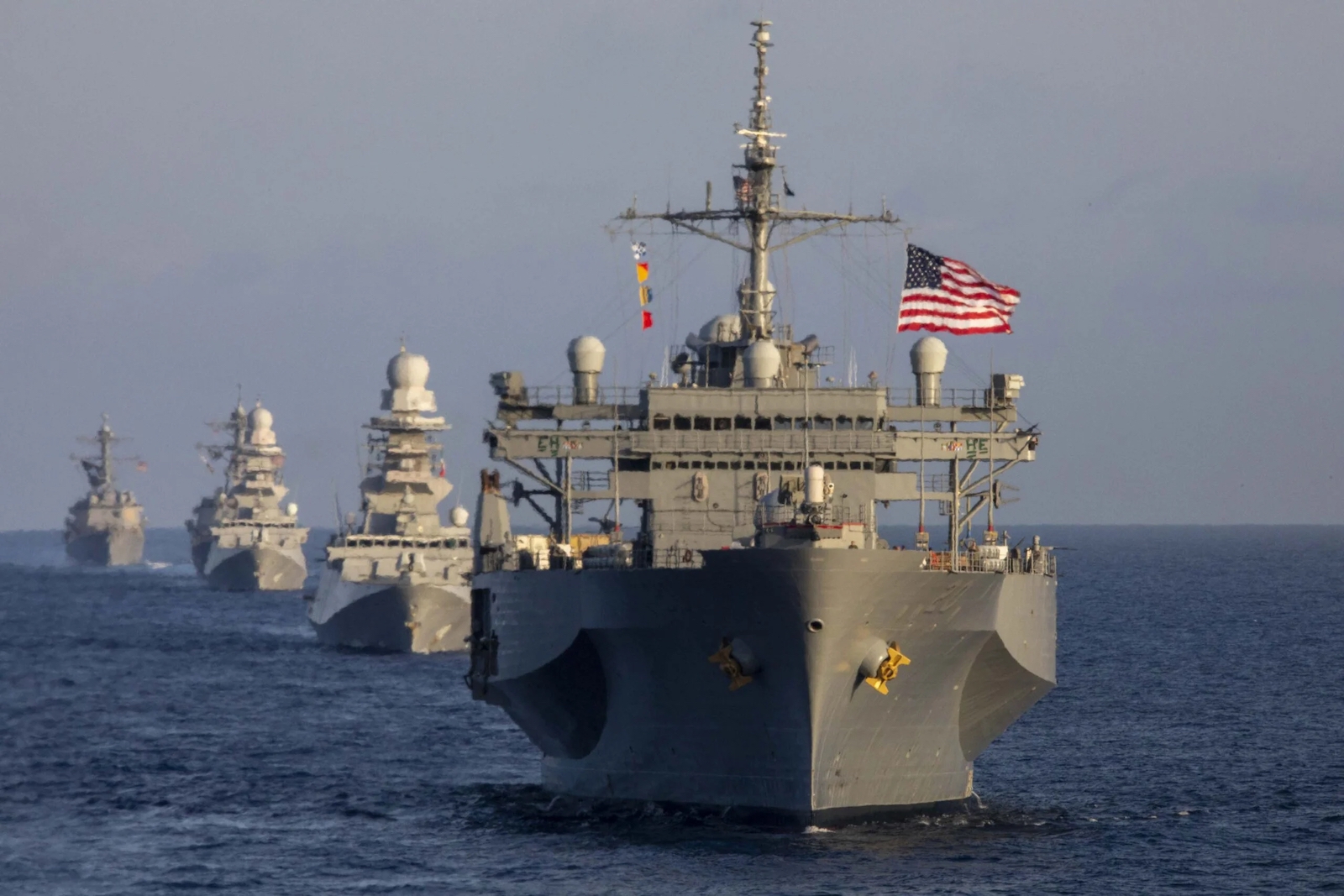

Trump Wants Korean-Built Warships. Good Luck With That.
At the recent G7 summit, President Donald Trump asked South Korean President Lee Jae Myung whether South Korea could quickly build 10 U.S. Navy warships. Lee replied that it could. Yet despite the optimistic exchange, the request is far less realistic than it appears. Two major obstacles stand in the way: Congress has moved to restrict the procurement of foreign-built naval vessels, and South Korea’s shipyards simply do not have the capacity to deliver such an order on the timetable Trump appeared to envision.
As part of its effort to strengthen U.S. sea power and expand America’s maritime presence in the Indo-Pacific, the Trump administration has explored procuring certain combat vessels from allied shipyards. This approach aligns with the broader concept of the Bridge Strategy, a procurement framework that would allow trusted foreign shipyards to build U.S. naval vessels while the United States rebuilds its own industrial base. At the same time, the administration hopes to revive domestic shipbuilding through allied investment—particularly from South Korea—and expand the American shipbuilding workforce.
These objectives, however, sit uneasily alongside one another. The administration is seeking greater long-term independence in U.S. shipbuilding while simultaneously relying on foreign shipyards to address immediate naval shortfalls. Adding to the tension are persistent concerns that procuring foreign-built battle force ships could create national security vulnerabilities and further weaken America’s domestic industrial base.
The Congress Problem
Congress has already begun responding to those concerns. Through its annual markups of the Fiscal Year 2027 National Defense Authorization Act (NDAA), lawmakers in both parties have proposed restrictions on the procurement of foreign-built naval vessels, allowing only limited exceptions.
In the House, the House Armed Services Committee approved an amendment prohibiting any FY2027 Pentagon funds from being used to procure battle force ships constructed in foreign shipyards. The Senate Armed Services Committee has taken a somewhat more permissive approach, allowing the procurement of up to four foreign-built auxiliary vessels—two bulk fuel ships and two sealift ships—but stopping well short of authorizing foreign construction of frontline combat vessels.
Given the broad bipartisan consensus on protecting the domestic shipbuilding industry and limiting potential national security risks, Trump’s proposal to purchase Korean-built naval warships appears unlikely to gain congressional approval.
Still, it would be premature to dismiss the possibility entirely. Committee amendments do not always survive the legislative process, and the restrictive provisions could ultimately be removed from the final version of the FY2027 NDAA. Such an outcome is hardly inconceivable given President Trump’s demonstrated ability to pressure congressional Republicans into supporting key elements of his legislative agenda. The narrow passage of the “One Big Beautiful Bill” in July 2025 and the Secure America Act in June 2026 illustrates the administration’s influence over Congress when major political priorities are at stake.
The Shipyard Capacity Problem
Even if Congress ultimately permits the procurement of Korean-built naval vessels, assuming South Korea could immediately fulfill an order for 10 U.S. warships would be a serious mistake. The issue is not capability but capacity.
South Korea possesses some of the world’s most advanced shipbuilders, including HD Hyundai and Hanwha Ocean, and the technical expertise to construct sophisticated naval vessels. What it lacks is available production capacity. Most major Korean shipyards are effectively booked through 2029 or even 2030. Floating docks, dry docks, slipways, and much of the skilled workforce have already been committed to commercial shipbuilding contracts years in advance.
Diverting production to fulfill a large U.S. naval order would therefore come at considerable cost. Shipbuilders could face substantial financial penalties for delaying or breaching existing commercial agreements with international clients. The strain on production schedules has already become apparent through South Korea’s commitments to construct LNG carriers for Qatar and Australia amid heightened demand following the U.S.-Israeli conflict with Iran.
Labor shortages present an additional challenge. Like the United States, South Korea is grappling with a shortage of skilled shipyard workers and has become increasingly dependent on foreign labor. Expanding production sufficiently to accommodate 10 additional naval vessels would require hundreds of experienced welders, engineers, electricians, and other specialized tradespeople who are unlikely to be readily available within South Korea’s existing shipbuilding workforce.
If Congress ultimately removes the restrictive provisions on procuring foreign-built battle force ships from the FY2027 NDAA, the most practical approach would be a phased procurement strategy rather than an immediate order for all 10 vessels. Korean shipyards could potentially begin construction on one or two ships in the near term, with the remaining vessels scheduled for delivery after 2030 as production capacity becomes available.
Even this approach, however, would come at a cost. Prioritizing U.S. naval contracts would almost certainly require delaying existing commercial shipbuilding commitments, exposing Korean shipbuilders to financial penalties and contractual liabilities. To make such an arrangement commercially viable, the Trump administration would likely need to incorporate compensation into any procurement agreement to offset the costs associated with postponing commercial deliveries.
If Congress ultimately retains the proposed restrictions, the administration would face two principal options: challenge the legislation or delay its ambitions.
One possibility would be for President Trump to veto the FY2027 NDAA over provisions prohibiting the procurement of foreign-built battle force ships. Such a move, however, would place the broader U.S. defense budget in jeopardy, creating significant strategic uncertainty. Trump has demonstrated a willingness to veto the NDAA before, most notably in FY2021, but Congress overrode that veto with strong bipartisan support, underscoring the political difficulty of using the defense authorization bill as leverage.
The more realistic course would be patience. Rather than attempting to force procurement through the FY2027 NDAA, the administration could spend the intervening year building congressional support for revised provisions in the FY2028 legislation. Such an approach would give lawmakers additional time to weigh the strategic benefits of allied shipbuilding while allowing South Korean shipyards to gradually free production capacity. It would also reduce the financial burden associated with disrupting existing commercial contracts.
Given the precedent established during the FY2021 NDAA debate, waiting may ultimately prove the more pragmatic and politically achievable path if the Trump administration hopes to secure congressional approval for procuring foreign-built battle force ships.