
Why Vietnam is Betting Big on the Blue Economy
Vietnam has long measured its economic success by what happens on land. Industrial parks have risen outside Hanoi. Manufacturing hubs have expanded around Ho Chi Minh City. Export figures have climbed steadily as multinational corporations diversify supply chains beyond China and deepen their presence across Southeast Asia.
Yet the country’s next great development opportunity may not be found in its factories, highways, logistics centers, or technology parks. It may lie offshore.
With more than 2,000 miles of coastline facing the South China Sea, Vietnam possesses one of Southeast Asia’s most valuable—and still underutilized—strategic assets. Its maritime domain supports fisheries, shipping, tourism, energy production, and some of the region’s richest marine ecosystems. As climate pressures intensify and traditional growth models face mounting constraints, policymakers are increasingly looking seaward for the next phase of national development.
At the center of that vision is the blue economy, a framework that seeks to align economic growth with the sustainable use of ocean resources. The approach encompasses fisheries, aquaculture, renewable energy, shipping, tourism, marine biotechnology, and environmental conservation. For Vietnam, the concept is not merely an environmental agenda. It is becoming an economic imperative.
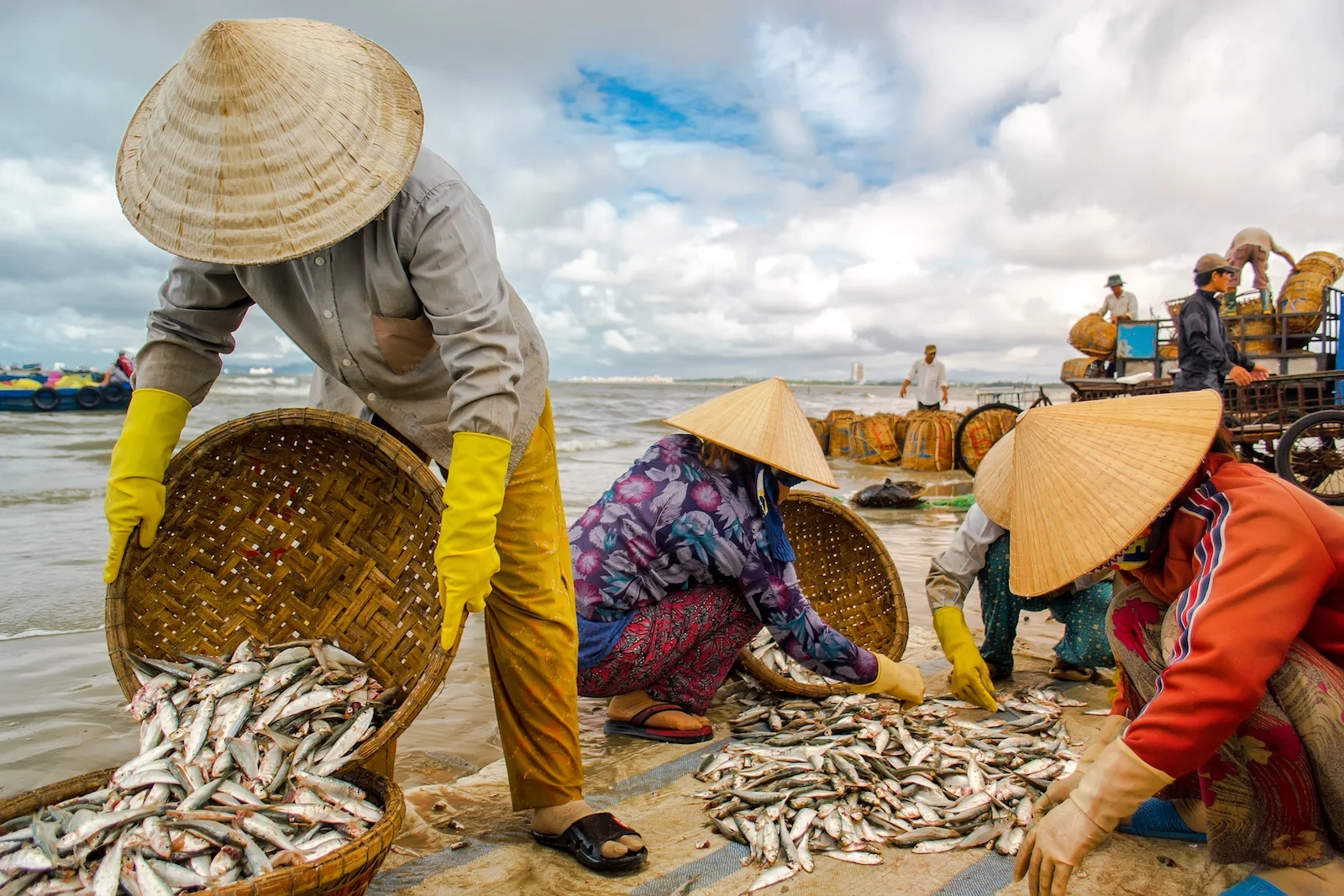
The East Sea supports millions of livelihoods, including roughly four million workers employed in fisheries and aquaculture. It sustains hundreds of coastal communities that depend on healthy oceans for employment, food security, and long-term economic resilience. As Vietnam seeks to maintain its growth trajectory while adapting to a changing climate, the sustainable management of marine resources is increasingly viewed as a national priority.
The timing could hardly be more consequential.
Vietnam has pledged to achieve net-zero emissions by 2050, a commitment that will require sweeping changes across its energy, industrial, and agricultural sectors. At the same time, the government faces mounting pressure to sustain economic growth, create jobs, and strengthen resilience against climate-related threats, including sea-level rise, coastal erosion, and increasingly severe weather events.
The country’s long-term prosperity will depend not only on what it produces but also on how effectively it manages the marine and coastal resources that support its economy. The challenge is no longer simply one of growth. It is one of balancing development with sustainability in a way that preserves opportunities for future generations.
Increasingly, science diplomacy is emerging as an important tool in that effort.
By fostering collaboration among marine scientists, policymakers, and regional stakeholders, Vietnam is using scientific cooperation to strengthen ocean governance, expand marine protected areas, improve fisheries management, and attract international support for a sustainable blue economy. In a region frequently defined by geopolitical rivalry and maritime disputes, science diplomacy also offers a practical avenue for building trust and advancing cooperation on shared environmental challenges.
Traditionally associated with international research partnerships, science diplomacy is increasingly being recognized as a mechanism for strengthening ocean governance, enhancing marine conservation, and expanding regional cooperation. Its growing importance was highlighted at the Johns Hopkins University Bloomberg Center Science Diplomacy Summit held in Washington, D.C., earlier this year.
During a panel discussion focused on the South China Sea, participants emphasized the potential of science diplomacy to address maritime challenges that transcend national borders. Environmental threats such as declining fish stocks, marine pollution, habitat degradation, and climate-related disruptions affect every country bordering the region. No single government can solve these problems independently.
The discussion underscored a simple reality: bringing together scientists, policymakers, and coastal stakeholders across national boundaries can provide a practical framework for addressing problems that are shared by all.
That principle is already beginning to shape regional engagement.
In 2025, Chinese and Vietnamese scholars met to commemorate the twenty-fifth anniversary of the Gulf of Tonkin Delimitation Agreement. Participants proposed expanding bilateral cooperation on marine environmental protection, marine debris management, mangrove restoration, and joint marine scientific research.
The dialogue reflected a growing recognition that environmental degradation and declining fish stocks require cooperative scientific responses regardless of competing territorial claims. While political disputes may persist, environmental realities often demand collaboration.
For Vietnam, science diplomacy offers a pathway to strengthen marine resource management while advancing broader national objectives tied to climate adaptation, sustainable development, and maritime security.
The stakes are particularly high in the Mekong Delta, often described as Vietnam’s rice bowl.
Rising sea levels, saltwater intrusion, and coastal erosion are already threatening agricultural productivity and local livelihoods. Climate change is transforming what was once viewed primarily as an environmental issue into a broader economic and national security concern.
Communities that have relied on predictable environmental conditions for generations are increasingly confronting uncertainty. Agricultural land is becoming more vulnerable. Infrastructure faces greater risks. Population displacement and economic disruption are emerging as potential long-term challenges.
In this context, the blue economy offers a pathway toward diversification and resilience.
One particularly promising area is offshore renewable energy.
Vietnam possesses some of the most favorable offshore wind conditions in Asia. International investors once viewed the country as a potential regional leader in offshore wind development, and many continue to see substantial long-term potential despite recent setbacks.
Regulatory uncertainty has slowed progress in recent years. Policy changes, permitting challenges, and evolving investment frameworks have created obstacles for developers. Yet the sector remains capable of attracting billions of dollars in investment while helping Vietnam achieve its decarbonization goals.
If managed effectively, offshore wind could become a cornerstone of the country’s energy transition, reducing dependence on fossil fuels while generating new sources of employment and economic growth.
Equally important is the future of fisheries.
For generations, Vietnam’s coastal communities have depended on the sea for food and income. Fishing is deeply embedded in the economic and cultural life of many coastal regions. Yet overfishing, habitat degradation, and illegal, unreported, and unregulated fishing continue to place growing pressure on marine ecosystems.
The European Union’s long-standing “yellow card” warning remains a reminder that sustainability and market access are increasingly interconnected. Environmental stewardship is no longer solely an ecological issue. It is also becoming a commercial necessity.
The challenge facing Vietnam is no longer simply catching more fish. It is ensuring that fish stocks remain healthy and viable for future generations.
Achieving that goal will require stronger monitoring systems, improved enforcement mechanisms, and greater reliance on scientific data to guide management decisions. Science diplomacy can play an important role by facilitating cooperation on fisheries research, stock assessments, and information sharing among countries that depend on many of the same marine resources.
Marine conservation represents another critical pillar of Vietnam’s blue economy ambitions.
Around the world, marine protected areas are increasingly viewed not as restrictions on development but as investments in long-term sustainability. Healthy coral reefs, mangrove forests, and coastal wetlands provide essential services, including fisheries habitat, shoreline protection, and carbon sequestration.
These ecosystems also strengthen resilience against storms, flooding, and extreme weather events. Their value extends far beyond environmental preservation. They contribute directly to economic stability and public safety.
Vietnam has begun expanding its network of marine protected areas as part of a broader rules-based approach to ocean conservation. The effort aligns with international commitments to protect marine biodiversity, restore degraded coastal ecosystems, and improve the long-term sustainability of fisheries.
More importantly, it reflects a growing recognition that conservation and economic development are not competing objectives. In many cases, they are mutually reinforcing.
The initiative also creates opportunities for scientific cooperation with neighboring countries, including China.
Despite continuing maritime disputes in the South China Sea, marine biodiversity conservation, coral reef restoration, fisheries science, and ecosystem monitoring remain areas where practical collaboration is possible. Joint research programs, data-sharing initiatives, and coordinated conservation efforts could help build confidence while addressing environmental challenges that transcend national boundaries.
Science diplomacy provides a framework for much of that engagement.
By bringing together researchers, conservation experts, and government agencies, it offers a practical mechanism for advancing marine protection while reducing the risk of misunderstanding in one of the world’s most strategically important waterways.
Many of the environmental challenges affecting the South China Sea cannot be solved by any single nation. Fish stocks migrate across maritime jurisdictions. Marine pollution crosses borders. Coral reef ecosystems connect multiple coastal states. The health of one country’s waters is often linked directly to the actions of its neighbors.
Addressing these challenges requires scientific cooperation, information sharing, and confidence-building measures among countries with competing interests.
In a region often defined by maritime tensions and geopolitical competition, environmental stewardship may represent one of the few areas where sustained cooperation remains both possible and beneficial.
Vietnam is increasingly positioning itself as an active participant in international climate, sustainability, and ocean-governance initiatives. Through partnerships involving universities, marine research institutes, and regional organizations, the country is expanding its role in shaping discussions on sustainable fisheries, marine biodiversity, and coastal resilience.
The next step may be integrating ocean governance more fully into its broader development strategy.
Success will require more than ambitious policy declarations. It will depend on transparent governance, effective regulation, and sustained investment in scientific capacity. Universities, research institutes, and local communities all have important roles to play in determining how marine resources are managed, protected, and utilized.
Equally important is public awareness.
The blue economy cannot remain solely the domain of policymakers and technical experts. Citizens must understand the connection between healthy oceans, economic security, and national prosperity. Public support will be essential if long-term sustainability goals are to be achieved.
The concept itself is not new. What is new is the growing recognition that sustainable ocean management is no longer a niche environmental concern. It is becoming a central pillar of economic competitiveness, climate resilience, and regional stability.
Vietnam’s development story over the past three decades has been one of remarkable transformation. Millions have been lifted out of poverty. Foreign investment has surged. The country has emerged as one of Southeast Asia’s most dynamic economies.
The next chapter of that story may depend less on what happens inland and more on how Vietnam governs, protects, and sustainably develops the waters that define its geography. The future of the country’s economy, its environmental security, and perhaps even its regional influence may ultimately be written at sea.