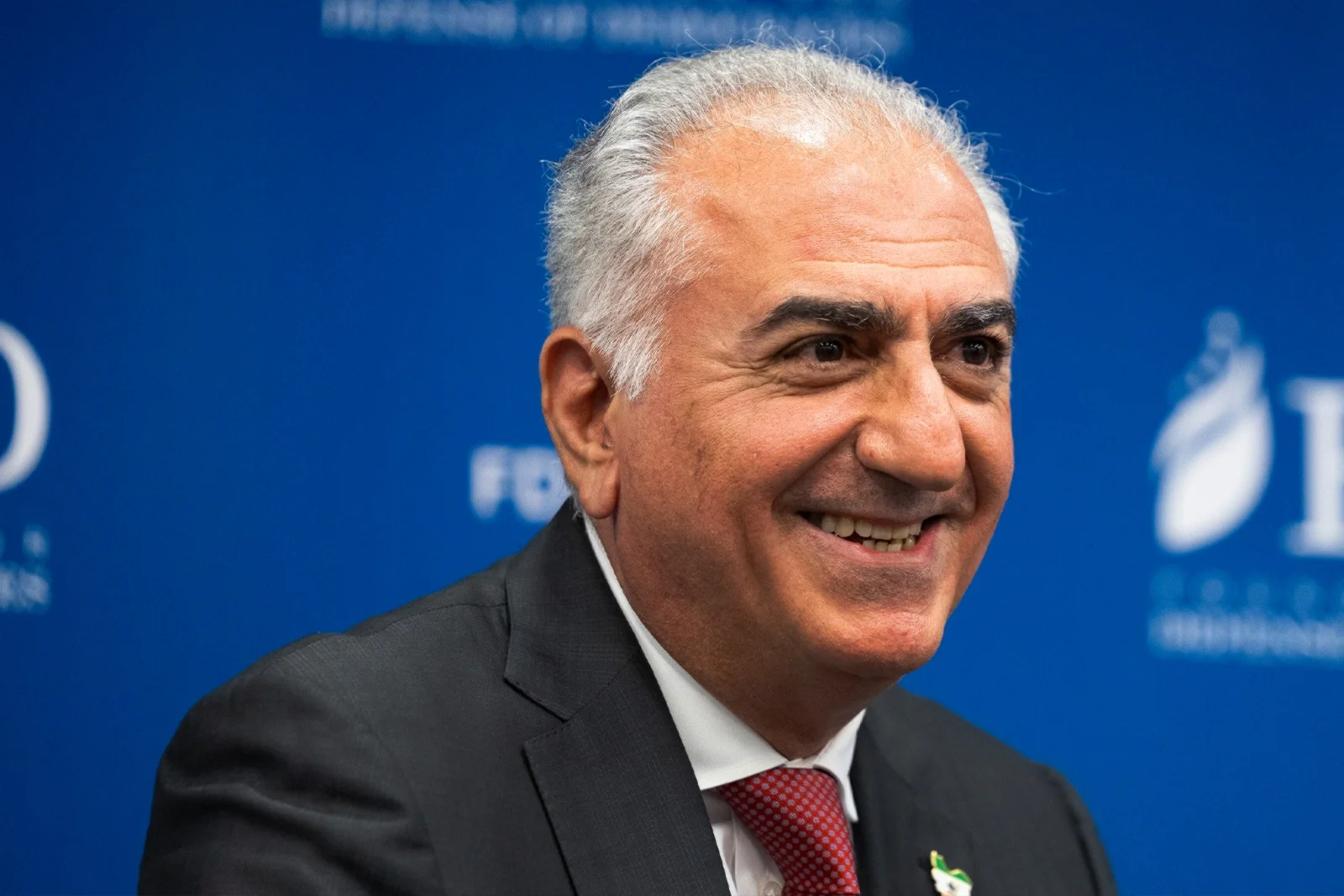

Zelensky’s Risky Bet on Iran’s Exiled Prince
When Volodymyr Zelensky met Reza Pahlavi—the exiled son of Iran’s deposed monarch—in Paris last week, the Ukrainian president may have believed he was acting on a familiar wartime instinct: the enemy of my enemy is my friend. Iran’s regime continues to supply drones and other military support to Russia, Ukraine’s principal aggressor. From Kyiv’s vantage point, engaging an Iranian opposition figure might have appeared not only defensible but strategically sound.
Yet in this case, the calculation was deeply flawed. The meeting amounted to a lose-lose encounter—one that delivered little of substance for Ukraine among its Western allies while simultaneously undercutting Zelensky’s standing with the Iranian people, who remain the true arbiters of their country’s future.
In effect, what may have seemed like a minor diplomatic gesture now reads as a costly and avoidable misstep.
To begin with, the meeting was never likely to yield meaningful geopolitical dividends for Ukraine. Western governments have already committed themselves to supporting Kyiv against Russian aggression; that consensus does not hinge on symbolic engagements with marginal or controversial figures. Pahlavi, for all his visibility, remains a politically lightweight actor still seeking recognition and legitimacy on the global stage. Aligning with such a figure was unlikely to enhance Zelensky’s political capital or strengthen Ukraine’s position in any tangible way.
More consequential, however, is the signal the meeting sent to the Iranian public—a signal that risks alienating precisely those whose goodwill Ukraine might otherwise hope to cultivate.
Reza Pahlavi is the son of Mohammad Reza Pahlavi, whose monarchy was swept away in the 1979 Iranian Revolution. The Pahlavi dynasty governed as a royal dictatorship, sustained by repression and enforced by the notorious secret police, SAVAK, which systematically silenced political dissent and targeted intellectuals. In practice, it functioned as a one-party state. Corruption and nepotism were so pervasive that even the Shah himself was compelled to acknowledge them publicly in the final months before his fall.
Although the younger Pahlavi has attempted to recast himself as a supporter of democratic transformation, his record raises difficult questions. He has never renounced the oath of allegiance he swore in 1981 to assume the throne, nor has he meaningfully repudiated the abuses and atrocities committed under his father’s rule.
Instead, his vision for Iran’s future has often seemed to offer a familiar exchange: replacing the Ayatollah with a King, trading one form of authoritarianism for another, albeit under a different banner.
Iran is, moreover, a profoundly diverse society. Ethnic minorities constitute roughly 35 percent of the population, encompassing Kurds, Arabs, Turks, Baluch, and others. Pahlavi has, at times, accused these communities of separatism and endorsed the use of military force to suppress them. Such positions resonate uneasily given the historical memory of the Pahlavi era, which was marked by policies of ethnic repression and forced displacement. It is therefore no surprise that many among these communities reject his leadership outright. During protests across Iran, demonstrators have repeatedly voiced a stark rejection of both past and present tyranny: “Death to the oppressor, whether Shah or Supreme Leader.”
That distinction matters. The Iranian struggle for freedom has never been merely about exchanging one ruler for another. For years, Iranians have articulated a demand for a democratic republic—one that rejects both theocratic rule and hereditary monarchy in favor of accountable governance.
Against this backdrop, Zelensky’s meeting with Pahlavi carries an additional, unintended consequence: it risks reinforcing the very narrative the Iranian regime seeks to promote. Tehran has long framed the political horizon as a binary choice between monarchy and theocracy, between the past and the present. By appearing alongside Pahlavi, Zelensky may inadvertently lend credence to that false dichotomy, strengthening a propaganda line that constrains the imagination of Iran’s political future.
None of this is to suggest that Ukraine should ignore Iran’s malign role in the war or the material support it provides to Russia. Nor does it imply that Zelensky should remain indifferent to the aspirations of the Iranian people. On the contrary, Kyiv has every reason to express solidarity with Iranians who oppose their government’s militarism and its alignment with Moscow. It has every reason to stand with those seeking meaningful political change rooted in the will of the Iranian people and their organized resistance.
But solidarity, to be credible, must be directed toward the right actors. It belongs with the Iranian public, with grassroots movements, and with leaders who have spent decades pursuing democratic change through sacrifice rather than spectacle. It does not reside in the carefully curated public relations campaigns and social media visibility that have come to define Pahlavi’s political presence.
Zelensky has, throughout the war, demonstrated a remarkable degree of political resolve in defending Ukraine against Russian aggression. Yet even strong leaders are not immune to misjudgment. In this instance, the optics are difficult to ignore. Maintaining distance from the exiled crown prince would better serve Ukraine’s strategic interests—and would more faithfully align Kyiv with the democratic aspirations of the Iranian people.
A free and democratic Iran would, in time, serve Ukraine’s cause far more effectively than any symbolic alignment with contested figures of the past. Meeting Reza Pahlavi, by contrast, risks undermining both.