
Alaska Confab Coincided With a New Squeeze on Russia’s Media Space
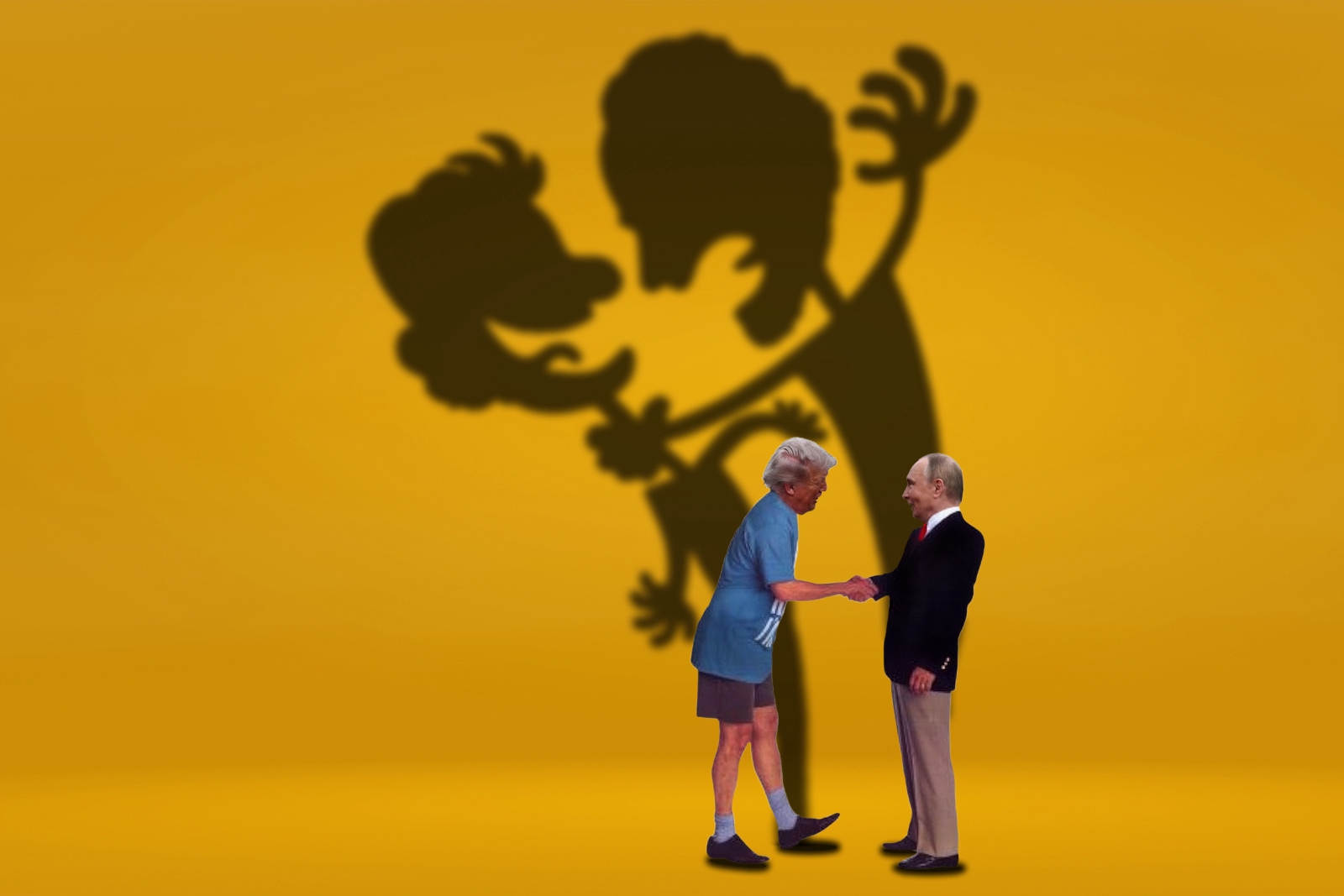
The optics from Alaska were cinematic: President Trump greeting Vladimir Putin on the tarmac at Joint Base Elmendorf–Richardson on August 15, even as the Kremlin moved to smother one of the last widely used Western platforms inside Russia. In parallel with the high-stakes summit, the Kremlin announced fresh measures against WhatsApp, the Meta-owned messaging service—another turn of the screw in a broader campaign to bury what remains of free expression at home. The juxtaposition was hard to miss: photo-op diplomacy abroad, information control at home.
Any credible diplomacy has to be matched by a willingness to say plainly what is happening. That means a White House prepared to condemn the Kremlin’s pressure on journalists, independent outlets, and digital platforms with the same clarity it uses to defend Ukraine’s borders. The defense of Ukraine’s territorial integrity—down to the last kilometer—rings hollow if Washington stays quiet while Russia criminalizes dissent and throttles tools that tens of millions rely on to talk to family, organize communities, and keep in touch with the outside world.
“Putin is once again tightening his grip on freedom of speech in Russia. Now he wants to kick out WhatsApp – but the messaging service refuses,” Danish journalist Kirstine Eklund noted. The choreography in Alaska spotlighted what Moscow actually values: not a credible path to a durable peace with Ukraine, but the consolidation of narrative control at home, where propaganda still outmuscles transparency.
In Anchorage, the two leaders reached for old-world statecraft to solve 21st-century wars. Meanwhile, back in Russia, the information vise turned another notch.
The tightening did not begin this summer. Since the full-scale invasion of Ukraine in February 2022, Russia has banned or throttled major social networks, including Instagram and Facebook, both under Meta’s umbrella. Every step has been justified under the banner of national security, and every step has narrowed the aperture through which Russians can see beyond state television. Recent weeks have added new layers of constraint that make cross-border communication more precarious and more legally fraught—further isolating Russian citizens from independent reporting and ordinary conversation with the outside world.
The trend line is unmistakable: Moscow is not merely policing content; it is redesigning the information ecosystem to privilege loyal channels and to disable or discredit everything else. The goal is less to persuade than to suppress—to make alternatives to the state narrative so costly and cumbersome that people stop trying.
The latest move appears designed to replace global platforms with Kremlin-friendly alternatives, often tied—directly or indirectly—to security services. Roskomnadzor, Russia’s media regulator, has accused WhatsApp of “sabotage” and “terrorist activity,” charges amplified by state media outlets such as TASS, which also warn of “deception and blackmail” on the app. The message is clear: encrypted, foreign-owned services are suspect by definition; domestically curated platforms are “safer” because they are easier to monitor and to bend.
WhatsApp has pushed back. In a post on X, the company said it “defies governments’ attempts to violate people’s right to secure communication,” adding that Russia is “trying to block it for over 100 million Russians.” The platform pledged to keep end-to-end encryption available “everywhere, including in Russia.” Telegram has faced parallel allegations. Founded by Russian entrepreneur Pavel Durov and now based abroad, it remains under periodic fire from authorities who alternately tolerate and attack it, depending on political convenience and perceived utility.
None of this is new in concept. As Yevgeniy Golovchenko, an assistant professor at the University of Copenhagen, points out, the Kremlin’s desire to command information flows predates the current war. “It’s been like that since 2000,” he argues. The invasion merely accelerated the project, providing legal pretexts and transforming long-standing ambitions into urgent policy.
Lost in parts of the U.S. news cycle, meanwhile, is the human cost of Russia’s war in Ukraine. While headlines can fixate on rumor bursts about the president’s health, the war continues to produce relentless civilian and military casualties. The sense of impunity that sustains the offensive at times spills into outright terror. Consider the August 30 killing in Lviv of former parliamentary speaker Andriy Parubiy—a political assassination widely attributed in Kyiv to Kremlin operatives. Whether in occupied territories or far from the front, the message is meant to be the same: fear as strategy.
Against this, the moral clarity is not complicated. Moscow remains an occupying power. Its forces have disrupted the European security order, inflicted mass suffering, and—according to Kyiv and international monitors—abducted thousands of Ukrainian children. Ukrainians, for their part, have been unwavering about their destination. Despite Russia’s threats—and despite pushback from Budapest and Bratislava, where Viktor Orbán and Robert Fico have leaned toward Moscow—Kyiv’s course points toward the European Union, however turbulent the road.
That determination is visible far beyond Ukraine’s borders. On August 24, Ukrainian diaspora groups in Denmark and Ireland marked the country’s 34th Independence Day. The gatherings were modest in size but large in symbolism: reminders that a community scattered by war remains deeply connected to home. The message was blunt enough—Russia is the occupier; Ukraine is the country fighting to live free—and it resonated precisely because it was carried by ordinary citizens rather than ministries or embassies.
The Kremlin’s strategy, at home and abroad, is built on attrition. It seeks to exhaust Ukraine and sap Western stamina while flooding the zone with disinformation. The cost to Russians themselves is staggering: a grinding mobilization, a militarized economy, and the steady loss of liberties that once seemed basic. Week after week, the toll in lives climbs. Cities far from Russia’s borders are pulverized. An arms race accelerates. The future shrinks.
And yet the pattern of the war cuts both ways. Ukrainian forces, learning and adapting at speed, continue to degrade Russia’s military machine. The Kremlin can continue to bury independent media and drive foreign platforms off its networks. What it cannot do—no matter how many laws it passes or cables it severs—is fully contain the truth about a brutal, unnecessary war, or the determination of a people who have chosen Europe.
Whatever Moscow’s allies inside the EU say today, Ukrainians will not retreat from their own horizon: a sovereign state embedded in European institutions, governed by the rule of law, and connected to the world. That vision is not only geopolitical; it is historical. On August 24, 1991, Ukraine declared independence and pulled away from the Soviet system that had produced—among other crimes—Stalin’s man-made famine of 1932–33, the Holodomor. Independence Day is therefore not just an anniversary; it is an affirmation that Ukrainians will not be dragged back into a past defined by coercion and scarcity.
The Alaska Summit did not change that calculus. If anything, it clarified it. Diplomacy that rewards aggression is not a foundation for peace. Talks that proceed while the Kremlin tightens the screws on speech and assembly at home are not signs of moderation. For negotiations to mean anything, they must be accompanied by a plain recognition of facts: Russia invaded; Ukraine resists; and the free flow of information is not a bargaining chip but a precondition for any durable settlement.